PocketQube
Also known as PQ, 1P, 2P, 3P
Picosatellite standard built from 50 mm cubic units (P). A 1P weighs at most 250 g, has one eighth of the volume of a 1U CubeSat and rides in its deployer on a sliding backplate instead of rails.
- Document
- SQ-FF-001
- Updated
- Reading time
- 11 min
In this tab
Definition
A PocketQube is a picosatellite assembled from cubic units of 50 mm, written "P". A 1P measures 50 × 50 × 50 mm and may weigh at most 250 g; its 125 cm³ are one eighth of the volume of a 1U CubeSat. Larger spacecraft grow along a single axis: a 2P or a 3P keeps the 50 × 50 mm cross-section and adds 64 mm of length per unit[1].
What separates the format from a scaled-down CubeSat is the mechanical interface. A CubeSat slides along four corner rails; a PocketQube is held only by a sliding backplate, a thin plate fixed to one face that protrudes beyond the body and runs in the guides of the deployer. The deployer pushes on the and nothing else touches the spacecraft[1].
Origins and first flights
Robert J. Twiggs, one of the originators of the CubeSat, proposed the PocketQube at the 2009 CubeSat Developers’ Workshop, building on work by Morehead State University and Kentucky Space[2]. The aim was to cut development and launch costs once more by halving the unit edge and simplifying the interface between spacecraft and launcher.
The first four PocketQubes reached orbit on 21 November 2013. A Dnepr rocket carried GAUSS Srl’s UniSat-5 microsatellite, whose Morehead–Rome FemtoSat Orbital Deployer (MRFOD) released $50SAT, Beakersat-1, QubeScout-S1 and WREN near 600 km[3]. The 1.5P $50SAT, built by Morehead State University and three radio amateurs from parts costing less than US$250, became the emblem of the class. No PocketQube flew for the next six years; the format returned in December 2019, when Alba Orbital’s released six of them from a Rocket Lab Electron[4].
The standard
Alba Orbital, Delft University of Technology and GAUSS Srl released Issue 1 of the in July 2018[1]. It fixes the mechanical interface: the envelope, the backplate, the mass per unit and the clauses on materials, such as the recommendation of 6061 or 7075 aluminium and the consultation required for magnesium or unusual alloys[5]. Electrical, testing and operational requirements were left to later issues and are, in practice, still set by deployer providers and launch brokers.
At subsystem level TU Delft proposed the PQ9 and CS14 interface standards: a lean bus with RS-485 data lines and a few unregulated power lines that replaces the PC/104 heritage of CubeSat avionics[6]. flew on Delfi-PQ.
Why PocketQubes
The class does not replace CubeSats; it serves the niches in which small, cheap and numerous beats capable[7]:
- Cost of access. At the 2018 PocketQube Workshop, launch cost about 20 k€ per 1P, roughly 80 k€ per kilogram, with 10 k€ considered achievable.
- Education and fast iteration. A team can design, build and test a complete spacecraft on a handful of 50 mm boards, and repeat the cycle quickly.
- Distributed systems. Spectrum monitoring and Internet-of-Things relays need many nodes more than they need one capable satellite.
- Short orbital life. The high area-to-mass ratio brings a PocketQube down within years from the altitudes where most of them fly.
The population
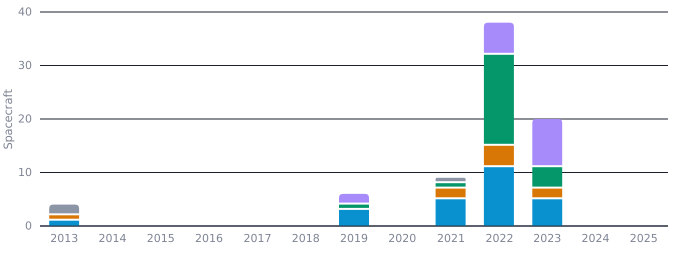
The nadir lab. review counts 77 PocketQubes launched between 2013 and 2023[4]. Activity was uneven: four units in 2013, none until 2019, then a peak of 38 in 2022, 21 of them on a single Falcon 9 (Transporter-3).
- 1P
- 1.5P
- 2P
- 3P
- 2.5P and 6P
Show the data as a table
| Category | 1P | 1.5P | 2P | 3P | 2.5P and 6P | Total |
|---|---|---|---|---|---|---|
| 2013 | 1 | 1 | 0 | 0 | 2 | 4 |
| 2014 | 0 | 0 | 0 | 0 | 0 | 0 |
| 2015 | 0 | 0 | 0 | 0 | 0 | 0 |
| 2016 | 0 | 0 | 0 | 0 | 0 | 0 |
| 2017 | 0 | 0 | 0 | 0 | 0 | 0 |
| 2018 | 0 | 0 | 0 | 0 | 0 | 0 |
| 2019 | 3 | 0 | 1 | 2 | 0 | 6 |
| 2020 | 0 | 0 | 0 | 0 | 0 | 0 |
| 2021 | 5 | 2 | 1 | 0 | 1 | 9 |
| 2022 | 11 | 4 | 17 | 6 | 0 | 38 |
| 2023 | 5 | 2 | 4 | 9 | 0 | 20 |
| 2024 | 0 | 0 | 0 | 0 | 0 | 0 |
| 2025 | 0 | 0 | 0 | 0 | 0 | 0 |
By unit count 1P (32%), 2P (30%) and 3P (22%) dominate, followed by 1.5P (12%), 2.5P (3%) and one 6P. Two commercial operators account for 39% of all units: Fossa Systems with 17, mostly the 2P FossaSat-2E series, and Alba Orbital with 13 Unicorns. Counting batches rather than designs explains why surveys disagree on the most common size: weighted by spacecraft, 2P and 3P lead; weighted by mission, 1P does[8].
Dimensions and mass
| Size | Envelope (mm) | Volume (cm³) | Mass limit (kg) | Deployers |
|---|---|---|---|---|
| 1PSliding backplate 58 × 64 mm, 1.6 mm thick. | 50 × 50 × 50 | 125 | 0.25 | AlbaPod, MRFOD, PicoBus |
| 2PBackplate 58 × 128 mm; the 114 mm body length is indicative. | 50 × 50 × 114 | 285 | 0.50 | AlbaPod, PicoBus |
| 3PBackplate 58 × 192 mm (Delfi-PQ, Unicorn-2). | 50 × 50 × 178 | 445 | 0.75 | AlbaPod |
PocketQube Standard Issue 1 (2018); CubeSat Design Specification Rev. 14.1 (2022). The 2P length is indicative.
The cross-section is 50 × 50 mm for every size. Each additional unit adds 64 mm along the , so a 3P measures 50 × 50 × 178 mm; the 2P length of 114 mm in the table is indicative. The mass limit scales at 250 g per unit, which makes the maximum bulk density of a 1P 2.00 g/cm³, higher than the 1.76 g/cm³ allowed for a 1U CubeSat[4].
Mechanical interface
The 1P backplate measures 58 × 64 × 1.6 mm: it overhangs the 50 mm body by 4 mm on each side to engage the deployer guides. Its length grows with the number of units; the backplate of the 3P Delfi-PQ is 58 × 192 mm[9]. Because its thickness is fixed, its mass depends only on the material, from 11 g in FR-4 to 16 g in 6061-T6 aluminium.
| Deployer | Developer | Notes |
|---|---|---|
| MRFOD | Morehead State University, GAUSS | Released the first four PocketQubes from UniSat-5 in 2013 |
| AlbaPod | Alba Orbital | Used for the 2019 Electron launch and the Transporter rideshares; AlbaPod v2 carries up to six units |
| PicoBus | Libre Space Foundation | Open-hardware deployer flown on both Firefly Alpha missions |
Delfi-PQ sized its internal boards at 42 × 42 mm to keep a 4 mm integration margin on every side and detected separation with two independent switches[9].
Electrical interfaces
The standard does not define an electrical bus. Most 1P designs stack a few square boards joined by board-to-board connectors or threaded rods, and several flight units, such as SMOG-1, used the boards themselves as the load-carrying structure. The interface and its CubeSat sibling CS14 offer a common bus for teams that want interchangeable modules[6].
Power
A randomly tumbling body exposes on average a quarter of its surface to the Sun. With cells (η = 0.28), a packing factor of 0.6 and a 525 km Sun-synchronous orbit, the orbit-average power of body-mounted cells is[4]:
| Form factor | Surface (cm²) | Mean projected area (cm²) | Mean in sunlight (W) | Orbit average (W) | Specific power (W/kg) |
|---|---|---|---|---|---|
| 1P | 150 | 37.5 | 0.86 | 0.55 | 2.20 |
| 2P | 278 | 69.5 | 1.59 | 1.02 | 2.03 |
| 3P | 406 | 101.5 | 2.32 | 1.49 | 1.98 |
| 1U | 654 | 163.5 | 3.74 | 2.39 | 1.20 |
| 3U | 1,562 | 390.5 | 8.93 | 5.71 | 0.95 |
Eq. 1 of the review: solar constant 1361 W/m², triple-junction cells with η = 0.28, packing factor 0.6.
A 1P therefore runs on about half a watt. Per kilogram it collects more than a 1U (2.2 against 1.2 W/kg); the binding constraint is the absolute power available to a single consumer such as a transmitter amplifier, whose demand does not shrink with the spacecraft[7].
Communications
Most PocketQubes downlink in the 435–438 MHz amateur-satellite sub-band, with or framed in , or for robust low-rate links. A quarter-wave monopole at 437 MHz is 171 mm long, more than three times the edge of a 1P, so every UHF PocketQube carries a deployable antenna. Operating in amateur bands requires frequency coordination and limits the mission to non-commercial purposes.
Surface-rich, volume-poor
Volume scales with the cube of size and surface with its square, so everything collected through the surface (sunlight, radiative cooling, drag) is large per kilogram, while the absolute resources for any single function are small. A fully loaded 1P has 0.60 cm² of surface per gram against 0.33 cm²/g for a 1U[4]. The consequences run through every subsystem, and the form factor comparator shows them side by side.
Thermal response
Linearizing radiative exchange gives a lumped time constant . For a PocketQube it is roughly half that of a 1U:
| Form factor | Mass (kg) | Surface (cm²) | Time constant (min) | Longest eclipse ÷ time constant |
|---|---|---|---|---|
| 1P | 0.25 | 150 | 56 | 0.63 |
| 2P | 0.50 | 278 | 61 | 0.59 |
| 3P | 0.75 | 406 | 63 | 0.57 |
| 1U | 2.00 | 654 | 104 | 0.34 |
c_p = 900 J/(kg·K), ε = 0.8, T₀ = 290 K. The longest eclipse at 525 km lasts 35.7 min; the larger the ratio, the deeper the spacecraft cools in it.
The longest eclipse at 525 km lasts 0.63 time constants for a 1P but only 0.34 for a 1U, so the PocketQube follows the orbital forcing more closely: a 250 g unit swings by about 30 K per orbit in a single-node model, against 23 K for a 1.33 kg 1U[5].
Attitude control
Magnetorquers are the only practical actuators at this scale. The low inertia makes fast, but coil dipoles are small and the field of any permanent magnet is strong at the walls of a 50 mm cube. Most 1P and 1.5P missions use passive magnetic attitude control; three-axis control with has flown on the 3P Unicorn-2 platform, specified for about 5° worst-case pointing[4]. The PMAC entry explains why the magnet must be sized to the small disturbance torques of a PocketQube.
Orbital lifetime and debris
With a drag coefficient of 2.2 and the mean tumbling area, the of fully loaded PocketQubes is 0.030–0.033 m²/kg, almost twice that of a 1U. A PocketQube therefore lives about half as long from the same altitude:
| Form factor | Mass (kg) | Ballistic parameter (m²/kg) | From 400 km | From 450 km | From 500 km | From 550 km | From 600 km |
|---|---|---|---|---|---|---|---|
| 1P | 0.25 | 0.0330 | 3 months | 8 months | 20.4 months | 4.3 years | 10.1 years |
| 3P | 0.75 | 0.0298 | 3 months | 9 months | 22.6 months | 4.7 years | 11.2 years |
| 1U | 2.00 | 0.0180 | 5 months | 14.2 months | 3.1 years | 7.8 years | 18.6 years |
| 3U | 6.00 | 0.0143 | 6 months | 17.8 months | 3.9 years | 9.8 years | 23 years |
Kennewell density model, drag coefficient 2.2, mean tumbling area A_tot/4, re-entry at 180 km, spacecraft at the mass limit of its standard. Solar activity: low F10.7 = 70 sfu, Ap = 6; moderate 140 sfu, Ap = 12; high 210 sfu, Ap = 18.
A 1P meets the five-year disposal rule below about 560 km at moderate solar activity, and anywhere between 490 and 630 km depending on the Sun[4]. The same sensitivity makes individual forecasts uncertain, as the decay of Grizu-263A showed.
Trackability
PocketQubes are catalogued routinely once deployed (WREN as 39435, Grizu-263A as 51025)[10], but accuracy degrades for light objects, and radar detection depends on frequency. A 1P is deep in the Rayleigh regime at 440 MHz, returning roughly 80 times less power than a 1U, while at 3 GHz the penalty is much smaller[4]. Identification is hardest after large rideshares, when dozens of similar objects separate within minutes.
Launch risk
The launch segment has been a major cause of loss: 13 of the 77 units launched by 2023 (17%) were lost or degraded before nominal operations, mostly on maiden or early flights of new launchers and transfer vehicles[4]. The launch and deployment entry gives the details.
Representative missions
| Mission | Size | Launch | Operator | Status |
|---|---|---|---|---|
| $50SAT | 1.5P | 21 Nov 2013 | Morehead State Univ., United States | Re-entered |
| SMOG-P | 1P | 6 Dec 2019 | BME, Hungary | Re-entered |
| FossaSat-1 | 1P | 6 Dec 2019 | Fossa Systems, Spain | Re-entered |
| STECCO | 6P | 22 Mar 2021 | Sapienza Univ. of Rome, Italy | Re-entered |
| Delfi-PQ | 3P | 13 Jan 2022 | TU Delft, Netherlands | Re-entered |
| Grizu-263A | 1P | 13 Jan 2022 | Zonguldak Bülent Ecevit Univ., Türkiye | Re-entered |
| SATLLA-2A | 2P | 13 Jan 2022 | Ariel Univ., Israel | Not verified |
| Unicorn-2 | 3P | 2 May 2022 | Alba Orbital, United Kingdom | Not verified |
| Istanbul | 1P | 12 Jun 2023 | Hello Space, Türkiye | Re-entered |
| POQUITO | 1P | 14 Jan 2025 | Univ. of Luxembourg (SnT), Luxembourg | Not verified |
Status from SatNOGS DB, operator pages and Gunter’s Space Page; open a mission for its sources.
Technology demonstration dominates, often combined with amateur radio or education. Within that envelope PocketQubes have demonstrated spectrum monitoring (SMOG-P), links (FossaSat-1), satellite laser ranging with cube-corner reflectors (STECCO), three-axis control with Earth imaging at about 24 m ground sampling distance (Unicorn-2) and the first PocketQube-to-ChipSat optical link (POQUITO)[11].
Türkiye’s PocketQubes
The first PocketQube from Türkiye, Grizu-263A, was built by the Grizu-263 Space Team of Zonguldak Bülent Ecevit University and launched on Transporter-3 on 13 January 2022. It operated for 628 days, until its re-entry on 3 October 2023. Hello Space’s 1P Istanbul followed in June 2023, released from a D-Orbit ION transfer vehicle[4].
Open challenges
The review closes with the questions that limit the class: micronewton propulsion that fits in tens of grams, magnetically clean layouts for passive and active attitude control, materials and solder joints qualified for fast thermal cycling, and launch arrangements that tolerate the risk of new vehicles[4]. Both papers are available in full in the research section.
References
- [1]Alba Orbital, TU Delft, & GAUSS Srl. (2018). The PocketQube Standard, Issue 1.albaorbital.com
- [2]Twiggs, R. J. (2009). Making it small: the PocketQub. CubeSat Developers’ Workshop, San Luis Obispo (archived presentation).web.archive.org(accessed 20 October 2026)
- [3]Krebs, G. D. (2026). PocketQube (PocketQub). Gunter’s Space Page.space.skyrocket.de(accessed 20 October 2026)
- [4]nadir lab. (2026). PocketQube-class picosatellites: architecture, flight heritage, and a multi-method post-flight analysis of Grizu-263A [Preprint]. nadir lab. Research Monographs (SQ-R-001).Read on nadir lab.
- [5]nadir lab. (2026). A review of structural, thermal, magnetic and electronic materials in PocketQube-class picosatellites [Preprint]. nadir lab. Research Monographs (SQ-R-002).Read on nadir lab.
- [6]Bouwmeester, J. (2018). PQ9 and CS14 electrical and mechanical subsystem interface standard for PocketQubes and CubeSats, Version 1.0. DataverseNL.doi:10.34894/6MVBCZ
- [7]Bouwmeester, J., Radu, S., Uludag, M. S., Chronas, N., Speretta, S., Menicucci, A., & Gill, E. K. A. (2020). Utility and constraints of PocketQubes. CEAS Space Journal, 12(4), 573–586.doi:10.1007/s12567-020-00300-0
- [8]Idriss, M. I., & Ismail, N. A. (2025). The rise of PocketQube: an in-depth look at mission trends and attitude determination and control systems technologies [Preprint]. TechRxiv.doi:10.36227/techrxiv.175393444.46626282/v1
- [9]Uludag, M. S., Yakut, E., Speretta, S., Radu, S., Chronas-Foteinakis, N., Bouwmeester, J., Menicucci, A., & Gill, E. (2019). Getting the Delfi-PQ ready for multiple launch options. In: International Symposium on Space Technology and Science (ISTS), Fukui (2019-f-08).pure.tudelft.nl
- [10]Libre Space Foundation. (2026). SatNOGS DB — satellite and transmitter database.db.satnogs.org(accessed 20 October 2026)
- [11]Franzese, V. (2025). PocketQube picosatellites: survey of missions and technologies. CEAS Space Journal, 17, 1007–1018.doi:10.1007/s12567-025-00603-0
Cite this SatWiki entry
@misc{nadirlab2026pocketqube,
  author       = {{nadir lab.}},
  title        = {{PocketQube}},
  year         = {2026},
  month        = oct,
  howpublished = {nadir lab. SatWiki SQ-FF-001 (Rev. 4)},
  url          = {https://nadirlab.space/wiki/pocketqube/}
}
nadir lab. (2026). PocketQube. nadir lab. SatWiki (SQ-FF-001, Rev. 4). https://nadirlab.space/wiki/pocketqube/
TY  - ENCYC
AU  - nadir lab.
TI  - PocketQube
T2  - nadir lab. SatWiki
PY  - 2026
ET  - Rev. 4
C1  - SQ-FF-001
UR  - https://nadirlab.space/wiki/pocketqube/
ER  -