Launch and deployment
Also known as Launch, Deployment, Rideshare, Deployer, OTV
How small satellites reach orbit: from a host satellite, directly from the launch vehicle or from an orbital transfer vehicle. For PocketQubes the launch segment has been a major cause of loss, with 13 of 77 units lost or degraded before operations.
- Document
- SQ-OP-001
- Updated
- Reading time
- 5 min
In this tab
Three routes to orbit
A small satellite reaches orbit in a deployer that something else carries. For PocketQubes three routes have been used[1]:
- From a host satellite. A microsatellite carries the deployer and releases the PocketQubes after its own separation. The first four PocketQubes left GAUSS Srl’s UniSat-5 in 2013 from the MRFOD deployer, and UniSat-7 repeated the scheme in 2021[2].
- From the launch vehicle. The deployer rides on the rocket itself, as AlbaPods did on Rocket Lab’s Electron in 2019 and on SpaceX’s Transporter rideshares.
- From an orbital transfer vehicle (). A free-flying carrier such as D-Orbit’s ION, or once Launcher’s Orbiter, separates from the rocket and releases its passengers later, possibly into different orbits.
The balance has shifted towards transfer vehicles: from 2022 onwards they became the dominant route and carried all 20 PocketQubes launched in 2023[3].
- From a host satellite
- From the launch vehicle
- From an orbital transfer vehicle
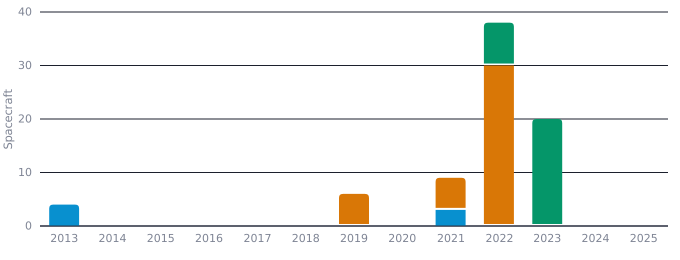
Show the data as a table
| Category | From a host satellite | From the launch vehicle | From an orbital transfer vehicle | Total |
|---|---|---|---|---|
| 2013 | 4 | 0 | 0 | 4 |
| 2014 | 0 | 0 | 0 | 0 |
| 2015 | 0 | 0 | 0 | 0 |
| 2016 | 0 | 0 | 0 | 0 |
| 2017 | 0 | 0 | 0 | 0 |
| 2018 | 0 | 0 | 0 | 0 |
| 2019 | 0 | 6 | 0 | 6 |
| 2020 | 0 | 0 | 0 | 0 |
| 2021 | 3 | 6 | 0 | 9 |
| 2022 | 0 | 30 | 8 | 38 |
| 2023 | 0 | 0 | 20 | 20 |
| 2024 | 0 | 0 | 0 | 0 |
| 2025 | 0 | 0 | 0 | 0 |
Deployers
| Deployer | Developer | Notes |
|---|---|---|
| MRFOD | Morehead State University and GAUSS | Morehead–Rome FemtoSat Orbital Deployer, flown inside UniSat-5 |
| AlbaPod | Alba Orbital | AlbaPod v2 carries up to six units, weighs less than 500 g and was specified for at least 2 m/s ejection; by 2024 it had flown eight missions and deployed 41 PocketQubes |
| PicoBus | Libre Space Foundation | Open-hardware PocketQube deployer, flown on both Firefly Alpha missions[4] |
The v2 shell, ejection mechanism and door are laser-sintered from the carbon-filled polyamide Windform XT 2.0, which cut its mass by about 60% compared with its predecessor[5].
The launch segment as a failure mode
The launch segment has been a major source of mission loss for PocketQubes[1]:
- Firefly Alpha FLTA001, September 2021. Six PocketQubes were lost when the first flight of Alpha failed after a first-stage engine shut down prematurely.
- Firefly Alpha FLTA002, 1 October 2022. The second flight reached orbit[6], but the five PocketQubes in the PicoBus deployer were released into an orbit of about 220 × 275 km instead of the planned 300 km circle and re-entered within days[7].
- Transporter-6, January 2023. Two Unicorn-2 units were not deployed after an anomaly of Launcher’s Orbiter transfer vehicle.
| Outcome | Units | Share |
|---|---|---|
| Nominal deployment | 64 | 83% |
| Launch failure | 6 | 8% |
| Off-nominal low orbit, re-entered within days | 5 | 6% |
| Not deployed from the transfer vehicle | 2 | 3% |
| Total | 77 | 100% |
nadir lab. PocketQube census (Appendix A): every PocketQube launched in 2013–2025, launch failures included; one row per spacecraft.
In total 13 of 77 units (17%) were lost or severely degraded before nominal operations could begin. The fraction reflects how often PocketQube developers fly on maiden and early flights of new launchers and transfer vehicles, which offer cheap and frequent access but carry higher risk; the difficulty of insuring picosatellites compounds the exposure[1].
Delays
Rideshare manifests slip. Grizu-263A was delivered to its launch provider in October 2020 for a window at the turn of 2020–2021 and flew in January 2022[1]. Batteries in storage, frequency coordination validity, team turnover and student graduations all have to survive such delays. Ground-segment and operations plans that tolerate slips, and an explicit treatment of launch risk in programme planning, are part of mission design.
Cost
At the 2018 PocketQube Workshop, launch cost about 20 k€ per 1P, roughly 80 k€ per kilogram, with 10 k€ per unit considered achievable[8]. Launch prices quoted per kilogram favour light spacecraft, but integration, deployer and test fees set a floor per unit.
The first minutes
The CubeSat Design Specification forbids deployment of any element earlier than 30 minutes after separation and any radio transmission earlier than 45 minutes after separation; separation switches keep the spacecraft unpowered in the deployer, and a remove-before-flight pin cuts all power on the ground[9]. The requires at least two at the Z− end that touch the rails or the neighbouring unit[10]. Delfi-PQ detected separation with two independent switches[11].
sequenceDiagram
  participant LV as Launch vehicle or OTV
  participant D as Deployer
  participant S as Spacecraft
  participant G as Ground network
  LV->>D: Release command
  D->>S: Ejection, kill switches open
  Note over S: Power on, timers start
  S->>S: Wait at least 30 min, deploy antenna
  S->>S: Wait at least 45 min, start beacon
  S-->>G: First beacon heard
  G->>G: Match signal to TLEs, identify
Identifying the spacecraft
After a large dozens of similar objects separate within minutes, and operators must match their signals to anonymous two-line elements. Before catalogue numbers were assigned, the community tracked Grizu-263A under a temporary identifier, 99488; it then received number 51025[1]. Transporter-3 itself carried Grizu-263A with Delfi-PQ, HADES, EASAT-2, SATLLA-2A/2B, Unicorn-1 and Unicorn-2A/2D, among others, and community threads followed the identification of each signal[12].
Release altitude and lifetime
The release orbit decides how long the spacecraft will live. Sun-synchronous rideshares release near 500–550 km, which gives a 1P one to four years under moderate solar activity; ISS deployments near 400 km give months.
| Form factor | Mass (kg) | Ballistic parameter (m²/kg) | From 300 km | From 400 km | From 450 km | From 500 km | From 550 km |
|---|---|---|---|---|---|---|---|
| 1P | 0.25 | 0.0330 | 9 days | 3 months | 8 months | 20.4 months | 4.3 years |
| 3P | 0.75 | 0.0298 | 10 days | 3 months | 9 months | 22.6 months | 4.7 years |
| 1U | 2.00 | 0.0180 | 16 days | 5 months | 14.2 months | 3.1 years | 7.8 years |
| 3U | 6.00 | 0.0143 | 20 days | 6 months | 17.8 months | 3.9 years | 9.8 years |
Kennewell density model, drag coefficient 2.2, mean tumbling area A_tot/4, re-entry at 180 km, spacecraft at the mass limit of its standard. Solar activity: low F10.7 = 70 sfu, Ap = 6; moderate 140 sfu, Ap = 12; high 210 sfu, Ap = 18.
The lifetime calculator shows the effect of the Sun and of drag devices for any release altitude.
References
- [1]nadir lab. (2026). PocketQube-class picosatellites: architecture, flight heritage, and a multi-method post-flight analysis of Grizu-263A [Preprint]. nadir lab. Research Monographs (SQ-R-001).Read on nadir lab.
- [2]Krebs, G. D. (2026). UniSat 5. Gunter’s Space Page.space.skyrocket.de(accessed 20 October 2026)
- [3]Krebs, G. D. (2026). PocketQube (PocketQub). Gunter’s Space Page.space.skyrocket.de(accessed 20 October 2026)
- [4]Libre Space Foundation. (2026). LSF-PICOBUS PocketQube deployer.libre.space(accessed 20 October 2026)
- [5]nadir lab. (2026). A review of structural, thermal, magnetic and electronic materials in PocketQube-class picosatellites [Preprint]. nadir lab. Research Monographs (SQ-R-002).Read on nadir lab.
- [6]Wall, M. (2022). Firefly Aerospace’s Alpha rocket reaches orbit for 1st time. Space.com.space.com(accessed 20 October 2026)
- [7]SpaceNews. (2022). Report on the outcome of Firefly Alpha flight FLTA002.spacenews.com(accessed 20 October 2026)
- [8]Bouwmeester, J., Radu, S., Uludag, M. S., Chronas, N., Speretta, S., Menicucci, A., & Gill, E. K. A. (2020). Utility and constraints of PocketQubes. CEAS Space Journal, 12(4), 573–586.doi:10.1007/s12567-020-00300-0
- [9]The CubeSat Program, Cal Poly SLO. (2022). CubeSat Design Specification, Rev. 14.1 (CP-CDS-R14.1). California Polytechnic State University.nasa.gov
- [10]Alba Orbital, TU Delft, & GAUSS Srl. (2018). The PocketQube Standard, Issue 1.albaorbital.com
- [11]Uludag, M. S., Yakut, E., Speretta, S., Radu, S., Chronas-Foteinakis, N., Bouwmeester, J., Menicucci, A., & Gill, E. (2019). Getting the Delfi-PQ ready for multiple launch options. In: International Symposium on Space Technology and Science (ISTS), Fukui (2019-f-08).pure.tudelft.nl
- [12]Libre Space Foundation community forum. (2022). SpaceX F9 Transporter-3, 2022-01-13 15:25 UTC (discussion thread).community.libre.space(accessed 20 October 2026)
Cite this SatWiki entry
@misc{nadirlab2026launch,
  author       = {{nadir lab.}},
  title        = {{Launch and deployment}},
  year         = {2026},
  month        = oct,
  howpublished = {nadir lab. SatWiki SQ-OP-001 (Rev. 1)},
  url          = {https://nadirlab.space/wiki/launch-deployment/}
}
nadir lab. (2026). Launch and deployment. nadir lab. SatWiki (SQ-OP-001, Rev. 1). https://nadirlab.space/wiki/launch-deployment/
TY  - ENCYC
AU  - nadir lab.
TI  - Launch and deployment
T2  - nadir lab. SatWiki
PY  - 2026
ET  - Rev. 1
C1  - SQ-OP-001
UR  - https://nadirlab.space/wiki/launch-deployment/
ER  -