Grizu-263A
Also known as Grizu, YM2VRZ, NORAD 51025, 2022-002AT
Türkiye’s first PocketQube: a 237 g 1P built by the Grizu-263 Space Team of Zonguldak Bülent Ecevit University, launched on Transporter-3 in January 2022. It operated for 628 days with passive magnetic attitude control, dual-rate UHF telemetry and a digipeater.
- Document
- SQ-MS-001
- Updated
- Reading time
- 9 min
In this tab
Background
Grizu-263A was developed by the Grizu-263 Space Team of Zonguldak Bülent Ecevit University (ZBEÜ), a student team founded in 2016 whose earlier work centred on CanSat-class projects. The team and the satellite are named after the 263 miners who lost their lives in the firedamp explosion at the Kozlu coal mine in Zonguldak on 3 March 1992[1]. Work on a modular PocketQube platform began at the end of 2018; after about two years of development the flight model was delivered to the launch provider in October 2020[2]. Grizu-263A was the first PocketQube from Türkiye; the second, Hello Space’s 1P Istanbul, followed in 2023.
Objectives
The mission was a technology demonstration with an amateur-radio service. Its objectives were to[1]:
- design, build and operate a spacecraft able to perform the basic functions of a satellite within a 1P envelope;
- demonstrate a modular core bus to which payloads can be added without changing the core subsystems;
- characterize the in-orbit behaviour of the passive magnetic attitude control and the efficiency of the power system through , current and voltage telemetry;
- give radio amateurs worldwide openly decodable telemetry, -observation opportunities and a that relays short messages uplinked from the ground.
The uplink was deliberately minimal: besides digipeater messages, the spacecraft accepted a command to change the telemetry period and the transmitter shut-down command required in the amateur-satellite service.
Outcome at a glance
Grizu-263A lifted off on 13 January 2022 on the SpaceX Transporter-3 and operated until its re-entry on 3 October 2023: 628 days, about 9500 revolutions, well beyond the expected year of active operation. Its primary communication objective was met, with telemetry received and shared by stations around the world; both downlink modes were still being received in several countries between 29 September and 1 October 2023, days before re-entry[1].
Architecture
Body-mounted panels on five faces feed the power system, which holds the battery and seven INA-type current and bus-voltage monitors: one on the EPS-to-computer line, one on the main bus and one on each panel. The on-board computer formats telemetry from these monitors, a three-axis and a temperature sensor, and runs the . The radio transmits at 4800 Bd or 2400 Bd through a deployable quarter-wave monopole. If communication between radio and computer is lost, the radio reports an error code directly to the power system, so the fault can be handled without the computer[1].
flowchart TB
  SP["Solar panels on five faces"] --> EPS["EPS: battery, 7 current and voltage monitors"]
  EPS --> OBC["On-board computer: telemetry, digipeater"]
  EPS --> COMM["COMM: 2-FSK, 4800 and 2400 Bd"]
  EPS --> SENS["IMU, temperature sensor"]
  SENS --> OBC
  OBC <--> COMM
  COMM -. "error code if OBC link fails" .-> EPS
  COMM --> ANT["Deployable monopole"]
  ANT --> GS["ZBEÜ station and SatNOGS"]
  PMAC["PMAC: 4 AlNiCo-5 magnets, 12 HyMu-80 rods, unpowered"]
Power
The power budget filed for frequency coordination gives an average generation of 0.75 W and an average active consumption of 1.5 W, so the high-consumption mode was duty-cycled and the battery bridged eclipses and transmissions. The generation figure matches the sunlit mean predicted by Eq. 1 of the review without the eclipse factor, 0.71–0.86 W for five to six populated faces, which corresponds to an orbit average of 0.46–0.55 W[1].
Passive magnetic attitude control
Four 8 mm AlNiCo-5 cubes align one axis with the geomagnetic field and twelve HyMu-80 rods of 0.2 × 0.2 × 33.5 mm damp the motion; pre-flight dynamics were simulated with the Smart Nanosatellite Attitude Propagator. The review estimates the magnet moment from the AlNiCo demagnetization curve at 0.31 A·m² for isolated cubes and 0.91 A·m² for a stacked column, and derives the torque budget[1]:
| Mass and magnetic properties | ||
|---|---|---|
| Principal moment of inertia (homogeneous 237 g cube) | 9.9 × 10⁻⁵ | kg·m² |
| Magnet moment, isolated cubes to stacked column | 0.31 – 0.91 | A·m² |
| Geomagnetic field, magnetic equator to pole | 23 – 47 | µT |
| Torques | ||
| Magnetic restoring torque at 10° | 1.3 × 10⁻⁶ – 7.4 × 10⁻⁶ | N·m |
| Aerodynamic torque, moderate activity | 2.5 × 10⁻⁹ | N·m |
| Aerodynamic torque, high activity | 7.2 × 10⁻⁹ | N·m |
| Solar radiation pressure torque | 7.3 × 10⁻¹⁰ | N·m |
| Gravity-gradient torque | ≲ 7.3 × 10⁻¹¹ | N·m |
| Equilibrium shift from a 10⁻³ A·m² residual dipole | 0.18 | ° |
| Dynamics and sizing | ||
| Undamped libration period | 23 – 10 | s |
| Moment for a tenfold margin at 10° | 0.018 | A·m² |
| Libration period with 0.02 A·m² | 91 | s |
Aerodynamic and radiation-pressure torques for a 171 mm × 5 mm antenna tape on a 0.11 m lever arm plus a 5 mm centre-of-pressure offset of the body; gravity gradient for an inertia difference of at most 4 × 10⁻⁵ kg·m² (review, Table 6).
The magnet oversizes the restoring torque by more than an order of magnitude; about 0.02 A·m² would have given a tenfold margin. With such a moment and magnet-to-rod distances of 20 mm or less, the stray field along the rods exceeds the geomagnetic field unless the rods lie within a fraction of a millimetre of the magnet mid-plane, and the IMU magnetometer measures a bias of several millitesla unless it sits far from the magnets. The PMAC entry explains both effects.
Radio link
The downlink used the coordinated of 20 dBm. Against a directional and an omnidirectional amateur station[1]:
| Quantity | Directional, 4800 Bd | Directional, 2400 Bd | Omnidirectional, 4800 Bd | Omnidirectional, 2400 Bd |
|---|---|---|---|---|
| Frequency (MHz) | 437.190 | 435.675 | 437.190 | 435.675 |
| EIRP (dBW) | −10.0 | −10.0 | −10.0 | −10.0 |
| Free-space loss (dB) | 144.8 | 144.8 | 144.8 | 144.8 |
| Polarization, atmospheric and pointing losses (dB) | 4.5 | 4.5 | 4.5 | 4.5 |
| Ground-station G/T (dB/K) | −12.4 | −12.4 | −25.0 | −25.0 |
| C/N₀ (dB-Hz) | 56.8 | 56.9 | 44.3 | 44.3 |
| Data rate (dB-bit/s) | 36.8 | 33.8 | 36.8 | 33.8 |
| Eb/N₀ (dB) | 20.0 | 23.1 | 7.5 | 10.5 |
| Implementation loss (dB) | 2.0 | 2.0 | 2.0 | 2.0 |
| Required Eb/N₀ for BER 10⁻⁵ (dB) | 13.4 | 13.4 | 13.4 | 13.4 |
| Margin (dB) | +4.7(positive margin) | +7.7(positive margin) | −7.9(link does not close) | −4.8(link does not close) |
| Lowest elevation with positive margin | 13° | 4° | Never | 74° |
Directional station: 13 dBic crossed Yagi, 350 K. Omnidirectional station: 2 dBic, 500 K. Non-coherent 2-FSK. The values reproduce Table 7 of the review.
- Directional, 4800 Bd
- Directional, 2400 Bd
- Omnidirectional, 4800 Bd
- Omnidirectional, 2400 Bd
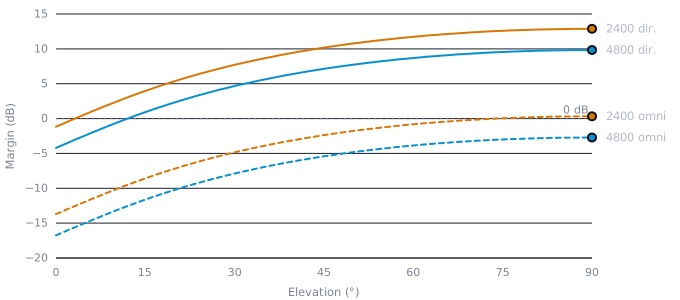
Show the data as a table
| Elevation (°) | Directional, 4800 Bd | Directional, 2400 Bd | Omnidirectional, 4800 Bd | Omnidirectional, 2400 Bd |
|---|---|---|---|---|
| 5 | −2.4 | 0.7 | −14.9 | −11.9 |
| 10 | −0.7 | 2.4 | −13.2 | −10.2 |
| 15 | 0.9 | 4.0 | −11.6 | −8.6 |
| 20 | 2.3 | 5.4 | −10.2 | −7.2 |
| 30 | 4.7 | 7.7 | −7.9 | −4.8 |
| 45 | 7.1 | 10.2 | −5.4 | −2.4 |
| 60 | 8.7 | 11.7 | −3.9 | −0.8 |
| 75 | 9.6 | 12.6 | −3.0 | 0.0 |
| 90 | 9.8 | 12.9 | −2.7 | 0.3 |
At 4800 Bd, decoding needed a directional antenna above about 12° elevation and was never possible with the omnidirectional station; the 2400 Bd mode gained 3 dB, reaching directional stations down to 3° and omnidirectional ones only near zenith. The small margins agree with the early-mission observation that many network recordings lacked the signal-to-noise ratio needed for decoding.
Telemetry
Each frame carried 31 fields: identification and time (7), temperature (1), currents and voltages (14) and IMU data (9), with five frames every 10 s. All formats were published without encryption, and a Kaitai Struct decoder[3] in the database decoded the fields automatically[4].
Assembly, integration and test
Development followed a test-as-you-fly sequence of bench, engineering-model, thermal-vacuum and vibration tests. The flight model went through protoqualification vibration inside its flight pod on 21 September 2020 at the Vibration and Acoustics Laboratory of the Faculty of Mechanical Engineering of Istanbul Technical University: resonance surveys and random runs on all three axes, with no damage found. It was integrated into an in October 2020 and its released for flight[1].
Launch and early operations
The launch slipped from a window at the turn of 2020–2021 to 13 January 2022, when Transporter-3 lifted off from Cape Canaveral at 15:25 UTC with other PocketQubes including Delfi-PQ, HADES, EASAT-2, SATLLA-2A/2B, Unicorn-1 and Unicorn-2A/2D[5]. The ZBEÜ ground station received the first data on 14 January. Before catalogue numbers were assigned, the community tracked the satellite under the temporary identifier 99488; the first community decoders assumed a different line coding and failed until the framing was clarified, and frames were decoded on 19 January 2022. The satellite then received number 51025[1].
Orbital decay: forecast and outcome
The team expected about four years in orbit; Grizu-263A re-entered after 21 months. The review reconstructs the decay from a circular 525 km orbit with the Kennewell density model driven by the observed monthly [6], a mean of 141 sfu over the mission, and constant [1]:
| Ballistic-parameter scenario | Ballistic parameter (m²/kg) | Constant 100 sfu | Constant 141 sfu | Observed flux (review) |
|---|---|---|---|---|
| Tumbling cube alone (C_D 2.2) | 0.035 | 1,795 d | 920 d | 845 d |
| Cube with 5 mm antenna tape (nominal) | 0.039 | 1,611 d | 825 d | 774 d |
| Upper bound: C_D 2.4, 10 mm tape | 0.047 | 1,337 d | 685 d | 666 d |
| Effective value matching the re-entry (B_eff ≈ 0.050) | 0.050 | 1,252 d | 641 d | 628 d |
Constant-flux columns are recomputed here with Ap = 12; 141 sfu is the mission mean. The last column is the review’s reconstruction driven by the observed monthly F10.7 (Section 5.8); the effective value reproduces the re-entry of 3 October 2023 by construction.
With a priori ballistic parameters the model predicts 845, 774 and 666 days, 6–35% longer than observed, which is within the accuracy of a single-scale-height model and of the initial-orbit uncertainty: ±10 km of initial altitude moves the prediction between 669 and 885 days, while between 6 and 18 changes it by less than ±5%. With the effective parameter of and a constant 100 sfu the model gives 3.4 years, close to the pre-launch expectation. The difference between forecast and outcome is therefore largely solar: the flux was about 40% above the level that reproduces the four-year forecast, as Solar Cycle 25 rose faster than the 2019 forecast[7] and peaked earlier and stronger, as NOAA acknowledged in 2023[8].
Lessons learned
| Area | Observation | Recommendation |
|---|---|---|
| Launch schedule | Fifteen months between delivery and launch | Plan battery storage and maintenance charging, keep the team and ground operations ready for slips |
| Decoding and identification | Community decoders failed at first; temporary identifier | Publish modulation, line coding, framing and a reference decoder before launch, tested on recorded flight-model signals |
| Link design | 4800 Bd needs directional stations; 2400 Bd reaches omnidirectional ones only near zenith | Keep dual-rate operation; add forward error correction or adaptive rates |
| Passive attitude control | Magnet moment of 0.3–0.9 A·m² against a need of about 0.02 A·m² | Size the magnet to the disturbances, control magnet-to-rod geometry, measure the moment, verify damping in a Helmholtz cage |
| Simulation inputs | A 1P has an inertia of about 10⁻⁴ kg·m² | Use mass properties from the 1P CAD model, not CubeSat templates |
| Orbital lifetime | 21 months observed against four years expected | Report lifetime ranges over solar-activity scenarios and update them as the cycle evolves |
| Telemetry content | Panel currents, gyroscope and magnetometer data allow post-flight reconstruction | Add frame and reset counters and on-board timestamps; publish calibration data with the decoder |
| Open science | Open decoders, printable models and public campaigns widened participation | Archive design documents and telemetry in citable open repositories |
The complete case study, with figures and the reconstruction of the decay, is in the PocketQube review.
References
- [1]nadir lab. (2026). PocketQube-class picosatellites: architecture, flight heritage, and a multi-method post-flight analysis of Grizu-263A [Preprint]. nadir lab. Research Monographs (SQ-R-001).Read on nadir lab.
- [2]Grizu-263 Space Team. (n.d.). Grizu-263A. Zonguldak Bülent Ecevit University.grizu263.beun.edu.tr(accessed 20 October 2026)
- [3]Kaitai Project. (n.d.). Kaitai Struct: a declarative language for describing binary data structures.kaitai.io(accessed 20 October 2026)
- [4]Libre Space Foundation. (2026). SatNOGS DB: Grizu-263A (NORAD 51025).db.satnogs.org(accessed 20 October 2026)
- [5]Libre Space Foundation community forum. (2022). SpaceX F9 Transporter-3, 2022-01-13 15:25 UTC (discussion thread).community.libre.space(accessed 20 October 2026)
- [6]NOAA Space Weather Prediction Center. (n.d.). Observed monthly 10.7 cm solar radio flux.services.swpc.noaa.gov(accessed 20 October 2026)
- [7]NOAA Space Weather Prediction Center. (2019). Solar Cycle 25 forecast update.spaceweather.gov(accessed 20 October 2026)
- [8]NOAA Space Weather Prediction Center. (2023). NOAA forecasts quicker, stronger peak of solar activity.spaceweather.gov(accessed 20 October 2026)
Cite this SatWiki entry
@misc{nadirlab2026grizu,
  author       = {{nadir lab.}},
  title        = {{Grizu-263A}},
  year         = {2026},
  month        = oct,
  howpublished = {nadir lab. SatWiki SQ-MS-001 (Rev. 1)},
  url          = {https://nadirlab.space/wiki/grizu-263a/}
}
nadir lab. (2026). Grizu-263A. nadir lab. SatWiki (SQ-MS-001, Rev. 1). https://nadirlab.space/wiki/grizu-263a/
TY  - ENCYC
AU  - nadir lab.
TI  - Grizu-263A
T2  - nadir lab. SatWiki
PY  - 2026
ET  - Rev. 1
C1  - SQ-MS-001
UR  - https://nadirlab.space/wiki/grizu-263a/
ER  -