Regulation and debris mitigation
Also known as Five-year rule, 25-year rule, Space debris, Frequency coordination, Licensing
Spectrum coordination, licensing and the end-of-life rules that decide where a small satellite may fly. The FCC five-year rule and the older 25-year guideline translate directly into altitude ceilings for spacecraft without propulsion.
- Document
- SQ-OP-003
- Updated
- Reading time
- 5 min
In this tab
Two kinds of rules
Two bodies of rules shape a small-satellite mission beyond its engineering. Spectrum rules decide which frequencies it may use and how it must coordinate them. Space-debris rules decide how long it may stay in orbit after its mission ends, and therefore where it may fly without propulsion.
Spectrum
Radio spectrum is allocated internationally by the ITU Radio Regulations[1], and every satellite network is notified to the ITU through its national administration. Missions in the amateur-satellite service additionally coordinate their frequencies with the International Amateur Radio Union, whose satellite advisers check the proposed frequencies, modes and the amateur character of the mission[2]. The amateur service is restricted to non-commercial purposes: open, decodable telemetry and a service to radio amateurs are part of the bargain, and a reliable command that shuts the transmitter down is required.
Grizu-263A followed this path. Its frequencies were coordinated (serial 775) with the support of TAMSAT, and the team published all telemetry formats without encryption[3]. The additional spectrum for telemetry, tracking and command of short-duration missions agreed at WRC-19 offers an alternative for missions that are not amateur in character[3].
Licensing
In the United States, any non-federal transmitter needs a licence from the Federal Communications Commission; experimental licences are common for university CubeSats[4]. Launch providers ask for the licence, the frequency coordination and the debris assessment before integration, so the paperwork has to start a year or more before launch[5].
The five-year rule
In September 2022 the FCC replaced the long-standing 25-year guideline with a five-year limit on post-mission disposal for satellites in low Earth orbit[6]. The rule applies to satellites launched after 29 September 2024, both US-licensed and non-US-licensed satellites that seek access to the US market; satellites already in orbit by that date are grandfathered[7]. International standards such as ISO 24113 keep the older 25-year limit[8], and NASA’s technical standard for limiting orbital debris sets agency requirements for its own missions[9].
A total orbital lifetime of five years is a conservative way to meet the rule: if the spacecraft re-enters within five years of launch, it re-enters within five years of the end of its mission.
What the rules mean for altitude
For a spacecraft without propulsion, the rules become an altitude ceiling that depends on the and the Sun:
| Form factor | Within 5 years | Within 25 years | ||||
|---|---|---|---|---|---|---|
| Low | Moderate | High | Low | Moderate | High | |
| 1P | 493 | 559 | 627 | 567 | 656 | 752 |
| 2P | 490 | 555 | 622 | 563 | 651 | 745 |
| 3P | 489 | 553 | 620 | 562 | 649 | 743 |
| 1U | 467 | 525 | 585 | 538 | 618 | 702 |
| 3U | 457 | 513 | 570 | 528 | 604 | 685 |
Bisection on the lifetime model of the review (Eqs. 5–6). The FCC five-year rule applies to satellites launched after 29 September 2024 that are licensed in or serve the United States; ISO 24113 keeps 25 years. Solar activity: low F10.7 = 70 sfu, Ap = 6; moderate 140 sfu, Ap = 12; high 210 sfu, Ap = 18.
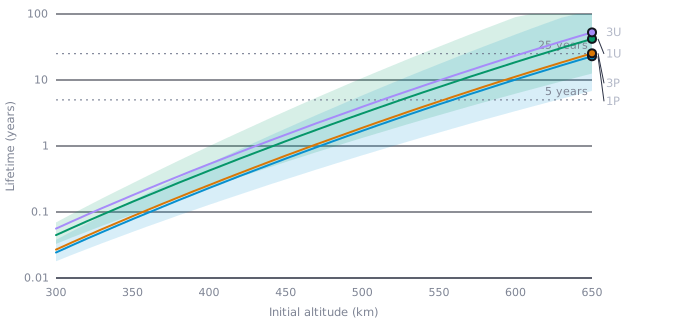
A fully loaded 1P meets the below about 560 km at moderate solar activity, but the ceiling moves from about 490 to 630 km between low and high activity[3]. Because a release orbit is chosen years before the activity it will meet is known, a margin of tens of kilometres is prudent. The sensitivity is visible in the lifetime chart:
- 1P, 0.033 m²/kg
- 3P, 0.030 m²/kg
- 1U, 0.018 m²/kg
- 3U, 0.014 m²/kg
- 1P, low to high activity
- 1U, low to high activity
Show the data as a table
| Initial altitude (km) | 1P, 0.033 m²/kg | 3P, 0.030 m²/kg | 1U, 0.018 m²/kg | 3U, 0.014 m²/kg |
|---|---|---|---|---|
| 350 | 0.08 | 0.09 | 0.14 | 0.18 |
| 400 | 0.23 | 0.26 | 0.42 | 0.53 |
| 450 | 0.64 | 0.71 | 1.18 | 1.49 |
| 500 | 1.70 | 1.89 | 3.12 | 3.92 |
| 550 | 4.26 | 4.72 | 7.82 | 9.82 |
| 600 | 10.13 | 11.23 | 18.59 | 23.35 |
| 650 | 22.87 | 25.35 | 41.97 | 52.72 |
Above the ceiling
A mission that must fly higher has three options: an operational altitude-lowering burn, a drag device or simply a smaller ballistic coefficient. Drag sails enlarge the area that the flow sees:
| Altitude (km) | Required ballistic parameter (m²/kg) | 1P: sail area (m²) | 3P: sail area (m²) | 3U: sail area (m²) |
|---|---|---|---|---|
| 550 | 0.028 | Not needed | Not needed | 0.075 |
| 600 | 0.067 | 0.008 | 0.025 | 0.29 |
| 650 | 0.151 | 0.027 | 0.083 | 0.75 |
| 700 | 0.324 | 0.066 | 0.20 | 1.69 |
| 800 | 1.280 | 0.28 | 0.85 | 6.91 |
A flat sail that tumbles with the spacecraft (mean projected area half the sail area); a sail held face-on to the flow needs half as much.
Propulsion can lower the perigee at the end of the mission. From typical altitudes a single burn of 70–100 m/s brings the perigee to 250 km, which is a demanding budget for a PocketQube:
| Altitude (km) | Perigee to 250 km (m/s) | Perigee to 180 km (m/s) | Low-thrust spiral to 250 km (m/s) | Propellant for a 1P, Isp 65 s (g) |
|---|---|---|---|---|
| 500 | 71 | 91 | 142 | 26.3 |
| 550 | 84 | 105 | 170 | 31.0 |
| 600 | 98 | 118 | 197 | 35.6 |
| 700 | 124 | 144 | 251 | 44.3 |
| 800 | 150 | 170 | 303 | 52.4 |
Single impulsive burn from a circular orbit; a 250 km perigee brings re-entry within weeks. Propellant from the rocket equation for a 250 g 1P with cold gas (Isp 65 s).
The five-year rule article compares the three options for PocketQubes and CubeSats.
Being catalogued
Debris mitigation assumes that objects can be tracked. PocketQubes are catalogued routinely once deployed, but the accuracy of orbits derived from two-line elements degrades for light objects[10], and identification after large rideshares can take days. Operators help by publishing transmitter frequencies and beacon formats before launch, so that networks can match signals to catalogue objects quickly.
Short life as a feature
For the smallest spacecraft, the high area-to-mass ratio is the most reliable mitigation measure: from 450 km a fully loaded 1P re-enters in well under a year at moderate activity, and from 400 km in months. Low orbits shorten missions, which is the tension the propulsion entry describes: debris rules push PocketQubes down, where only micronewton propulsion could keep them working for long.
References
- [1]International Telecommunication Union. (2020). Radio Regulations, Edition of 2020. ITU.
- [2]International Amateur Radio Union. (2026). Amateur satellite frequency coordination.iaru.org(accessed 20 October 2026)
- [3]nadir lab. (2026). PocketQube-class picosatellites: architecture, flight heritage, and a multi-method post-flight analysis of Grizu-263A [Preprint]. nadir lab. Research Monographs (SQ-R-001).Read on nadir lab.
- [4]NASA Small Spacecraft Systems Virtual Institute. (2026). Communications. State-of-the-Art of Small Spacecraft Technology (2026 edition), Chapter 9. NASA Ames Research Center.nasa.gov(accessed 20 October 2026)
- [5]NASA CubeSat Launch Initiative. (2017). CubeSat 101: Basic Concepts and Processes for First-Time CubeSat Developers. NASA.nasa.gov(accessed 20 October 2026)
- [6]Federal Communications Commission. (2022). Space innovation; Mitigation of orbital debris in the new space age, Second Report and Order (FCC 22-74). FCC.
- [7]Federal Communications Commission, Space Bureau. (2026). Frequently asked questions: orbital debris and the five-year rule.fcc.gov(accessed 20 October 2026)
- [8]International Organization for Standardization. (2023). ISO 24113:2023 Space systems — Space debris mitigation requirements. ISO.
- [9]NASA. (2021). NASA-STD-8719.14C: Process for Limiting Orbital Debris. NASA Office of Safety and Mission Assurance.standards.nasa.gov(accessed 20 October 2026)
- [10]Kahr, E., Montenbruck, O., & O’Keefe, K. (2013). Estimation and analysis of two-line elements for small satellites. Journal of Spacecraft and Rockets, 50, 433–439.doi:10.2514/1.A32352
Cite this SatWiki entry
@misc{nadirlab2026regulation,
  author       = {{nadir lab.}},
  title        = {{Regulation and debris mitigation}},
  year         = {2026},
  month        = oct,
  howpublished = {nadir lab. SatWiki SQ-OP-003 (Rev. 1)},
  url          = {https://nadirlab.space/wiki/regulation-debris/}
}
nadir lab. (2026). Regulation and debris mitigation. nadir lab. SatWiki (SQ-OP-003, Rev. 1). https://nadirlab.space/wiki/regulation-debris/
TY  - ENCYC
AU  - nadir lab.
TI  - Regulation and debris mitigation
T2  - nadir lab. SatWiki
PY  - 2026
ET  - Rev. 1
C1  - SQ-OP-003
UR  - https://nadirlab.space/wiki/regulation-debris/
ER  -