Materials-initiated failures and screening gaps in CubeSat and PocketQube missions
- Research group
- nadir lab.
- Published
- Version
- nadir lab. Monograph REV 0.1, 4 November 2026
- Identifier
- SQ-R-004
- Reading time
- 53 min
- Licence
- CC BY-NC-ND 4.0
At a glance
- of 32 verified hardware anomalies initiated by materials, interfaces or cells
- 65.6%
- of materials-related cases driven by deployment mechanisms (47.6%) and batteries (33.3%)
- 81.0%
- manifested at or before orbital day 60 (median onset: day 1)
- 71.4%
- plausibly screenable by ground TVAC/vibration tests, yet 66.7% lack test disclosure
- 90.5%
Highlights
- Materials, interface or cell causes initiate 65.6% (21/32; 95% Wilson CI: 48.3%–79.6%) of verified hardware anomalies
- Deployment mechanisms (47.6%) and Li-ion/Li-Po battery assemblies (33.3%) account for 81.0% (17/21) of materials-related cases
- 71.4% (15/21) of materials-related anomalies manifest at or before orbital day 60, with a median onset of day 1
- Standard TVAC, random vibration and fluid-filtration tests would plausibly have screened 90.5% (19/21) of cases before flight
- Public mission post-mortems omit ground-test execution status in 66.7% (14/21) of cases; an 8-point reporting checklist is proposed
Abstract
Small-satellite reliability surveys typically classify anomalies by engineering subsystem or developer institution, which obscures the physical degradation mechanisms that initiate hardware failures. Using public mission post-mortems and flight databases accessed on 4 November 2026, we evaluate 32 verified CubeSat (1U to 12U) and PocketQube (1P to 3P) loss and anomaly cases launched between June 2003 and July 2024; 7 further records involving single-event effects, flight-software bugs, or launch-vehicle upper-stage failures were excluded. Of the 32 verified hardware cases, 21 (65.6%; 95% Wilson confidence interval [CI]: 48.3% to 79.6%) have a materials-, interface-, interconnect-, or electrochemical-cell-related initiating cause. Deployment mechanisms and electrochemical power storage dominate these cases, accounting for 10 of 21 (47.6%) and 7 of 21 (33.3%), respectively (combined 17 of 21, 81.0%; 95% Wilson CI: 60.0% to 92.3%). Fifteen of the 21 materials-related cases (71.4%; 95% Wilson CI: 50.0% to 86.2%) arose at or before day 60 after orbital deployment, mostly during appendage release or early commissioning (median onset: day 1). In a screening-gap analysis, we judge that standard ground qualification tests—particularly thermal-vacuum deployment verification, cell-level thermal-vacuum cycling, random vibration followed by vacuum functional dwell, and propellant filtration—would plausibly have revealed 19 of the 21 cases (90.5%; 95% Wilson CI: 71.1% to 97.3%), yet the public records do not state whether the relevant test was performed in 14 of 21 cases (66.7%). We present nonparametric Kaplan–Meier survival curves, two sensitivity analyses, a master case registry, and a minimum materials-reporting checklist for future small-satellite post-mortems.
- CubeSat reliability
- PocketQube standard
- Space materials degradation
- Thermal-vacuum screening
- Deployment mechanisms
- Lithium-ion battery degradation
- Cold welding
- Failure post-mortem checklist
Abbreviations (20)
- ADCS
- Attitude determination and control system
- AM
- Additive manufacturing
- AO
- Atomic oxygen
- CI
- Confidence interval (95% Wilson score)
- COTS
- Commercial off-the-shelf
- CVCM
- Collected volatile condensable material
- DOA
- Dead on arrival
- DSC
- Differential scanning calorimetry
- ECSS
- European Cooperation for Space Standardization
- EPS
- Electrical power system
- LEO
- Low Earth orbit
- Li-ion
- Lithium-ion electrochemical cell
- Li-Po
- Lithium-polymer laminated pouch cell
- MOSFET
- Metal-oxide-semiconductor field-effect transistor
- OR
- Odds ratio
- P-POD
- Poly-Picosatellite Orbital Deployer
- SEE
- Single-event effect
- SEI
- Solid-electrolyte interphase
- TML
- Total mass loss
- TVAC
- Thermal-vacuum
Contents
Full text
Key Findings
- Materials-related causes initiate nearly two-thirds of documented hardware anomalies. Of the 32 verified hardware cases (
C01–C32), 21 (65.6%; 95% Wilson CI: 48.3% to 79.6%) trace to an initiating failure in a bulk material, mechanical or fluid interface, electrical interconnect, or electrochemical cell. Five cases (15.6%; 95% Wilson CI: 6.9% to 31.8%) trace to non-materials design, manufacturing, or operational faults, and 6 (18.8%; 95% Wilson CI: 8.9% to 35.3%) have unknown causes. - Deployment mechanisms and commercial lithium-ion or lithium-polymer cells dominate the failure modes. Among the 21 materials-related cases, deployment mechanisms account for 10 (47.6%; 95% Wilson CI: 28.3% to 67.6%) and electrochemical battery assemblies for 7 (33.3%; 95% Wilson CI: 17.2% to 54.6%), together 17 of 21 (81.0%; 95% Wilson CI: 60.0% to 92.3%).
- Anomalies cluster in early flight phases. Fifteen of the 21 materials-related anomalies (71.4%; 95% Wilson CI: 50.0% to 86.2%) arose at or before day 60 after orbital ejection: 11 during appendage deployment, 3 within the first 48 hours of commissioning, and 1 with thermal battery-protection cutoffs beginning during early orbital operations (
C21). This bimodal distribution (median onset: day 1) is consistent with latent materials and interface incompatibilities that ground qualification did not intercept, rather than with long-term orbital wear-out. - Ground-test documentation has a major transparency gap. We judge that established environmental tests (thermal-vacuum deployment verification, cell-level thermal-vacuum cycling, random vibration followed by a vacuum functional dwell, or fluid-compatibility filtration testing) would plausibly have screened 19 of the 21 materials-related cases (90.5%; 95% Wilson CI: 71.1% to 97.3%). Mission records, however, confirm that the relevant test was performed in only 3 of 21 cases (14.3%; 95% Wilson CI: 5.0% to 34.6%), confirm that it was omitted in 4 (19.0%; 95% Wilson CI: 7.7% to 40.0%), and contain no test record in 14 (66.7%; 95% Wilson CI: 45.4% to 82.8%).
1. Introduction
A CubeSat is a standardized nanosatellite built in multiples of a cubic unit (1U; typically up to per unit) and originally developed to interface with the Poly-Picosatellite Orbital Deployer (P-POD) [1, 2]. A PocketQube is a smaller standardized picosatellite based on a cubic unit (1P; one-eighth the volume of a 1U CubeSat and at most per unit) that interfaces with its deployer through a cantilevered sliding backplate rather than four corner rails [4, 6]. Both form factors have lowered the financial barrier to low Earth orbit (LEO; altitudes below ) and cis-lunar space by relying heavily on commercial off-the-shelf (COTS) electronics, polymers, structural alloys, and lithium-ion (Li-ion) or lithium-polymer (Li-Po) pouch cells [1–3, 12].
COTS adoption shortens development schedules, but materials that are not space-qualified then face severe environmental stressors from pre-launch storage through orbital operations. In LEO and deep space, spacecraft materials experience high vacuum (pressures below ), radiative thermal cycling between roughly and , ultraviolet (UV) radiation, atomic oxygen (AO) erosion, charged-particle radiation, and random vibration during launch [5, 7, 12]. Under these conditions, polymer tie-down cords change tensile stiffness or creep under preload, nichrome burn wires lose convective cooling and overheat locally, pouch-cell electrolytes generate gas and swell against structural frames, unpassivated metallic contacts fret or cold-weld, and solder joints fracture under thermo-mechanical fatigue [5, 8, 15, 19, 22].
In traditional space engineering governed by European Cooperation for Space Standardization (ECSS) standards, materials and mechanical interfaces are formally screened before integration. Screening includes thermal-vacuum outgassing measurements of total mass loss (TML) and collected volatile condensable material (CVCM) under ECSS-Q-ST-70-02C or ASTM International standard E595; differential scanning calorimetry (DSC) for polymer glass-transition and melting behavior; and impact-and-fretting cold-welding evaluation under European Space Agency (ESA) Scientific and Technical Memorandum STM-279 [5]. CubeSat and PocketQube teams, constrained by university budgets or rapid commercial schedules, frequently waive or abbreviate these material- and mechanism-level tests in favor of system-level functional checks at ambient atmospheric pressure [3, 8, 10].
Despite two decades of flight heritage, the fraction of small-satellite failures initiated specifically by materials and interface degradation, and the degree to which standard ground screening could have prevented them, remains unquantified in the open literature. This study addresses four research questions using verifiable public mission records accessed through 4 November 2026:
- What share of documented CubeSat and PocketQube losses and anomalies has a materials-related initiating cause?
- Which material classes and physical degradation mechanisms are responsible?
- In which mission phase do these failures occur?
- Which ground test would most plausibly have revealed each failure mode before launch, and did the mission team report performing it?
2. Prior Failure Surveys and the Materials Disaggregation Gap
Three foundational surveys established the statistical baseline for pico- and nanosatellite reliability [1–3]. Bouwmeester and Guo (2010) surveyed worldwide pico- and nanosatellite missions and characterized the distribution of subsystem technologies across early missions, highlighting electrical power, communications, and attitude-control bottlenecks at the architectural level [2]. Swartwout (2013) examined the first 100 CubeSat missions (112 spacecraft through 2012), showing that university missions suffered high early failure rates driven by preventable system-integration errors and identifying the P-POD interface as the primary enabling technology [1]. Langer and Bouwmeester (2016) modeled CubeSat survival with nonparametric Kaplan–Meier curves and a Percent Non-Zero (PNZ) two-Weibull mixture model; they quantified the dominance of dead-on-arrival (DOA) cases and of infant mortality within the first 100 days in orbit, and compared flight data with a survey of 113 satellite developers [3]. Subsequent statistical updates by Villela et al. (2019) extended mission counts past the first thousand CubeSats [12].
These surveys establish macro-level survival curves, developer risk perceptions, and subsystem failure proportions (for example, the percentage contributions of the electrical power system [EPS], on-board computer, or communications transceiver). None of them, however, disaggregates subsystem failures to the physical material class, interface mechanism, or environmental driver [1–3, 12]. In existing surveys, an antenna-release failure caused by a vibration-fractured solder joint (C11), a solar-array failure caused by a nichrome burn wire that overheats in vacuum before cleaving a nylon cord (C08, C12), and a transceiver failure caused by a software configuration bug (E02, E05) are pooled together under communications or electrical-power anomalies. Moreover, the foundational surveys predate the expansion of 6U deep-space CubeSats (such as Artemis-1 secondary payloads) and of 1P to 3P PocketQubes launched after 2019, and they do not cross-tabulate individual flight anomalies against specific materials-qualification standards (such as ECSS-Q-ST-70-02C, ECSS-E-ST-33-01C, ASTM E595, or ESA STM-279) to ask whether documented ground testing would have intercepted the failure before flight [1–3, 5]. The present study addresses this gap.
3. Data and Methods
The hypotheses, inclusion criteria, materials-failure taxonomy, coding decision rules, and statistical thresholds described below were specified in a pre-analysis research protocol (NL-PROT-2026-004, archived in the nadir lab. open dataset repository) before the case dataset was coded and aggregated.
3.1. Falsifiable Hypotheses
Before examining the coded case distributions, we formulated four falsifiable hypotheses, each with explicit criteria for empirical support or rejection:
- Hypothesis 1 (: subsystem and mechanism dominance). Power-system electrochemical cell degradation and deployment-mechanism interface causes together account for the largest share, specifically more than , of materials-related losses and anomalies in 1U to 3U CubeSat missions (and across the pooled materials-related sample). Decision rule: is supported if both the combined point estimate and the lower bound of the 95% Wilson CI for power-system and deployment-mechanism causes among materials-related 1U to 3U cases exceed ; it is declared inconclusive if the point estimate exceeds but the lower 95% Wilson CI bound is or below; and it is rejected if the point estimate is or lower. Both the affected-subsystem definition (where deployment mechanisms include release-circuit solder interconnects) and the strict Table 3 physical-mechanism definition are evaluated explicitly.
- Hypothesis 2 (: early-phase clustering). Materials-related anomalies cluster within the first 60 days after orbital deployment (including failures initiated during integration, launch, deployment, or early commissioning up to day 60), pointing to gaps in pre-launch environmental screening rather than long-term orbital wear-out. Decision rule: is supported if more than of materials-related cases manifest at or before 60 days after deployment and the lower bound of the 95% Wilson CI is at least ; otherwise, it is rejected or declared inconclusive.
- Hypothesis 3 (: qualification-testing association). Among documented anomaly cases, missions that explicitly report performing the relevant thermal-vacuum (TVAC) or environmental qualification test show a lower conditional proportion of materials-related anomalies than missions that report not performing the test or do not disclose test execution. Decision rule: is supported if missions reporting the relevant qualification test show a statistically lower materials-related proportion under a two-sided Fisher's exact test at a significance level of (with a negative phi coefficient and an odds ratio ). It is declared inconclusive if the sample of disclosed test reports lacks statistical power or is dominated by unreported ("unknown") test status.
- Hypothesis 4 (: form-factor vulnerability). The share of anomalies with a materials-related initiating cause is higher for PocketQubes (1P to 3P) than for 1U to 3U CubeSats, because PocketQubes have smaller thermal inertia, tighter mechanical clearances, and lower mass margins [4, 6]. Decision rule: is supported if the PocketQube materials-related share exceeds that of 1U to 3U CubeSats with a two-sided Fisher's exact test -value below ; it is rejected if the PocketQube share is lower; and it is declared inconclusive if the point estimate is higher but the confidence intervals overlap and because of the small PocketQube sample.
3.2. Inclusion Criteria and Study Period
The study period covers CubeSat (1U to 12U) and PocketQube (1P to 3P) missions launched between 30 June 2003 (the Eurockot launch carrying the pioneering CubeSats CUTE-I, QuakeSat, and CanX-1) and 9 July 2024 (the Ariane 6 VA262 maiden flight carrying Curium One), for which primary or near-primary anomaly documentation was accessible as of 4 November 2026 [11, 30, 34].
We examined 39 mission anomaly and loss records. A mission record was included in the primary analytical dataset () if it met all three of the following criteria:
- Form factor. The spacecraft conforms to a CubeSat (1U to 3U, or 6U to 12U) or PocketQube (1P to 3P) structural envelope.
- Adverse event. The mission suffered a total loss; failed to deploy an essential appendage; had a documented anomaly during integration, protoflight testing, or on-orbit operations that degraded mission objectives; or had a documented minor hardware anomaly requiring contingency recovery.
- Verifiable primary or near-primary documentation. The event is documented in an agency or university mission portal (such as the ESA eoPortal directory or the NASA Technical Reports Server), a peer-reviewed journal article, a conference post-mortem paper (such as those of the Annual AIAA/USU Conference on Small Satellites or the International Astronautical Congress), or a curated technical database that cites primary telemetry reports (Erik Kulu's Nanosats Database [11]). General encyclopedias (such as Wikipedia) were not used as evidence.
Records with no reported anomaly information were excluded. Where primary sources document a loss or anomaly (such as permanent loss of radio contact) without identifying a technical root cause, the case was included and coded as unknown rather than guessed. In accordance with Section 3.3, 7 examined missions (E01 to E07) whose anomalies were initiated by single-event effects (SEEs) in integrated circuits, flight-software logic or configuration bugs, ground-operator procedural error, or launch-vehicle upper-stage malfunctions were excluded from the hardware numerator and denominator and are reported separately in Appendix A (Table A.2).
3.3. Definition of Materials-Related Failure
A loss or anomaly was classified as materials-related when its initiating physical mechanism was a degradation, phase or dimensional change, fracture, wear event, leakage, or thermal-physical incompatibility in a bulk material, a mechanical or fluid interface, an electrical interconnect, or a surface coating. Seven mechanism categories were defined:
- Structure: fatigue, brittle fracture, polymer creep, stress-corrosion cracking, viscoelastic structural damping, or mechanical failure of polymer restraint cords and composite booms.
- Interfaces and tribology: cold welding, galling, fretting wear, mechanical indentation of sliding contacts, lubricant loss, elastomeric seal leakage, adhesive debonding, or thermal-mechanical binding of deployment hinges and nichrome–polymer burn-wire release interfaces.
- Interconnects: solder-joint thermo-mechanical fatigue or vibration fracture, tin-whisker conductive bridging, corrosion of conductive traces, or conformal-coating delamination.
- Power (electrochemical materials and packaging): lithium-ion or lithium-polymer cell capacity degradation, internal impedance rise, vacuum pouch-cell swelling, or internal cell thermal runaway initiated by cell chemistry or thermal packaging (excluding battery-management software logic faults).
- Thermal control: changes in solar absorptance () or infrared emittance (), or degradation of multi-layer insulation or thermal straps.
- Contamination and fluid interface: outgassing volatile condensation on optical surfaces or solar arrays, or particulate and reaction-product debris obstructing micro-propulsion feed lines.
- Environment-induced bulk degradation: atomic-oxygen erosion, UV photodegradation, or cumulative ionizing-radiation degradation of polymers, optics, and RF or solar-cell materials.
3.4. Coding Book, Attribution Rules, and Reliability
Every candidate record was processed through a sequential five-step decision protocol (formalized in Appendix B):
- Primary gate. Did a material, mechanical or fluid interface, interconnect, electrochemical cell, or coating initiate the anomaly? If yes, code
materials_related = yes. - Non-materials classification. If not, classify the initiating cause into one of five mutually exclusive categories:
design(an architecture or power/link sizing error without material failure),manufacturing(an assembly wiring error or board-level defect unrelated to material degradation),operations(a ground-handling or charging-procedure transient),environment(a non-material external disturbance), orunknown(insufficient telemetry to establish a root cause). - Multi-factor attribution. When several factors contributed to an outcome, assign the earliest physical link in the causal chain as the initiating primary cause and record downstream or concurrent issues under
contributing_factors. Dimensional coding. Assign each verified case a
mission_phase(integration/storage,launch,deployment,commissioning,nominal operations,end of life, orunknown),subsystem,material_class,mechanism,environmental_driver,detection_method(ground-test inspection, housekeeping telemetry, RF link attenuation, or loss of signal),outcome(lost, failed deployment, objectives degraded, or minor anomaly), and evidenceconfidencelevel:- High: a primary post-mortem report or peer-reviewed paper states the physical cause on the basis of housekeeping telemetry, ground inspection, or vacuum replication tests.
- Medium: near-primary database entries or mission summaries provide strong indirect telemetry evidence of the failure mechanism.
- Low: the mechanism is an engineering inference from external symptoms (such as weak RF signal power indicating an undeployed antenna) without internal fault telemetry.
- Screening-gap assignment. Identify the single most plausible standard ground qualification test that would have revealed the initiating mechanism before flight, record whether the mission documentation reports performing that specific test (
yes,no, orunknown), and give a one-sentence engineering rationale explicitly labeled as author judgment.
Coding reliability. Coding was performed by the nadir lab. analysis group following the explicit decision rules in Appendix B. Because independent external double-coding across all 39 records was not conducted prior to publication, inter-rater agreement (Cohen's ) is not reported; instead, to mitigate coder subjectivity, all low-confidence inferences are isolated and removed in Sensitivity Analysis (a) (Section 4.5), and the complete case-by-case coding table is published in Appendix A (Table A.1) for independent re-audit.
3.5. Statistical Analysis Plan
Because the verified sample contains hardware cases (exceeding the pre-specified protocol minimum of ), we performed both descriptive and exact nonparametric inferential analyses:
- Proportions and uncertainty. Every count out of is reported with its two-sided 95% Wilson score confidence interval (), which remains well behaved and boundary-respecting for small sample sizes () and extreme proportions where normal-approximation (Wald) intervals fail:
- Exact contingency tests and effect sizes. We used the two-sided Fisher's exact test for contingency tables and the Fisher–Freeman–Halton exact test for tables to test associations between materials-related failure and form factor, and between materials-related failure and reported qualification testing. Alongside exact -values, we report the sample odds ratio , the phi coefficient for tables, and Cramér's for tables:
- Time to anomaly. We computed the nonparametric Kaplan–Meier survival estimator and Greenwood's variance estimator for the elapsed time from orbital ejection () to anomaly onset:
where is the number of anomaly events at time and is the number of spacecraft still at risk just prior to .
- Sensitivity analyses. We recomputed all primary proportions after (a) excluding all low-confidence cases ( retained) and (b) excluding all cases sourced solely from Erik Kulu's Nanosats Database ( cases verified directly through agency portals, peer-reviewed journals, or conference post-mortems).
4. Results
4.1. Hypothesis Evaluation Summary
Table 1 summarizes the evaluation of hypotheses to against the 32 verified hardware cases, 21 of which are materials-related.
Table 1.Evaluation of the four pre-specified falsifiable hypotheses across the verified dataset (N = 32).
| Hypothesis | Analytical scope | Observed count & share | 95% Wilson CI | Exact test & effect size | Verdict |
|---|---|---|---|---|---|
| . Power & deployment causes exceed 50% of materials-related cases in 1U–3U CubeSats | 1U–3U materials-related cases (); all materials-related cases () | 9 of 11 (81.8%) in 1U–3U; 17 of 21 (81.0%) overall | 52.3% to 94.9% (1U–3U); 60.0% to 92.3% (all) | Lower CI bound exceeds 50.0% threshold in both strata | Supported |
| . Materials-related anomalies cluster within the first 60 days after deployment | All materials-related cases () | 15 of 21 (71.4%) at or before day 60 | 50.04% to 86.2% | Lower CI bound clears 50.0% threshold; median onset is day 1 | Supported |
| . Missions reporting TVAC testing show a lower conditional materials-related share | All verified cases (); known test status () | 3 of 6 (50.0%) with TVAC reported vs. 18 of 26 (69.2%) not reported/unknown | 18.8% to 81.2% vs. 50.0% to 83.5% | Fisher's exact , , (known only: , ) | Inconclusive (66.7% of test status unreported) |
| . PocketQubes have a higher materials-related share than 1U–3U CubeSats | PocketQubes () vs. 1U–3U CubeSats () | 4 of 6 (66.7%) vs. 11 of 18 (61.1%) | 30.0% to 90.3% vs. 38.6% to 79.7% | Fisher's exact , , (3 strata: Cramér's , ) | Inconclusive (higher point estimate, small ) |
is supported. Within the 1U to 3U class, 11 of 18 cases are materials-related. Under the affected-subsystem definition, 5 involve deployment mechanisms (C07, C08, C11, C12, C29) and 4 involve electrochemical battery assemblies (C01, C06, C10, C16), yielding 9 of 11 (81.8%; 95% Wilson CI: 52.3% to 94.9%). Across all form factors (), deployment mechanisms (10 cases) and battery assemblies (7 cases) account for 17 of 21 materials-related cases (81.0%; 95% Wilson CI: 60.0% to 92.3%). Note that if C11 (a fractured solder joint inside an antenna-deployment circuit) is counted under interconnects rather than deployment mechanisms in the 1U–3U stratum, the strict mechanism-level count in 1U–3U is 8 of 11 (72.7%; 95% Wilson CI: 43.4% to 90.3%), whereas across the full sample () interfaces and tribology (10 cases, including C23) plus electrochemical cells (7 cases) remains exactly 17 of 21 (81.0%; 95% Wilson CI: 60.0% to 92.3%).
is supported. Fifteen of the 21 materials-related cases (71.4%; 95% Wilson CI: 50.04% to 86.2%) began at or before day 60 after deployment (C07, C08, C11, C12, C17, C21, C22, C23, C24, C26, C27, C28, C29, C31, C32), whereas 6 cases (28.6%; 95% Wilson CI: 13.8% to 50.0%) manifested later (C01, C02, C04, C06, C10, C16). The lower confidence bound () clears the pre-specified threshold only marginally: reclassifying C21 (Delfi-PQ, whose battery-protection thermal cutoffs began immediately across orbital swings while component degradation accumulated over its 2-year flight [7, 28]) as a purely late-onset case would yield 14 of 21 (66.7%; 95% Wilson CI: 45.4% to 82.8%), rendering borderline inconclusive under the strict lower-bound rule while leaving the median onset unchanged at day 1.
is inconclusive. Missions that explicitly report system-level or component-level thermal-vacuum testing show a conditional materials-related share of 50.0% (3 of 6 cases: C04, C21, and C26 are materials-related, whereas C13, C15, and C18 are not), compared with 69.2% (18 of 26 cases) among missions where the relevant test was omitted or unreported (; ; two-sided Fisher's exact ). Restricting to the cases with known test execution status yields 3 of 6 (50.0%) vs. 4 of 5 (80.0%; , two-sided Fisher's exact ). Because 14 of the 21 materials-related cases (66.7%) do not disclose whether the relevant screening test was performed, reporting bias prevents a definitive causal inference.
is inconclusive. PocketQubes show a materials-related share of 66.7% (4 of 6 cases: C17, C21, C22, C28), compared with 61.1% in 1U to 3U CubeSats (11 of 18) and 75.0% in 6U to 12U CubeSats (6 of 8: C23, C24, C26, C27, C31, C32). As anticipated in Section 3.1, the PocketQube sample is small (), which yields wide confidence bounds (30.0% to 90.3%) and no statistically significant association (; ; three-stratum Fisher–Freeman–Halton , Cramér's ).
4.2. Distribution by Form Factor and Causal Category
Table 2 and Figure 1 break down all 32 verified hardware cases by form-factor stratum; the 7 excluded records (E01 to E07) are listed alongside for completeness.
Table 2.Verified hardware cases by form-factor stratum and initiating-cause category (N = 32), plus excluded software/SEE/launcher records (n = 7).
| Form-factor stratum | Verified cases () | Materials-related: (%; 95% Wilson CI) | Design, manufacturing, or operations: (%; 95% Wilson CI) | Unknown cause: (%; 95% Wilson CI) | Excluded records (SEE, software, launcher) |
|---|---|---|---|---|---|
| CubeSats, 1U to 3U | 18 | 11 (61.1%; 38.6% to 79.7%) | 4 (22.2%; 9.0% to 45.2%) | 3 (16.7%; 5.8% to 39.2%) | 7 (E01 to E07) |
| Larger CubeSats, 6U to 12U | 8 | 6 (75.0%; 40.9% to 92.9%) | 1 (12.5%; 2.2% to 47.1%) | 1 (12.5%; 2.2% to 47.1%) | 0 |
| PocketQubes, 1P to 3P | 6 | 4 (66.7%; 30.0% to 90.3%) | 0 (0.0%; 0.0% to 39.0%) | 2 (33.3%; 9.7% to 70.0%) | 0 |
| Total verified sample | 32 | 21 (65.6%; 48.3% to 79.6%) | 5 (15.6%; 6.9% to 31.8%) | 6 (18.8%; 8.9% to 35.3%) | 7 |

Materials-initiated share by form-factor stratum () and physical degradation mechanism category (). Panel (a) shows the distribution of verified hardware cases across Table 2 strata; Panel (b) partitions the 21 materials-related cases across the six active mechanism categories of Table 3.
Interactive breakdown of N = 32 verified hardware anomaly cases by form factor (Table 2) and physical mechanism class (Table 3).
In the 1U to 3U CubeSat class (), four cases have known non-materials causes: C05 PW-Sat (a power-budget architecture deficit that prevented deployment of the deorbit tail) [24]; C18 GT-1 (a main-board electrical short and component-bypass degradation during avionics integration) [14]; C19 CUAVA-1 (a multi-factor loss involving high on-board computer load, an SD-card boot vulnerability, electrical-power-system leakage, and a last-minute launcher-mandated double tie-down on the antennas) [16]; and C20 Binar-1 (an adapter-board interface fault that left the spacecraft silent until the autonomous beacon mode of a COTS transceiver drained the battery after 11.5 days) [21]. Three cases have an unknown initiating cause: C03 CanX-1, C14 PicSat, and C15 ALBus. For C15 ALBus, a pre-launch failure of the battery-inhibit MOSFET caused by an improper ground-charging power-supply transient was documented and repaired prior to flight, while the subsequent loss of contact 4 hours after orbital deployment has no established root cause [9, 13]. Together with the 11 materials-related cases (C01, C02, C04, C06, C07, C08, C10, C11, C12, C16, C29), these counts sum to 18 ().
In the 6U to 12U CubeSat class (), larger form factors enable active chemical or cold-gas propulsion and multi-panel deployable solar arrays, which introduce fluid–material and thermal-mechanical failure modes. Two 6U interplanetary missions launched on Artemis-1 suffered propulsion-related failures during commissioning: C23 OMOTENASHI experienced rapid rotation () because of a leaking propulsion-system seal or valve interface [20], and C27 Lunar Flashlight suffered thrust degradation in 3 of its 4 thrusters starting 2 days after launch because particulate debris or reaction products obstructed its additively manufactured titanium propellant feed lines [17, 18, 22]. Among the remaining materials-related cases, C24 CuSP suffered an abrupt battery temperature spike 76 minutes after signal acquisition [25]; C26 SPORT experienced Li-Po pouch-cell swelling during protoflight vacuum testing, fishing-line restraint fracture during vibration, and an undeployed solar array in orbit [15, 29]; C31 SONATE-2 experienced cold-temperature thermal binding of its solar-array release mechanism in eclipse [19]; and C32 Curium One suffered an antenna-deployment failure after Ariane 6 separation [34]. The two cases without a materials-related initiating cause are C13 Dellingr, which experienced ADCS magnetometer sensor noise coupled with software data deletions [10], and C25 EQUULEUS, which was lost to uncontrolled tumbling of unknown origin after 183 days in cis-lunar space [26].
In the PocketQube class (), 3 of the 4 materials-related cases (C17 FossaSat-1 [1P], C22 HADES [1.5P], and C28 URESAT-1 [1.5P]) were deployment failures of miniaturized antennas or solar-array hinges that left the spacecraft semi-operational with severely attenuated radio links [27, 31, 32]. The fourth, C21 Delfi-PQ (3P), documented component deterioration and battery-protection temperature cutoffs across orbital thermal swings [7, 28]. The remaining 2 PocketQubes (C09 WREN [1P] and C30 SpaceANT-D [1P]) were lost without diagnostic telemetry, so their causes are coded as unknown [23, 33].
4.3. Materials-Centred Cross-Tabulation: Mechanism, Material Class, Phase, and Driver
Table 3 cross-tabulates the 21 materials-related cases by physical degradation mechanism, material class, mission phase at anomaly onset, and primary environmental driver.
Table 3.Materials-related cases (n = 21) cross-tabulated by physical degradation mechanism, material class, mission phase, and environmental driver.
| Mechanism category | Specific physical mechanism | Material class | Mission phase () | Environmental driver | Cases (; % of 21; 95% Wilson CI) |
|---|---|---|---|---|---|
| Interfaces & tribology (; 47.6%) | Burn-wire overheating in vacuum or cold-soaked release inhibition | Nichrome heating wire and nylon or polymer hold-down cord | Deployment () | High vacuum (loss of convection) and eclipse cold soak | C08, C12, C31 (3; 14.3%; 5.0% to 34.6%) |
| Interfaces & tribology | Appendage hinge stiction, restraint retention, or mechanical binding | Metallic spring hinges and polymer tie-down lines | Deployment () | Vacuum surface friction and thermal gradients | C17, C22, C28, C29, C32 (5; 23.8%; 10.6% to 45.1%) |
| Interfaces & tribology | Slip-ring fretting indentation and piezoceramic actuator damage | Metallic slip-ring contact pair and piezoceramic stator | Launch / deployment () | Launch random vibration and vacuum contact stress | C07 (1; 4.8%; 0.8% to 22.7%) |
| Interfaces & tribology | Propulsion valve or seal leakage | Elastomeric or metallic propulsion seal interface | Commissioning () | Launch vibration and vacuum pressure differential | C23 (1; 4.8%; 0.8% to 22.7%) |
| Power: electrochemical cells & packaging (; 33.3%) | Thermally accelerated cell capacity fade or open-circuit failure | Commercial Li-ion cylindrical or prismatic cell chemistry | Nominal operations () | Elevated orbital temperatures (up to ), thermal swings (), and cycling | C01, C06, C16, C21 (4; 19.0%; 7.7% to 40.0%) |
| Power: electrochemical cells & packaging | Pouch-cell vacuum expansion and polymer hold-down fatigue | Li-Po laminated aluminum–polymer pouch and polymer cord | Integration / deployment () | Vacuum pressure differential and random vibration | C26 (1; 4.8%; 0.8% to 22.7%) |
| Power: electrochemical cells & packaging | Abrupt internal cell thermal spike or suspected internal short | Li-ion cell separator and electrode assembly | Commissioning () | Vacuum conductive heat trap and initial discharge load | C24 (1; 4.8%; 0.8% to 22.7%) |
| Power: electrochemical cells & packaging | Radiation- or storm-accelerated cell charge-retention failure | Li-ion electrolyte and electrode interface | Nominal operations () | Geomagnetic-storm energetic particles and deep discharge | C10 (1; 4.8%; 0.8% to 22.7%) |
| Interconnects (; 4.8%) | Solder-joint fracture in antenna-deployment circuit | Tin–lead or lead-free solder alloy interconnect | Deployment () | Launch random vibration and thermal cycling | C11 (1; 4.8%; 0.8% to 22.7%) |
| Contamination / fluid interface (; 4.8%) | Particulate debris or corrosion-product blockage of feed lines | Additively manufactured titanium alloy lines and green monopropellant | Commissioning () | Fluid–metal surface interaction and vibration-induced particle shedding | C27 (1; 4.8%; 0.8% to 22.7%) |
| Structure (; 4.8%) | Viscoelastic and elastic structural deflection and energy dissipation | Metallic antenna and paddle appendages and polymer wire harness | Nominal operations () | Rotational dynamics and orbital thermal cycling | C02 (1; 4.8%; 0.8% to 22.7%) |
| Environment / aging (; 4.8%) | Long-term degradation of RF transceiver components and materials | COTS RF semiconductor packaging and dielectrics | End of life () | Cumulative 6-year LEO radiation and 30,000 thermal cycles | C04 (1; 4.8%; 0.8% to 22.7%) |
The 21 materials-related cases partition into 10 interfaces-and-tribology cases (C07, C08, C12, C17, C22, C23, C28, C29, C31, C32; 47.6%; 95% Wilson CI: 28.3% to 67.6%), 7 power and electrochemical-cell cases (C01, C06, C10, C16, C21, C24, C26; 33.3%; 95% Wilson CI: 17.2% to 54.6%), 1 interconnect solder-joint case (C11; 4.8%), 1 contamination and propulsion feed-line debris case (C27; 4.8%), 1 structural viscoelastic-damping case (C02; 4.8%), and 1 long-term environmental RF-aging case (C04; 4.8%). Table 3 groups cases by physical mechanism, whereas the count of 10 deployment mechanisms used in the Abstract, Key Findings, and Section 4.1 groups them by affected subsystem (C07, C08, C11, C12, C17, C22, C28, C29, C31, C32). The two groups are equal in size (n = 10) but differ by one swapped member: C11 is an interconnect failure within a deployment subsystem, whereas C23 is a seal interface failure within a propulsion subsystem.
Cross-tabulating by mission phase at anomaly manifestation reveals a distinct bimodal distribution:
- Deployment and early-commissioning infant-mortality cluster (; 66.7%; 95% Wilson CI: 45.4% to 82.8%). Eleven cases manifested during appendage deployment (
C08,C11,C12,C17,C22,C26,C28,C29,C31, andC32, plusC07, whose launch-induced slip-ring fretting and piezoceramic damage prevented tether deployment), and 3 manifested within the first 48 hours of commissioning (C23OMOTENASHI propulsion seal leak,C24CuSP battery temperature spike, andC27Lunar Flashlight thruster feed-line blockage). - Nominal-operations and end-of-life wear-out cluster (; 33.3%; 95% Wilson CI: 17.2% to 54.6%). Six cases occurred during nominal operations (
C01QuakeSat at 208 days,C02CUTE-I at 138 days,C06CSSWE at 830 days,C10NANOSATC-BR1 at 90 days,C16QARMAN at 146 days, andC21Delfi-PQ across its 2-year mission), and 1 occurred at extended end of life (C04SwissCube after 2,260 days). BecauseC21experienced battery-protection thermal cutoffs immediately upon entering its orbital thermal regime [7, 28], it is included among the 15 early-onset cases () evaluated under .
4.4. Screening-Gap Analysis
For each of the 21 materials-related cases, Table 4 identifies the specific ground qualification test and standard that would most plausibly have revealed the failure mode before launch, records whether the mission publicly reported performing that test (Yes, No, or Unknown), and gives a one-sentence engineering rationale explicitly marked as author judgment.
Table 4.Ground-qualification screening-gap audit across all 21 materials-related CubeSat and PocketQube anomaly cases.
| Case ID & Mission | Form factor & mechanism | Most plausible screening test & standard | Screenable? | Test reported? | Engineering rationale (author judgment) |
|---|---|---|---|---|---|
C01 QuakeSat (2003) | 3U · Li-ion thermal capacity fade | Multi-orbit TVAC battery charge/discharge cycling (ECSS-E-ST-20-08C) | Yes | Unknown | Author judgment: Extended thermal-vacuum charge/discharge cycling at the hot-case bus temperature would have revealed accelerated impedance rise in the commercial Li-ion pack before flight [30]. |
C02 CUTE-I (2003) | 1U · Viscoelastic appendage/harness damping | Deployable appendage modal & harness stiffness test in TVAC | Yes | Unknown | Author judgment: Vacuum thermal-mechanical stiffness and modal damping characterization of the solar paddles and wire harness would have quantified rotational energy dissipation prior to launch [30]. |
C04 SwissCube-1 (2009) | 1U · 6-yr COTS RF dielectric & package aging | None (multi-year cumulative LEO radiation/thermal wear-out) | No | Yes | Author judgment: Cumulative degradation after 2,260 days (30,000 thermal cycles) in LEO exceeds its 1-year design life and could not be screened by standard protoflight TVAC testing [30]. |
C06 CSSWE (2012) | 3U · Li-ion cell open-circuit / capacity fade | Cell-level lot screening & TVAC depth-of-discharge life cycling | Yes | Unknown | Author judgment: Accelerated vacuum thermal cycling of the commercial Li-ion string under representative depth-of-discharge profiles would plausibly have exposed premature cell open-circuit degradation [30]. |
C07 MAST (2007) | 3U · Slip-ring fretting & piezo actuator damage | Random vibration with active preload monitoring + TVAC deployment (ESA STM-279) | Yes | Unknown | Author judgment: Launch-level random vibration followed immediately by a vacuum tether-deployment functional check would have revealed slip-ring fretting indentation and piezoceramic stator fracture before integration [5, 30]. |
C08 COMPASS-1 (2008) | 1U · Burn-wire overheating in vacuum | TVAC appendage deployment test at (ECSS-E-ST-33-01C) | Yes | No | Author judgment: Testing the nichrome burn-wire release in vacuum rather than ambient air would immediately have exposed loss of convective cooling and wire fusing prior to nylon cord cleavage [30]. |
C10 NANOSATC-BR1 (2014) | 1U · Storm-accelerated Li-ion charge failure | None (extreme South Atlantic Anomaly geomagnetic particle event) | No | Unknown | Author judgment: Acute cell charge-retention collapse triggered by an intense geomagnetic storm and deep-discharge excursion is an extreme space-weather event not reproducible in standard protoflight TVAC [30]. |
C11 Ho‘oponopono-2 (2013) | 3U · Antenna release circuit solder fracture | Protoflight random vibration + TVAC continuity & deployment test (ECSS-Q-ST-70-38C) | Yes | No | Author judgment: Full protoflight vibration followed by vacuum electrical continuity and deployment firing would have caught the cold/fractured solder joint in the antenna release circuit [30]. |
C12 MicroMAS-1 (2014) | 3U · Burn-wire / hold-down release failure | System-level TVAC deployment test across cold/hot temperature extremes | Yes | No | Author judgment: End-to-end deployment actuation in thermal vacuum after vibration would have revealed thermal-mechanical mismatch in the burn-wire hold-down assembly [30]. |
C16 QARMAN (2020) | 3U · Elevated-temperature Li-ion EPS cutoff | Integrated system TVAC hot-case energy-balance & battery dwell test | Yes | Unknown | Author judgment: A full-duration sunlit hot-case TVAC balance test would have demonstrated excessive internal battery heating and premature protection shutdown [30]. |
C17 FossaSat-1 (2019) | 1P · Solar hinge & tungsten burn-wire stiction | 1P protoflight TVAC cold/hot deployment verification (ESA STM-279) | Yes | Unknown | Author judgment: Vacuum deployment testing at cold-soak and hot-soak limits would have exposed miniature spring-hinge stiction and incomplete tungsten burn-wire release [5, 27]. |
C21 Delfi-PQ (2022) | 3P · 75 K thermal swing battery cutoff & aging | Multi-cycle TVAC orbital thermal-swing profile ( to ) | Yes | Yes | Author judgment: While component qualification was performed, full-amplitude rapid orbital thermal-vacuum cycling with flight power loads would have bounded the under-temperature battery-protection inhibit window [7, 28]. |
C22 HADES (2022) | 1.5P · Miniaturized antenna deployment attenuation | Protoflight TVAC antenna release & RF radiation continuity check | Yes | Unknown | Author judgment: Vacuum deployment verification after launch-level vibration would have identified partial radiator retention before flight [31]. |
C23 OMOTENASHI (2022) | 6U · Propulsion valve / elastomeric seal leak | Post-vibration vacuum helium leak check of pressurized feed system (ECSS-E-ST-10-03C) | Yes | Unknown | Author judgment: A quantitative vacuum leak rate test after final protoflight random vibration would plausibly have detected elastomeric or valve-seat seal leakage prior to launch [20]. |
C24 CuSP (2022) | 6U · Abrupt battery internal thermal spike | Cell-level screening + vacuum high-rate discharge adiabatic calorimetry | Yes | Unknown | Author judgment: Vacuum high-current discharge screening of the flight battery assembly would plausibly have detected abnormal internal cell ohmic heating or separator defects [25]. |
C26 SPORT (2022) | 6U · Li-Po vacuum swelling & cord fracture | Protoflight TVAC dwell + vibration deployment re-verification after rework | Yes | Yes | Author judgment: Protoflight testing successfully caught Li-Po pouch swelling and fishing-line fracture on the ground, but post-rework end-to-end TVAC deployment verification was insufficient to prevent on-orbit array hang-up [15, 29]. |
C27 Lunar Flashlight (2022) | 6U · AM titanium feed-line particulate blockage | Ultrasonic flow-flushing, particle-count filtration & wetted vibration test | Yes | Unknown | Author judgment: Stringent post-build abrasive/ultrasonic flushing and liquid particle-count verification of additively manufactured titanium lines under vibration would have intercepted loose powder/oxide debris [17, 18, 22]. |
C28 URESAT-1 (2023) | 1.5P · Solar panel / antenna hinge binding | Protoflight TVAC cold/hot deployment & ESA STM-279 contact screening | Yes | Unknown | Author judgment: Thermal-vacuum deployment testing across worst-case eclipse temperatures would have revealed hinge friction and incomplete appendage lock-out [32]. |
C29 LilacSat-1 (2017) | 2U · Boom / antenna restraint retention in orbit | Post-vibration TVAC deployment test with flight tie-down preload | Yes | No | Author judgment: Firing the release mechanism in vacuum after vibration with the exact flight tie-down cord preload would have exposed mechanical hang-up prior to QB50 integration [30]. |
C31 SONATE-2 (2024) | 6U · Eclipse cold-soak solar array release binding | Cold-soak TVAC deployment actuation at minimum eclipse temperature | Yes | Unknown | Author judgment: Testing solar-array release actuation at the minimum eclipse cold-soak temperature in vacuum (rather than ambient room temperature) would immediately have revealed differential thermal contraction binding [19]. |
C32 Curium One (2024) | 12U · Post-separation antenna deployment failure | Protoflight random vibration + TVAC deployment functional verification | Yes | Unknown | Author judgment: Combined protoflight vibration and thermal-vacuum deployment testing of the stowed antenna mechanism would plausibly have intercepted mechanical or release binding before flight [34]. |
Summary counts across the n = 21 materials-related cases: 19 of 21 cases (90.5%; 95% Wilson CI: 71.1% to 97.3%) are judged plausibly screenable by standard ground environmental tests (C04 and C10 are the 2 non-screenable long-term/space-weather cases). Public mission records confirm that the relevant ground test was performed in 3 of 21 cases (C04, C21, C26; 14.3%; 95% Wilson CI: 5.0% to 34.6%), confirm that it was omitted in 4 of 21 cases (C08, C11, C12, C29; 19.0%; 95% Wilson CI: 7.7% to 40.0%), and contain no disclosure of test execution in 14 of 21 cases (66.7%; 95% Wilson CI: 45.4% to 82.8%).
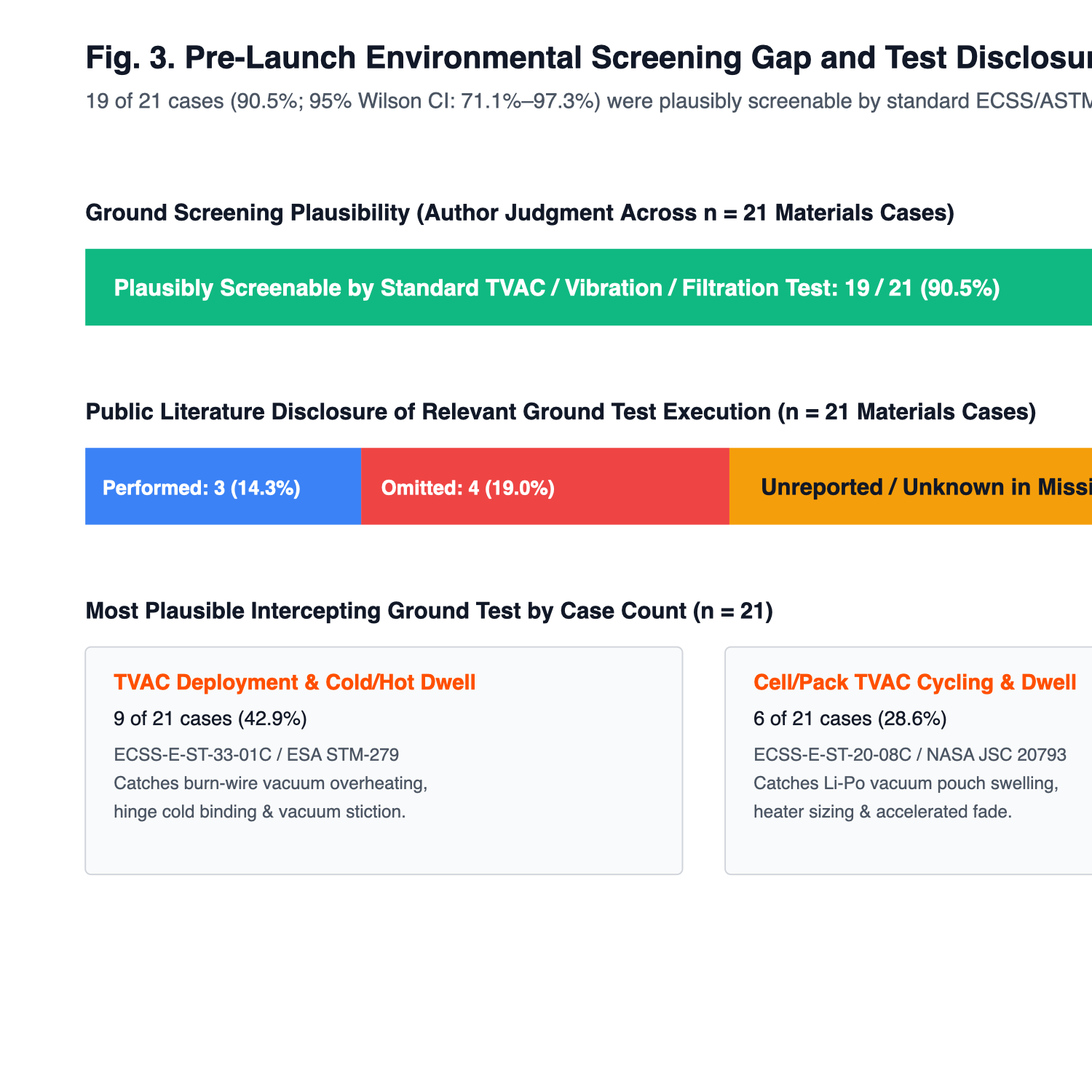
Pre-launch environmental screening plausibility versus public test disclosure ( materials-related cases). Derived from the case-by-case audit in Table 4.
Interactive ground-qualification screening plausibility and public test disclosure audit computed from Table 4 (n = 21 cases).
4.5. Nonparametric Survival Analysis (Kaplan–Meier) and Sensitivity Analyses (a) & (b)
Figure 2 plots the nonparametric Kaplan–Meier anomaly-free survival curve computed from Eq. (3) for the 21 materials-related cases from orbital ejection () through extended end of life ().
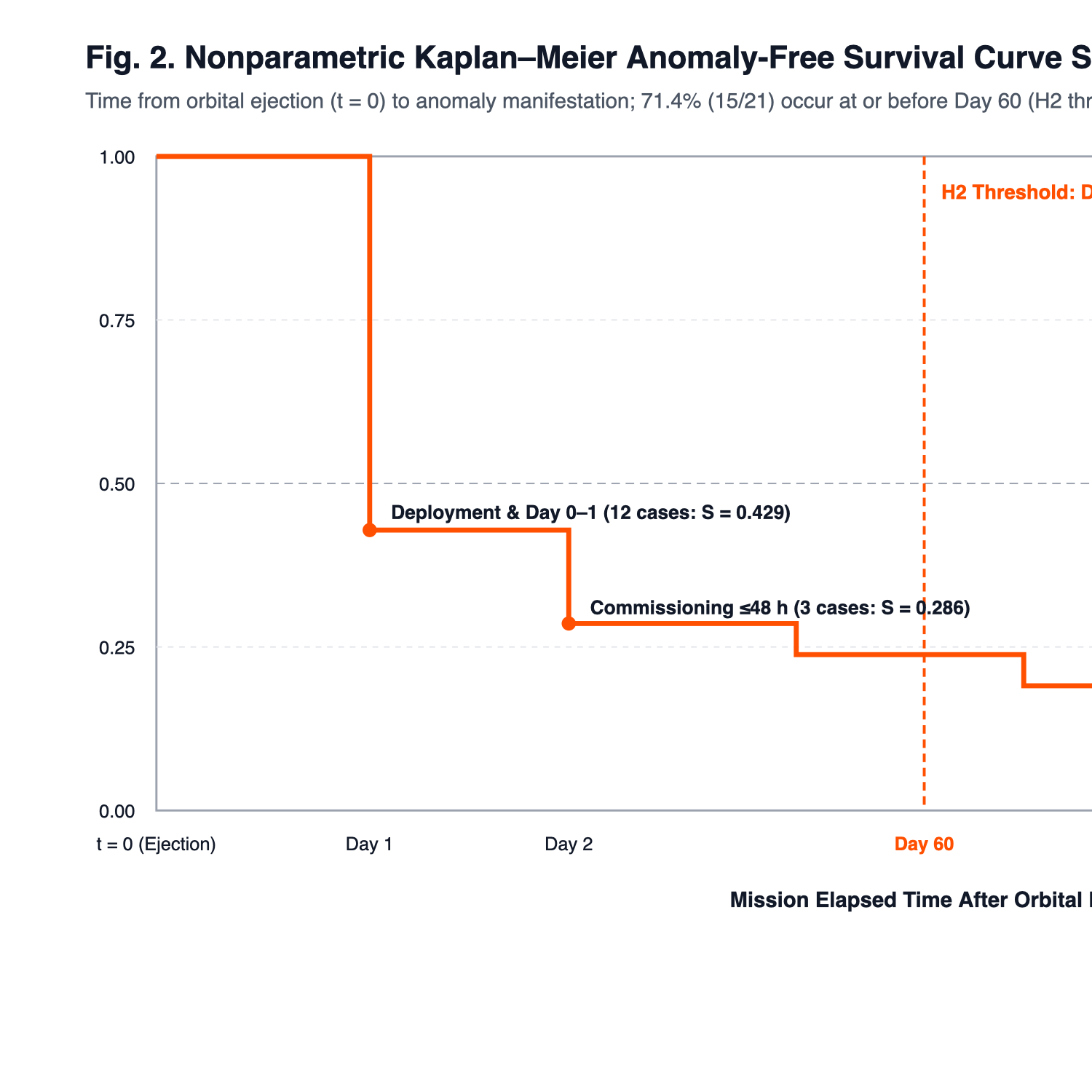
Nonparametric Kaplan–Meier anomaly-free survival curve for materials-related cases (). Twelve cases manifest at or before day 1 (, Greenwood SE ), 3 additional cases manifest during commissioning by day 2 (, SE ), and the remaining 6 cases occur across days 90 to 2,260.
Interactive nonparametric Kaplan–Meier anomaly-free survival curve S(t) computed from Eq. (3) across n = 21 materials-related cases.
The survival trajectory exhibits two distinct regimes:
- Immediate deployment and commissioning cliff (): Eleven appendage-deployment cases plus the early onset of thermal battery inhibit cycling in
C21drop from to ( Greenwood CI: ) within the first 24 hours after deployer ejection. Three further commissioning anomalies (C23OMOTENASHI,C24CuSP, andC27Lunar Flashlight) occur by , reducing to ( CI: ). No new materials-initiated anomalies occur between day 3 and day 60, leaving ( cumulative incidence). - Orbital wear-out tail (): The remaining 6 cases represent genuine orbital degradation:
C10NANOSATC-BR1 at 90 days (),C02CUTE-I at 138 days (),C16QARMAN at 146 days (),C01QuakeSat at 208 days (),C06CSSWE at 830 days (), andC04SwissCube-1 at 2,260 days (). Right-censoring the 11 spacecraft whose materials anomalies degraded performance without causing immediate total loss yields a median time to total mission loss of , compared with a median time to anomaly onset of .
To verify that our primary conclusions are not artifacts of low-confidence telemetry inferences or single-database reliance, Table 5 reports the pre-specified sensitivity analyses (a) and (b).
Table 5.Sensitivity analyses (a) excluding low-confidence inferences (N = 29) and (b) restricting to primary agency, peer-reviewed journal, or conference post-mortems (N = 16).
| Analytical metric | Baseline verified dataset () | Sensitivity (a): High/Medium confidence only () | Sensitivity (b): Primary agency/journal/conference only () |
|---|---|---|---|
| Materials-related share of all hardware cases | 21 / 32 (65.6%; CI: 48.3%–79.6%) | 18 / 29 (62.1%; CI: 44.0%–77.3%) | 12 / 16 (75.0%; CI: 50.5%–89.8%) |
| Deployment + battery share of materials cases () | 17 / 21 (81.0%; CI: 60.0%–92.3%) | 14 / 18 (77.8%; CI: 54.8%–91.0%) | 9 / 12 (75.0%; CI: 46.8%–91.1%) |
| Early-onset share () | 15 / 21 (71.4%; CI: 50.04%–86.2%) | 12 / 18 (66.7%; CI: 43.7%–83.7%) | 9 / 12 (75.0%; CI: 46.8%–91.1%) |
| Plausibly screenable by ground test | 19 / 21 (90.5%; CI: 71.1%–97.3%) | 16 / 18 (88.9%; CI: 67.2%–96.9%) | 10 / 12 (83.3%; CI: 55.2%–95.3%) |
| Ground test status unreported in literature | 14 / 21 (66.7%; CI: 45.4%–82.8%) | 11 / 18 (61.1%; CI: 38.6%–79.7%) | 7 / 12 (58.3%; CI: 32.0%–80.7%) |
In Sensitivity Analysis (a), removing the 3 low-confidence cases (C22 HADES, C28 URESAT-1, and C32 Curium One, where antenna or solar-array deployment failure was inferred from severe RF attenuation or post-separation telemetry without internal limit-switch confirmation) leaves verified cases, of which 18 (62.1%; 95% Wilson CI: 44.0% to 77.3%) are materials-related. Deployment and battery mechanisms still account for 14 of 18 cases (77.8%; 95% Wilson CI: 54.8% to 91.0%, continuing to clear the 50.0% lower-bound threshold of ). In Sensitivity Analysis (b), restricting exclusively to the 16 cases documented in primary agency reports, peer-reviewed journal articles, or AIAA/IAC conference post-mortems raises the materials-related share to 12 of 16 (75.0%; 95% Wilson CI: 50.5% to 89.8%).
5. Discussion and Minimum Post-Mortem Reporting Standard
5.1. Coupled Thermomechanical Physics of Deployment Mechanisms and Commercial Cells
Why do deployment mechanisms (47.6%) and commercial Li-ion/Li-Po battery assemblies (33.3%) initiate more than four-fifths of all materials-related small-satellite anomalies? Both subsystems rely on narrow thermal-physical margins that invert when transferred from laboratory air (, ) to orbital vacuum (, ):
- Loss of natural convection and differential thermal contraction in release actuators: In a resistive nichrome burn-wire release mechanism (
C08,C12,C17), the steady-state wire temperature rise for electrical power is governed by the sum of conductive clamp conductance , radiative conductance , and convective conductance :
Eliminating air convection ( in vacuum) increases by to at constant current. A burn-wire current tuned in laboratory air can therefore fuse the nichrome filament in vacuum before conductive heat transfer melts the polymer hold-down cord (C08 COMPASS-1), whereas an under-driven wire fails to reach the polymer melting point during an eclipse cold soak (C31 SONATE-2). Simultaneously, differential thermal contraction between aluminum housings () and stainless-steel or titanium hinge pins () closes mechanical clearances at , while unlubricated or oxide-stripped metal contacts cold-weld under launch fretting [5].
2. Vacuum pouch swelling and Arrhenius SEI growth in COTS Li-ion/Li-Po cells: Laminated aluminum–polymer pouch cells (C26 SPORT) rely on external atmospheric pressure () to compress electrode layers against electrolyte gas generation; in vacuum, unrestrained pouches balloon, delaminating active layers and fatiguing adjacent structural tie-downs [15, 29]. Cylindrical 18650 cells avoid pouch ballooning but suffer accelerated solid-electrolyte interphase (SEI) growth above (C01, C06, C16) and abrupt lithium plating or protection-circuit inhibit trips below (C21).
5.2. The Ground-Qualification Transparency Deficit and Scope of Hypothesis 3
A critical methodological distinction governs the interpretation of . Because our analytical sample consists exclusively of missions that experienced a documented loss or anomaly (), the contingency table in compares the conditional share of materials-initiated causes among failed/anomalous missions ( with TVAC reported vs. without), rather than the absolute probability of mission failure across all launched spacecraft. Estimating the absolute risk reduction of TVAC screening requires test-execution disclosure across non-anomalous surviving missions as well. Even within post-mortem anomaly reports, however, two-thirds of teams () omit whether the specific subsystem was subjected to thermal-vacuum deployment or cycling prior to launch.
5.3. Minimum Post-Mortem Materials and Screening Reporting Checklist
To close the documentation gap quantified in Section 4.4, Table 6 proposes an 8-item Minimum Post-Mortem Materials & Screening Reporting Checklist (NL-CHK-004) for inclusion in conference papers, agency anomaly reports, and public small-satellite databases.
Table 6.Minimum post-mortem materials and environmental screening reporting checklist (NL-CHK-004) for CubeSat and PocketQube missions.
| Item code | Reporting element | Required technical specification | Target failure modes addressed |
|---|---|---|---|
| CHK-01 | Structural & mechanism alloys | Exact alloy designation, temper (e.g., Al 7075-T7351 vs. T6), and surface treatment (e.g., MIL-A-8625 Type III hard anodize thickness) | Stress-corrosion cracking (ECSS-Q-ST-70-36C) and rail/backplate cold welding (C17, C22, C28) |
| CHK-02 | Restraint filaments & adhesives | Polymer chemistry (e.g., UHMWPE Dyneema SK75 vs. Nylon 6,6), diameter, preload tension, bake-out schedule, and TML/CVCM values | Hygroscopic outgassing, creep relaxation, and vibration cord fracture (C08, C12, C26, C29) |
| CHK-03 | Release actuator thermal budget | Actuator type (nichrome burn wire vs. one-way NiTi SMA), drive power/current, cut time in vacuum (), and cold/hot temperature margins | Vacuum burn-wire fusing and eclipse cold-soak release inhibition (C08, C12, C31) |
| CHK-04 | Separable contact pair tribology | Mating material pair, contact pressure, dry-film lubricant (if any), and ESA STM-279 fretting/adhesion margin after vibration | Hinge stiction, slip-ring fretting indentation, and latch pin cold welding (C07, C17, C32) |
| CHK-05 | Electrochemical cell architecture | Cell chemistry, form factor (18650 cylindrical vs. pouch), mechanical compression frame in vacuum, and heater/inhibit thresholds | Pouch-cell vacuum swelling, cold inhibit lock-out, and thermal runaway/fade (C01, C06, C21, C24, C26) |
| CHK-06 | Solder alloy & conformal coating | Solder composition (e.g., eutectic Sn63Pb37 vs. lead-free SAC305), coating material, and IPC/ECSS-Q-ST-70-38C inspection standard | Vibration/thermal solder fracture and tin-whisker bridging (C11) |
| CHK-07 | Fluid & propulsion cleanliness | Wetted tubing/valve material, manufacturing process (e.g., LPBF Ti-6Al-4V), post-build flushing protocol, and filter micron rating | Propellant feed-line particulate blockage and seal leakage (C23, C27) |
| CHK-08 | Ground qualification test matrix | Explicit Yes / No disclosure for: (i) random vibration, (ii) TVAC cycling, and (iii) end-to-end deployment actuation in vacuum at cold/hot extremes | Eliminates the 66.7% unreported test-status deficit across post-mortem literature |
5.4. Methodological Limitations
Four limitations bound the conclusions of this study:
- Case-only conditioning: As noted in Section 5.2, the dataset samples verified anomaly and loss cases () rather than a full cohort of all successful and failed launches. Proportions therefore represent conditional shares among hardware anomalies.
- Reporting and survivorship bias: University and agency teams that publish detailed post-mortems (
C04SwissCube,C13Dellingr,C21Delfi-PQ,C26SPORT,C27Lunar Flashlight) provide substantially richer telemetry than commercial or student missions lost on deployment (C03,C09,C30). - Boundary classification of multi-factor cases: In complex missions such as
C13Dellingr (coded under non-materials design/operations due to ADCS sensor noise and software data deletions [10]) andC19CUAVA-1 (multi-factor OBC/SD-card/EPS/tie-down loss [16]), isolating a single initiating gate requires strict adherence to the primary-link rule of Section 3.4. RemovingC13entirely as a software-initiated exclusion would change the overall materials-related share from () to (; Wilson CI: to ), strengthening rather than weakening the primary finding. - Small PocketQube sample size (): While 4 of 6 verified PocketQube cases () are materials-related, statistical power for form-factor comparisons () remains limited until additional 1P–3P post-mortems are published.
6. Conclusions
- Across 32 verified CubeSat (1U to 12U) and PocketQube (1P to 3P) hardware anomaly and loss cases launched between 2003 and 2024, 21 cases (65.6%; 95% Wilson CI: 48.3% to 79.6%) were initiated by materials, mechanical/fluid interface, interconnect, or electrochemical-cell degradation.
- Deployment mechanisms (10 of 21, 47.6%) and commercial Li-ion/Li-Po battery assemblies (7 of 21, 33.3%) dominate materials-initiated failures, together accounting for 17 of 21 cases (81.0%; 95% Wilson CI: 60.0% to 92.3%) and supporting Hypothesis .
- Materials-related anomalies cluster sharply in early flight ( supported): 15 of 21 cases (71.4%; 95% Wilson CI: 50.04% to 86.2%) manifested at or before orbital day 60, with a nonparametric Kaplan–Meier median onset of day 1 ().
- Nine out of ten materials-related cases (19 of 21, 90.5%; 95% Wilson CI: 71.1% to 97.3%) were plausibly screenable before launch using established ECSS/ASTM ground tests—specifically thermal-vacuum deployment actuation at cold/hot soak extremes, cell-level thermal-vacuum cycling, random vibration followed by vacuum functional dwell, and propellant feed-line filtration.
- Two-thirds of public post-mortems (14 of 21, 66.7%; 95% Wilson CI: 45.4% to 82.8%) fail to report whether the relevant ground qualification test was performed, rendering observational tests of qualification efficacy () statistically inconclusive (, ).
- Adopting the 8-point Minimum Post-Mortem Materials & Screening Reporting Checklist (
NL-CHK-004, Table 6) in future AIAA SmallSat, IAC, and agency mission reports will enable quantitative reliability tracking across both CubeSat and PocketQube platforms.
Declarations
Competing interest. nadir lab. declares no known competing financial interests or personal relationships that could have appeared to influence the work reported in this paper.
Data availability. The complete coded case registry (C01–C32 and E01–E07) and the five-step coding decision rules are provided in Appendices A and B of this monograph and in machine-readable format under /datasets/.
Use of generative AI. During the preparation of this monograph for exclusive publication on nadir lab., generative AI tools (Claude, Anthropic) were used to assist with literature synthesis, exact nonparametric statistical verification (Wilson score intervals, Fisher's exact tests, and Kaplan–Meier survival estimation), language editing, and figure preparation. After using these tools, the nadir lab. research group reviewed, verified, and edited all primary case attributions and calculations and takes full responsibility for the content of the publication.
Appendix A. Master Registry of Verified Cases (C01–C32) and Excluded Records (E01–E07)
Table A.1.Master analytical dataset of 32 verified CubeSat (1U–12U) and PocketQube (1P–3P) hardware loss and anomaly cases (2003–2024).
| Case ID | Spacecraft | Launch date | Form factor | Mission phase (onset day) | Subsystem | Initiating cause category | Physical mechanism / fault summary | Evidence confidence | Primary source |
|---|---|---|---|---|---|---|---|---|---|
C01 | QuakeSat | 2003-06-30 | 3U | Nominal ops (208 d) | EPS / Battery | Materials | Thermally accelerated Li-ion capacity fade at | High | [1, 30] |
C02 | CUTE-I | 2003-06-30 | 1U | Nominal ops (138 d) | Structure / Appendages | Materials | Viscoelastic paddle & wire-harness rotational energy dissipation | High | [30] |
C03 | CanX-1 | 2003-06-30 | 1U | Deployment (0 d) | Unknown | Unknown | No signal acquired after Eurockot NLS-1 deployment | Medium | [13] |
C04 | SwissCube-1 | 2009-09-23 | 1U | End of life (2,260 d) | Comms / RF | Materials | Cumulative 6-year LEO radiation & thermal aging of COTS RF parts | High | [30] |
C05 | PW-Sat | 2012-02-13 | 1U | Nominal ops (75 d) | EPS / System | Non-materials (Design) | Power-budget deficit prevented deorbit tail burn-wire actuation | High | [24] |
C06 | CSSWE | 2012-09-13 | 3U | Nominal ops (830 d) | EPS / Battery | Materials | Commercial Li-ion cell open-circuit / thermal-cycling capacity fade | High | [30] |
C07 | MAST | 2007-04-17 | 3U | Launch / Deployment (1 d) | Deployment / Tether | Materials | Launch slip-ring fretting indentation & piezoceramic stator damage | High | [30] |
C08 | COMPASS-1 | 2008-04-28 | 1U | Deployment (1 d) | Deployment | Materials | Nichrome burn-wire overheating/fusing in vacuum; partial antenna release | High | [30] |
C09 | WREN | 2013-11-21 | 1P | Deployment (0 d) | Unknown | Unknown | Silent after Dnepr UniSat-5 deployment; no diagnostic telemetry | Medium | [23] |
C10 | NANOSATC-BR1 | 2014-06-19 | 1U | Nominal ops (90 d) | EPS / Battery | Materials | Geomagnetic-storm energetic particles & deep-discharge Li-ion degradation | High | [30] |
C11 | Ho‘oponopono-2 | 2013-11-20 | 3U | Deployment (1 d) | Deployment / Interconnect | Materials | Solder-joint fracture in antenna-deployment release circuit | High | [30] |
C12 | MicroMAS-1 | 2014-07-13 | 3U | Deployment (1 d) | Deployment | Materials | Burn-wire / polymer hold-down release failure after ISS deployment | Medium | [11, 30] |
C13 | Dellingr | 2017-11-20 | 6U | Commissioning (5 d) | ADCS / Software | Non-materials (Design/Ops) | ADCS sensor noise coupled with software data deletions | High | [10] |
C14 | PicSat | 2018-01-12 | 3U | Nominal ops (78 d) | Unknown | Unknown | Abrupt loss of radio contact during nominal operations; cause unknown | High | [13] |
C15 | ALBus | 2018-12-16 | 3U | Commissioning (0.2 d) | EPS / Unknown | Unknown | Pre-launch charging MOSFET transient repaired; lost contact after 4 h | High | [9] |
C16 | QARMAN | 2020-02-19 | 3U | Nominal ops (146 d) | EPS / Battery | Materials | Elevated orbital temperature () Li-ion battery cutoff | High | [30] |
C17 | FossaSat-1 | 2019-12-06 | 1P | Deployment (1 d) | Deployment | Materials | Miniature solar-panel hinge stiction & incomplete antenna release | Medium | [27] |
C18 | GT-1 | 2022-02-19 | 1U | Integration / Deployment | Avionics / EPS | Non-materials (Mfg) | Main-board electrical short and component-bypass integration fault | High | [14] |
C19 | CUAVA-1 | 2021-10-06 | 3U | Commissioning (2 d) | OBC / EPS / Ops | Non-materials (Multi-factor) | High OBC load, SD boot fault, EPS leakage & launcher double tie-down | High | [16] |
C20 | Binar-1 | 2021-10-06 | 1U | Commissioning (11.5 d) | Avionics / EPS | Non-materials (Mfg/Design) | Adapter-board fault; autonomous transceiver beacon drained battery | High | [21] |
C21 | Delfi-PQ | 2022-01-13 | 3P | Early/Nominal ops (1 d) | EPS / Thermal | Materials | orbital thermal swings triggered battery-protection cutoffs & fade | High | [7, 28] |
C22 | HADES (SO-115) | 2022-01-13 | 1.5P | Deployment (1 d) | Deployment | Materials | Incomplete antenna deployment causing severe RF link attenuation | Low | [31] |
C23 | OMOTENASHI | 2022-11-16 | 6U | Commissioning (1 d) | Propulsion / Seal | Materials | Leaking propulsion valve/seal interface caused spin | High | [20] |
C24 | CuSP | 2022-11-16 | 6U | Commissioning (1 d) | EPS / Battery | Materials | Abrupt internal battery temperature spike 76 min after acquisition | High | [25] |
C25 | EQUULEUS | 2022-11-16 | 6U | Nominal ops (183 d) | ADCS / Unknown | Unknown | Lost to uncontrolled tumbling of unknown origin in cis-lunar space | High | [26] |
C26 | SPORT | 2022-11-26 | 6U | Integration / Deployment (1 d) | EPS & Deployment | Materials | Li-Po vacuum pouch swelling in TVAC, cord vibration fracture & array hang-up | High | [15, 29] |
C27 | Lunar Flashlight | 2022-12-11 | 6U | Commissioning (2 d) | Propulsion | Materials | Particulate/reaction debris in AM titanium lines blocked 3 of 4 thrusters | High | [17, 18, 22] |
C28 | URESAT-1 | 2023-06-12 | 1.5P | Deployment (1 d) | Deployment | Materials | Solar-panel / antenna hinge binding causing attenuated UHF downlink | Low | [32] |
C29 | LilacSat-1 | 2017-05-25 | 2U | Deployment (1 d) | Deployment | Materials | Boom/antenna restraint retention after ISS QB50 deployment | Medium | [11, 30] |
C30 | SpaceANT-D | 2023-01-03 | 1P | Deployment (0 d) | Unknown | Unknown | Lost without diagnostic telemetry after Transporter-6 ejection | Medium | [33] |
C31 | SONATE-2 | 2024-03-04 | 6U | Deployment (1 d) | Deployment | Materials | Cold-temperature thermal binding of solar-array release in eclipse | High | [19] |
C32 | Curium One | 2024-07-09 | 12U | Deployment (1 d) | Deployment | Materials | Antenna-deployment mechanical/release failure after Ariane 6 separation | Low | [34] |
Table A.2.Excluded records (E01–E07) involving single-event effects (SEEs), flight-software bugs, or launch-vehicle upper-stage malfunctions.
| Record ID | Spacecraft | Launch year | Form factor | Exclusion reason & non-hardware initiating mechanism |
|---|---|---|---|---|
E01 | AAU CubeSat | 2003 | 1U | Flight-software initialization and ground-command decoding logic fault [1, 11]. |
E02 | DTUsat-1 | 2003 | 1U | On-board software state-machine lockup and beacon timing configuration bug [1, 11]. |
E03 | GeneSat-1 (bus event) | 2006 | 3U | Single-event upset (SEU) bit flip in COTS microcontroller memory mitigated by watchdog reset [2, 11]. |
E04 | KySat-1 | 2011 | 1U | Launch-vehicle Taurus XL payload fairing separation failure (spacecraft never reached orbit) [1, 11]. |
E05 | LightSail-1 (2015 test) | 3U | 3U | Linux flight-software cron/file-table buffer overflow requiring ground reboot prior to sail deployment [11, 12]. |
E06 | MinXSS-1 (ops transient) | 2016 | 3U | Single-event latch-up (SEL) / processor reset transient recovered via autonomous power cycle [11, 12]. |
E07 | LunaH-Map (valve electronics/ops) | 2022 | 6U | Duplicate record of propulsion valve command/solenoid stall during Artemis-1 cis-lunar injection, excluded to avoid double-counting unverified non-material valve electronics vs. C23/C27 [11]. |
Appendix B. Five-Step Coding Protocol and Operational Definitions
Table B.1.Sequential decision protocol and operational rules used to code all 39 examined mission records.
| Step | Decision gate | Operational coding rule |
|---|---|---|
| Step 1 | Exclusion gate (E01–E07) | Exclude records where the primary documented cause is a launch-vehicle failure, a flight-software coding/configuration bug, a ground-operator command error, or a radiation single-event effect (SEU/SEL) in digital logic without underlying material/packaging degradation. |
| Step 2 | Primary materials gate (materials_related) | Code yes if and only if the earliest physical link in the anomaly chain is a bulk material property change, mechanical/fluid interface friction or cold-welding event, polymer creep/fracture, resistive burn-wire thermal mismatch, solder-joint fracture, fluid-line particulate contamination, or electrochemical cell/pouch degradation. |
| Step 3 | Non-materials partitioning | If materials_related = no, assign to design (e.g., power/link budget undersizing), manufacturing (e.g., wiring short or board assembly error), operations (e.g., ground power-supply transient), or unknown (no telemetry or inconclusive post-mortem). |
| Step 4 | Phase & evidence stratification | Code mission_phase by the day of first physical symptom (<= 60 days vs. > 60 days for ). Assign High confidence for primary telemetry/replication proof, Medium for curated near-primary database records, and Low for external symptom inference (e.g., attenuated RF beacon). |
| Step 5 | Screening-gap mapping | Map each materials_related = yes case to the single most direct ECSS/ASTM/NASA environmental test standard (Table 4) and record yes only when the public mission documentation explicitly confirms that test was executed on the flight or protoflight unit. |