Communications (COMMS)
Also known as COMMS, TT&C, Radio, RF
Carries telemetry, telecommands and payload data between spacecraft and ground. Small satellites span VHF and UHF amateur bands, S, X and Ka band and optical links; the link budget decides whether a link closes.
- Document
- SQ-SS-004
- Updated
- Reading time
- 8 min
In this tab
Definition
The communications subsystem consists of the radio or optical links that bring the state of the spacecraft (telemetry) down, take commands (telecommands) up and move payload data. Telemetry, tracking and command together are called TT&C. VHF and UHF are the most mature bands for small satellites; UHF, S, X and Ka are the bands commonly considered. Industry carries TT&C mostly in S band[1], whereas small satellites in amateur bands usually do it in UHF.
Choosing a band
Band selection trades data rate against complexity. In UHF, simple wide-beam antennas and cheap ground stations suffice, but channels are narrow and rates low. S and X band allow megabits to hundreds of megabits per second, at the price of directional antennas, attitude control towards Sun and ground, and spectrum licensing. Optical links can bring down orders of magnitude more data per pass than radio.
For a PocketQube the antenna alone decides much: a quarter-wave monopole at 437 MHz is 171 mm long, more than three times the edge of a 1P, so every UHF PocketQube depends on a deployable antenna[2].
Ground segment
Missions in amateur bands can be heard by , an open-source network of volunteer stations around the world; its database lists transmitter frequencies, modulations and observations of each satellite[3]. NASA missions may use the Near Space Network; others choose anything from their own stations to commercial pay-per-pass services. Existing constellations such as Globalstar and Iridium can relay data as well[1]. The ground segment entry covers stations, networks and operations.
Landmark demonstrations
The two MarCO spacecraft, the first interplanetary CubeSats, relayed InSight’s landing on Mars to Earth almost in real time[4]. Each 6U carried a UHF receiver for InSight’s 8 kbit/s transmission and a flat reflectarray high-gain X-band antenna that behaves like a parabolic dish[5].
On the optical side, the TBIRD payload of MIT Lincoln Laboratory and NASA, launched on Transporter-5 in May 2022, downlinked 4.8 TB without errors in a single pass of about five minutes at 200 Gbit/s in June 2023[6]. It flew on the 6U PTD-3 spacecraft[7].
The link equation
In free space, the power received over a distance between two antennas follows the Friis transmission formula[8]:
A link budget adds the same relation in decibels. The carrier-to-noise-density ratio and the energy per bit are
with free-space loss , the sum of pointing, polarization and propagation losses, Boltzmann’s constant and the data rate . The margin is the difference between the received and the value the modulation needs for the target bit error rate ().
Error rates
For non-coherent binary the bit error probability is ; for coherent BPSK it is [9]. Without forward error correction a frame is lost as soon as one bit is wrong, so frame loss collapses from almost all to almost none within a few decibels:
| Eb/N₀ (dB) | BER, coherent BPSK | BER, non-coherent 2-FSK | Frames lost, 2-FSK, 256 bytes |
|---|---|---|---|
| 8 | 1.9 × 10⁻⁴ | 2.1 × 10⁻² | 100% |
| 9 | 3.4 × 10⁻⁵ | 9.4 × 10⁻³ | 100% |
| 10 | 3.9 × 10⁻⁶ | 3.4 × 10⁻³ | 100% |
| 11 | 2.6 × 10⁻⁷ | 9.2 × 10⁻⁴ | 84.9% |
| 12 | 9.0 × 10⁻⁹ | 1.8 × 10⁻⁴ | 31.0% |
| 13 | 1.3 × 10⁻¹⁰ | 2.3 × 10⁻⁵ | 4.6% |
| 14 | < 10⁻¹² | 1.8 × 10⁻⁶ | 0.36% |
| 15 | < 10⁻¹² | 6.8 × 10⁻⁸ | 0.01% |
| 16 | < 10⁻¹² | 1.1 × 10⁻⁹ | < 0.01% |
Without forward error correction a frame is lost when any bit is wrong, so frame loss goes from almost none to almost all within about 3 dB.
Propagation losses
ITU-R P.618 gives the methods for gaseous absorption, cloud and rain attenuation and scintillation on Earth–space paths[10]. These dominate in X and Ka band. In UHF, ionospheric Faraday rotation fades linearly polarized links, which is one reason ground stations use circular polarization and accept the 3 dB mismatch with a linear spacecraft antenna.
Frequency bands
| Band | Range (MHz) | Quarter-wave monopole (mm) | Allocation |
|---|---|---|---|
| VHF | 145.8–146 | 514 | Amateur-satellite sub-band |
| UHF | 435–438 | 172 | Amateur-satellite sub-band |
| S | 2,200–2,290 | 33 | Space research and operation downlink |
| X | 8,025–8,400 | 9 | Earth exploration-satellite (EESS) downlink |
Amateur-satellite sub-bands require IARU coordination and non-commercial use; S and X band need ITU filings through a national administration.
Demonstrated data rates
| Band | Example | Notes |
|---|---|---|
| UHF | ≤ 9.6 kbit/s | Commercial UHF transceiver product |
| S | 15 Mbit/s | DVB-S2, 16APSK, LDPC 9/10 in a 5 MHz channel (NASA test) |
| X | up to ≈206 Mbit/s | X-band software-defined radio product data |
| Ka | above 100 Mbit/s | ISARA mission |
| Optical | 200 Gbit/s | TBIRD, 4.8 TB in one pass |
All rows except the optical one come from the communications chapter of the NASA report[1].
A flown example: Grizu-263A
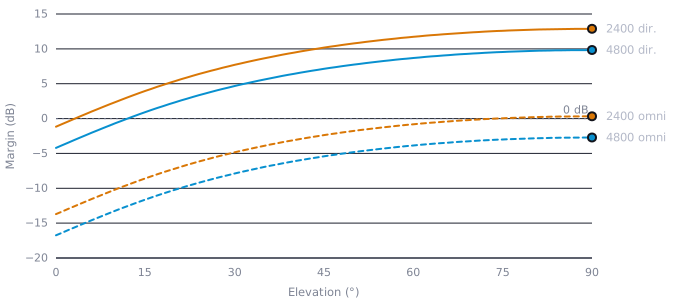
Grizu-263A transmitted 2-FSK at 4800 Bd on 437.190 MHz and at 2400 Bd on 435.675 MHz from a deployable quarter-wave monopole, with a coordinated of 20 dBm. Its budget against a directional and an omnidirectional amateur station reproduces Table 7 of the review[2]:
| Quantity | Directional, 4800 Bd | Directional, 2400 Bd | Omnidirectional, 4800 Bd | Omnidirectional, 2400 Bd |
|---|---|---|---|---|
| Frequency (MHz) | 437.190 | 435.675 | 437.190 | 435.675 |
| EIRP (dBW) | −10.0 | −10.0 | −10.0 | −10.0 |
| Free-space loss (dB) | 144.8 | 144.8 | 144.8 | 144.8 |
| Polarization, atmospheric and pointing losses (dB) | 4.5 | 4.5 | 4.5 | 4.5 |
| Ground-station G/T (dB/K) | −12.4 | −12.4 | −25.0 | −25.0 |
| C/N₀ (dB-Hz) | 56.8 | 56.9 | 44.3 | 44.3 |
| Data rate (dB-bit/s) | 36.8 | 33.8 | 36.8 | 33.8 |
| Eb/N₀ (dB) | 20.0 | 23.1 | 7.5 | 10.5 |
| Implementation loss (dB) | 2.0 | 2.0 | 2.0 | 2.0 |
| Required Eb/N₀ for BER 10⁻⁵ (dB) | 13.4 | 13.4 | 13.4 | 13.4 |
| Margin (dB) | +4.7(positive margin) | +7.7(positive margin) | −7.9(link does not close) | −4.8(link does not close) |
| Lowest elevation with positive margin | 13° | 4° | Never | 74° |
Directional station: 13 dBic crossed Yagi, 350 K. Omnidirectional station: 2 dBic, 500 K. Non-coherent 2-FSK. The values reproduce Table 7 of the review.
- Directional, 4800 Bd
- Directional, 2400 Bd
- Omnidirectional, 4800 Bd
- Omnidirectional, 2400 Bd
Show the data as a table
| Elevation (°) | Directional, 4800 Bd | Directional, 2400 Bd | Omnidirectional, 4800 Bd | Omnidirectional, 2400 Bd |
|---|---|---|---|---|
| 5 | −2.4 | 0.7 | −14.9 | −11.9 |
| 10 | −0.7 | 2.4 | −13.2 | −10.2 |
| 15 | 0.9 | 4.0 | −11.6 | −8.6 |
| 20 | 2.3 | 5.4 | −10.2 | −7.2 |
| 30 | 4.7 | 7.7 | −7.9 | −4.8 |
| 45 | 7.1 | 10.2 | −5.4 | −2.4 |
| 60 | 8.7 | 11.7 | −3.9 | −0.8 |
| 75 | 9.6 | 12.6 | −3.0 | 0.0 |
| 90 | 9.8 | 12.9 | −2.7 | 0.3 |
The dual-rate design traded throughput for accessibility: at 4800 Bd only directional stations above about 12° could decode, while the 2400 Bd mode opened the link to directional stations down to 3° and to omnidirectional ones near zenith. The UHF link budget article builds such a budget line by line.
Modulation, coding and antennas
AFSK, FSK and framed in and chirp spread spectrum are common in amateur bands. LoRa’s robustness at low signal levels made it popular for low-rate links, as on FossaSat-1, but and ionospheric scintillation must be accounted for[11][12]. Higher rates use BPSK, QPSK and APSK with CCSDS LDPC codes or DVB-S2[1]. Antennas range from tape-spring dipoles and monopoles, turnstiles and patches to arrays, deployable reflectors and reflectarrays. Deployables need power and a release mechanism, and are therefore a critical failure point after launch.
Power and duty cycle
The transmitter is the largest consumer of a small satellite. A 40%-efficient power amplifier draws about 1.25 W to radiate 0.5 W; a 1P with about half a watt of orbit-average power can only transmit at a duty cycle of a few per cent. The energy per bit links power and data: doubling the data rate costs 3 dB of margin, so the data volume per pass is proportional to the energy the power subsystem can give the transmitter[2].
Doppler and tracking
During a pass the carrier shifts by up to the values below, fastest at closest approach:
| Band | Frequency (MHz) | Largest shift (kHz) | Largest rate, overhead pass (Hz/s) | Largest rate, 30° pass (Hz/s) |
|---|---|---|---|---|
| VHF | 145.9 | ±3.4 | 49 | 27 |
| UHF | 437.2 | ±10.2 | 148 | 81 |
| L | 1,268 | ±29.7 | 430 | 236 |
| S | 2,250 | ±52.7 | 763 | 418 |
| X | 8,200 | ±192.0 | 2,780 | 1,523 |
Both scale with frequency: an S-band receiver tracks five times the Doppler of a UHF one. Earth rotation, neglected here, changes the values by a few per cent.
The receiver must either correct the shift from an orbit prediction or work with a wide enough capture range. Directional ground antennas also need current orbital elements and a rotator; the Doppler article gives the geometry.
Frequency coordination and licensing
Missions in amateur bands go through satellite frequency coordination and are limited to non-commercial purposes under the ITU Radio Regulations[13][14]; every mission is notified to the ITU through its national administration. The additional spectrum for telemetry, tracking and command of short-duration missions agreed at WRC-19 offers an alternative for non-amateur missions[2]. In the United States, any non-federal transmitter needs an FCC licence, and experimental licences are common for university CubeSats[1]. Coordination can take months and belongs at the start of the launch schedule.
Launch rules
The CubeSat Design Specification requires at least three independent RF inhibits against inadvertent transmission and does not count a timer as an independent inhibit. The spacecraft may not generate or transmit any signal for the first 45 minutes after release[15].
References
- [1]NASA Small Spacecraft Systems Virtual Institute. (2026). Communications. State-of-the-Art of Small Spacecraft Technology (2026 edition), Chapter 9. NASA Ames Research Center.nasa.gov(accessed 20 October 2026)
- [2]nadir lab. (2026). PocketQube-class picosatellites: architecture, flight heritage, and a multi-method post-flight analysis of Grizu-263A [Preprint]. nadir lab. Research Monographs (SQ-R-001).Read on nadir lab.
- [3]Libre Space Foundation. (2026). SatNOGS DB — satellite and transmitter database.db.satnogs.org(accessed 20 October 2026)
- [4]NASA Jet Propulsion Laboratory. (2019). The MarCO mission comes to an end.jpl.nasa.gov
- [5]NASA Jet Propulsion Laboratory. (2018). InSight landing press kit: Mars Cube One (MarCO).jpl.nasa.gov
- [6]MIT Lincoln Laboratory. (2024). NASA's record-breaking laser demo completes mission.ll.mit.edu
- [7]Krebs, G. D. (2026). PTD 3. Gunter’s Space Page.space.skyrocket.de(accessed 20 October 2026)
- [8]Friis, H. T. (1946). A note on a simple transmission formula. Proceedings of the IRE, 34(5), 254–256.doi:10.1109/JRPROC.1946.234568
- [9]Proakis, J. G., & Salehi, M. (2008). Digital Communications (5th ed.). McGraw-Hill.
- [10]ITU-R. (2023). Recommendation P.618: Propagation data and prediction methods required for the design of Earth-space telecommunication systems. International Telecommunication Union.itu.int
- [11]Doroshkin, A. A., Zadorozhny, A. M., Kus, O. N., Prokopyev, V. Y., & Prokopyev, Y. M. (2019). Experimental study of LoRa modulation immunity to Doppler effect in CubeSat radio communications. IEEE Access, 7, 75721–75731.doi:10.1109/ACCESS.2019.2919274
- [12]Fernandez, L., Ruiz-De-Azua, J. A., Calveras, A., & Camps, A. (2020). Assessing LoRa for satellite-to-Earth communications considering the impact of ionospheric scintillation. IEEE Access, 8, 165570–165582.doi:10.1109/ACCESS.2020.3022433
- [13]International Amateur Radio Union. (2026). Amateur satellite frequency coordination.iaru.org(accessed 20 October 2026)
- [14]International Telecommunication Union. (2020). Radio Regulations, Edition of 2020. ITU.
- [15]The CubeSat Program, Cal Poly SLO. (2022). CubeSat Design Specification, Rev. 14.1 (CP-CDS-R14.1). California Polytechnic State University.nasa.gov
Cite this SatWiki entry
@misc{nadirlab2026comms,
  author       = {{nadir lab.}},
  title        = {{Communications (COMMS)}},
  year         = {2026},
  month        = oct,
  howpublished = {nadir lab. SatWiki SQ-SS-004 (Rev. 3)},
  url          = {https://nadirlab.space/wiki/comms/}
}
nadir lab. (2026). Communications (COMMS). nadir lab. SatWiki (SQ-SS-004, Rev. 3). https://nadirlab.space/wiki/comms/
TY  - ENCYC
AU  - nadir lab.
TI  - Communications (COMMS)
T2  - nadir lab. SatWiki
PY  - 2026
ET  - Rev. 3
C1  - SQ-SS-004
UR  - https://nadirlab.space/wiki/comms/
ER  -