PocketQube picosatellites: A review of standards, mission trends and miniaturization constraints, with lessons learned from Grizu-263A, Türkiye’s first PocketQube
- Research group
- nadir lab.
- Published
- 20 October 2026
- Version
- nadir lab. Monograph REV 0.1, 20 October 2026
- Identifier
- SQ-R-001
- Reading time
- 57 min
- Licence
- CC BY-NC-ND 4.0
At a glance
- PocketQubes launched in 2013–2023, census in Appendix A
- 77
- of all units lost or degraded in the launch segment
- 17%
- orbit-average power of a fully loaded 1P, against 2.39 W for a 1U
- 0.55 W
- Grizu-263A in orbit, against a pre-launch expectation of about four years
- 628 days
Highlights
- Census of the 77 PocketQubes launched in 2013–2023, including routes to orbit
- Launch-segment anomalies lost or degraded 17% of all PocketQubes launched
- A fully loaded 1P has ∼1/4 the power and ∼1/2 the orbital life of a 1U CubeSat
- Solar activity largely explains Grizu-263A’s 21-month life vs. 4-year forecast
- In a 1P, magnet-to-rod coupling is a key constraint for passive magnetic control
Abstract
PocketQubes—modular picosatellites built from 50 mm cubic units with a mass of at most 250 g per unit—are the smallest standardized satellite class that reaches orbit routinely. This review traces the evolution of the PocketQube standard, compiles a census of the 77 PocketQubes launched between 2013 and 2023, and quantifies how miniaturization constrains power, thermal control, attitude control, communications and orbital lifetime. The census shows that 49% of all units flew in 2022, that orbital transfer vehicles carried every PocketQube launched in 2023, and that launch-segment anomalies lost or degraded 17% of all units. First-order scaling relations indicate that a fully loaded 1P unit offers about one quarter of the body-mounted power of a 1U CubeSat at maximum mass, about half its thermal time constant and roughly half its orbital lifetime at a given altitude. A case study of Grizu-263A, Türkiye’s first PocketQube, which was launched into a 525 km Sun-synchronous orbit in January 2022 and operated until its re-entry on 3 October 2023, complements the review. A simple drag model driven by the observed solar flux reproduces the 21-month lifetime to within 7–36% using a priori parameters, whereas a constant flux of 100 solar flux units yields 3.4–4.4 years, consistent with the pre-launch expectation of about four years. Analyses of the passive magnetic attitude control system and the UHF downlink show that magnet-to-rod coupling and transmitter power set the design margins of 1P missions. Priorities for micro-propulsion, standardized avionics and distributed PocketQube systems are identified.
- PocketQube
- Picosatellite
- Passive magnetic attitude control
- Orbital lifetime
- SatNOGS
- Grizu-263A
Abbreviations (21)
- ADCS
- attitude determination and control system
- AIT
- assembly, integration and test
- COTS
- commercial off-the-shelf
- EIRP
- equivalent isotropically radiated power
- EPS
- electrical power subsystem
- FSK
- frequency-shift keying
- GSD
- ground sampling distance
- IARU
- International Amateur Radio Union
- IMU
- inertial measurement unit
- IoT
- Internet of Things
- LEO
- low Earth orbit
- MTQ
- magnetorquer
- OBC
- on-board computer
- OTV
- orbital transfer vehicle
- PMAC
- passive magnetic attitude control
- RCS
- radar cross-section
- SLR
- satellite laser ranging
- SSO
- Sun-synchronous orbit
- TLE
- two-line element set
- TVAC
- thermal vacuum
- UHF
- ultra-high frequency
Contents
Full text
1. Introduction#
Over the past two decades, the miniaturization of spacecraft electronics and the growth of rideshare launch opportunities have transformed access to space [1]. The CubeSat standard, proposed in 1999 around a 10 cm cubic unit and a standardized deployer interface [2, 3], has been central to this transformation: it decoupled payload development from launcher integration, made the use of commercial off-the-shelf (COTS) components routine and created a global supply chain [4, 5]. As the CubeSat market matured, however, missions migrated towards larger form factors, higher reliability requirements and integrated commercial platforms [4, 5]. For universities and small teams the cost of entry did not decrease accordingly, while the high infant mortality of early CubeSats showed that rapid, low-cost development carries its own risks [6, 7].
The PocketQube concept, introduced by Twiggs in 2009 [8], addresses this gap by defining an even smaller modular unit: a 50 mm cube with a mass of at most 250 g, i.e. one eighth of the volume of a 1U CubeSat [9]. Since the first four PocketQubes were deployed in 2013 [10], the class has evolved from an educational experiment into a platform used by universities, amateur-radio groups and companies operating small fleets [11–13]. Four studies frame the field. Speretta et al. [14] discussed the opportunities and challenges of moving from CubeSats to PocketQubes; Bouwmeester et al. [11] quantified the utility and constraints of the class; Franzese [12] surveyed missions and technologies and identified propulsion as the main enabling technology for future missions; and Idriss and Ismail [13] analyzed mission trends with an emphasis on attitude determination and control systems (ADCS).
Three gaps nevertheless remain. First, existing surveys concentrate on missions and technologies; how PocketQubes reach orbit, and how often the launch segment rather than the spacecraft determines the outcome of a mission, have received less attention. Second, the engineering consequences of miniaturization are usually discussed subsystem by subsystem, without a common set of scaling relations that would allow power, thermal, drag and magnetic penalties to be compared consistently. Third, few end-to-end flight case studies combine design data with an independent check against an observable on-orbit outcome, such as the orbital lifetime.
This review addresses these gaps. Its contributions are:
- (i) a census of the 77 PocketQubes launched between 2013 and 2023, including form factor, operator, deployment route and launch-segment outcome (Section 3 and Appendix A);
- (ii) a consistent set of first-order scaling relations, evaluated for 1P–3P PocketQubes and 1U/3U CubeSats, covering power, thermal response, orbital lifetime, trackability, drag make-up requirements and the magnetic coupling that is specific to passive magnetic attitude control (PMAC) in very small volumes (Section 4);
- (iii) a case study of Grizu-263A, Türkiye’s first PocketQube, covering its architecture, PMAC design, UHF link, assembly, integration and test (AIT), operations, and a model-based reconstruction of its orbital decay that is checked against the observed re-entry date (Section 5); and
- (iv) a synthesis of open challenges and research directions (Section 6).
Methodologically, the review combines a narrative synthesis of peer-reviewed literature, standards and mission documentation with a census compiled from public satellite catalogues and with transparent first-order analyses. All web sources were accessed on 20 October 2026. The analyses are deliberately simple: their purpose is to expose scaling trends and design sensitivities, not to replace mission-specific tools, and every assumption is stated where it is used.
2. The PocketQube class and its standardization#
2.1. Origins and first flights#
The PocketQube was proposed by Robert J. Twiggs at the 2009 CubeSat Developers’ Workshop [8], building on a collaboration between Morehead State University and Kentucky Space [9]. The aim was to reduce development and launch costs further by shrinking the unit to 50 mm and by simplifying the launcher–payload interface. The first PocketQubes flew on 21 November 2013 on a Dnepr launcher: GAUSS Srl’s UniSat-5 microsatellite carried the Morehead–Rome FemtoSat Orbital Deployer (MRFOD), which ejected four PocketQubes—$50SAT (Eagle-2), Beakersat-1 (also referred to as T-LogoQube), QubeScout-S1 and WREN [10, 15]. The 1.5P $50SAT, developed by Morehead State University with three radio amateurs from parts costing less than US$250, became emblematic of the low-cost philosophy of the class [16]. These first PocketQubes, flying near 600 km, were tracked successfully, with two-line element sets (TLEs) updated several times per day [11]. No PocketQube was launched during the following six years. The class re-emerged in December 2019, when six PocketQubes were deployed from Alba Orbital’s AlbaPod on a Rocket Lab Electron [11, 17].
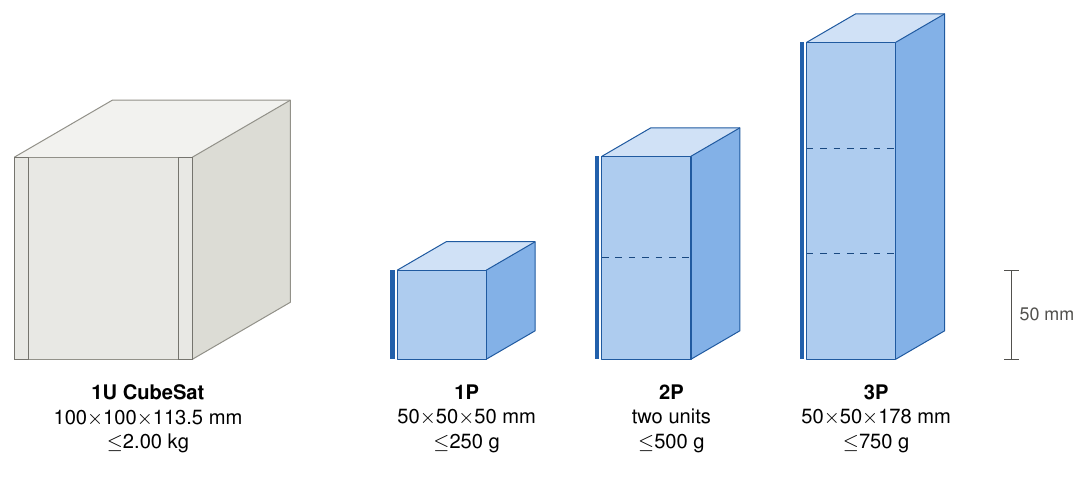
CubeSat and PocketQube form factors drawn to scale, with the maximum mass allowed by the respective standards [9, 21]. The dark strip on each PocketQube indicates the sliding backplate that engages the deployer; the 2P length is indicative.
2.2. The PocketQube Standard and interface standards#
Early PocketQubes relied on deployer-specific interfaces. In July 2018, Alba Orbital, Delft University of Technology (TU Delft) and GAUSS Srl jointly released Issue 1 of the PocketQube Standard [9, 18]. The standard addresses the mechanical interface (Table 1, Fig. 1): the external envelope of a 1P unit is a 50 mm cube, multi-unit spacecraft are elongated along one axis (a 3P measures 50 × 50 × 178 mm [18]), and the spacecraft is retained in the deployer by a sliding backplate (58 × 64 × 1.6 mm for a 1P [18]) instead of the four rails used by CubeSats. The mass is limited to 250 g per unit [9]. Later issues were intended to add electrical, testing and operational requirements [18]; in practice, these requirements are still set largely by individual deployer providers and launch brokers.
At subsystem level, TU Delft proposed the PQ9 and CS14 electrical and mechanical interface standards for PocketQubes and CubeSats [19]. PQ9 replaces the PC/104 heritage of CubeSat avionics with a leaner bus based on RS-485 data communication and a small number of unregulated power lines, trading some design flexibility for savings in volume, power, cost and integration time [19]. It was adopted on Delfi-PQ [18, 20].
Table 1.Interface-level comparison of a 1U CubeSat and a 1P PocketQube.
| Attribute | 1U CubeSat | 1P PocketQube |
|---|---|---|
| Governing document | CubeSat Design Specification, Rev. 14.1 [21] | PocketQube Standard, Issue 1 (2018) [9] |
| External envelope | 100 × 100 × 113.5 mm | 50 × 50 × 50 mm |
| Volume / external surface | 1135 cm³ / 654 cm² | 125 cm³ / 150 cm² |
| Maximum mass per unit | 2.00 kg | 0.25 kg |
| Maximum bulk density | 1.76 g cm⁻³ | 2.00 g cm⁻³ |
| Deployer interface | Four rails (e.g. P-POD [3]) | Sliding backplate (MRFOD, AlbaPod, PicoBus) [10, 17, 22] |
| Avionics interconnect | PC/104-derived stacks (de facto) | PQ9/CS14 proposed [19]; otherwise vendor-specific |
2.3. Ecosystem#
The ecosystem around the standard consists of deployer providers and launch brokers (Alba Orbital’s AlbaPod, the Libre Space Foundation’s PicoBus, GAUSS, Fossa Systems), open hardware and software, and community ground segments. At the 2018 PocketQube Workshop in Delft, launch prices were about 20 k€ per 1P unit (about 80 k€ kg⁻¹ net), and a future target of 10 k€ per unit was considered feasible [11]. Open designs lowered the entry barrier further: FossaSat-1 published its hardware and software [23], and the IEEE Geoscience and Remote Sensing Society (GRSS) Open PocketQube Kit, developed at the UPC NanoSat Lab, provides a complete 1P design—power, on-board computer, communications and ADCS boards—together with example payloads such as a VGA camera and L- and K-band radio-frequency-interference monitors [24, 25]. On the ground, the SatNOGS network of open-source stations [26], open demodulators such as gr-satellites [27] and declarative telemetry decoders written in Kaitai Struct [28] allow anyone to receive and decode PocketQube telemetry. Satellite catalogues such as the Nanosats Database [29] and Gunter’s Space Page [15] track the population.
3. Mission landscape, 2013–2023#
3.1. Census construction#
The census was compiled from the PocketQube list maintained on Gunter’s Space Page [15], which records form factor, operator, launch date, launch vehicle and, where applicable, the deployment platform. It includes every orbital launch attempt of a PocketQube-class spacecraft listed there for 2013–2023 (1P to 6P, including 1.5P and 2.5P variants); suborbital flights and TinySat-type units deployed from CubeSat rails were excluded. The outcome of each launch was cross-checked against independent reports for the two Firefly Alpha flights [22, 30] and against operator information for Grizu-263A [31]. The unit of analysis is the individual spacecraft rather than the mission: a batch of identical satellites counts once per unit. The resulting list of 77 spacecraft and 12 launch events is reproduced in Appendix A.
The census was cross-checked against the mission-level dataset of Idriss and Ismail [13], who analyzed 52 missions comprising 80 satellites launched in 2013–2024. The annual totals agree exactly for every year from 2013 to 2023 (4, 6, 9, 38 and 20 units in 2013, 2019, 2021, 2022 and 2023, respectively); the three additional satellites in their dataset are attributed to 2024. Public catalogues were not yet mutually consistent for 2024–2026 at the time of writing, so later launches—for example POQUITO and two AMSAT-EA/Hydra units on Transporter-12 (January 2025) [15, 32], three Unicorn-2 units on Transporter-13 (March 2025) and two on Transporter-16 (March 2026) [15, 17]—are discussed but not tallied.
3.2. Temporal trends, form factors and operators#
Launch activity has been highly uneven (Fig. 2a). After the first deployment in 2013, no PocketQube was launched until 2019; activity then increased sharply and peaked in 2022, when 38 units—49% of the 2013–2023 total—were launched, 21 of them on a single Falcon 9 rideshare (Transporter-3). By unit count, the population is dominated by 1P (32%), 2P (30%) and 3P (22%) spacecraft, followed by 1.5P (12%), 2.5P (3%) and a single 6P (1%). Two commercial operators account for 39% of all units: Fossa Systems (17 units, mostly the 2P FossaSat-2E series) and Alba Orbital (13 units of the Unicorn family). This concentration explains an apparent contradiction in the literature. Franzese [12] reported 2P and 3P as the most common form factors, whereas Idriss and Ismail [13] found that 51% of missions used the 1P format: the former statistic is weighted by batch deployments, the latter by distinct mission designs. At mission level, Idriss and Ismail [13] also report that private organizations form the largest developer group (19 developers), followed by universities (17), amateur groups (10), other organizations (4) and one space agency. The mass of launched PocketQubes ranges from about 125 g to 850 g, and no PocketQube has yet flown beyond low Earth orbit (LEO) [12].
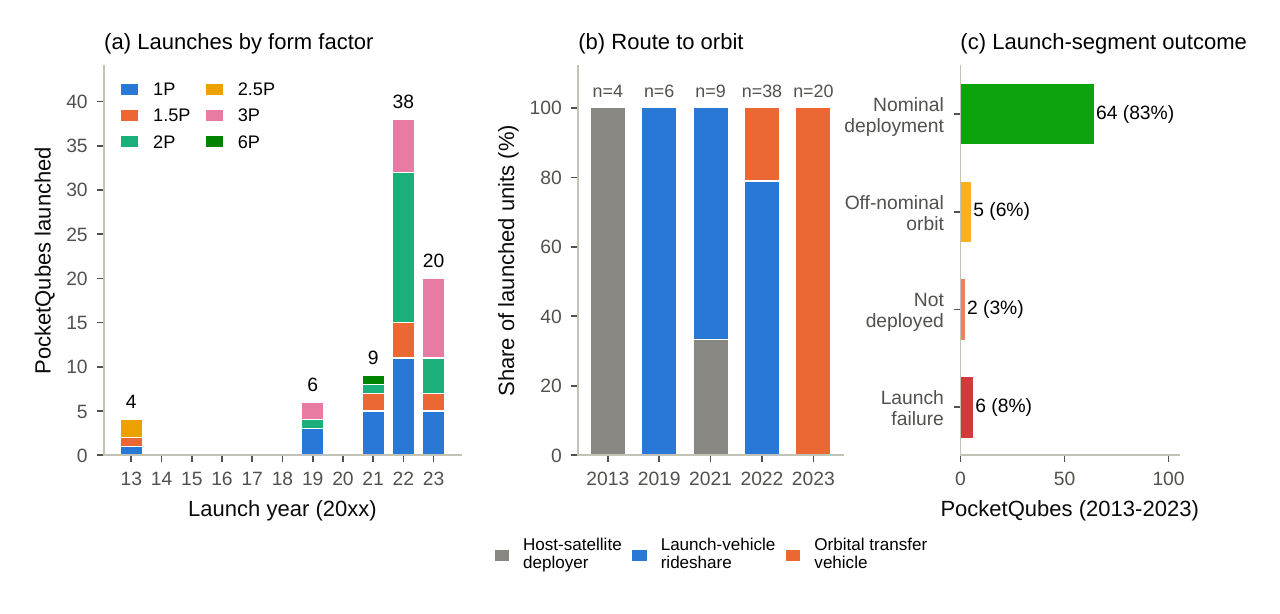
Census of the 77 PocketQubes launched in 2013–2023 (data in Appendix A). (a) Units launched per year by form factor. (b) Route to orbit per launch year: deployment from a host satellite (UniSat-5, UniSat-7), direct deployment from the launch vehicle, or deployment from an orbital transfer vehicle (OTV). (c) Outcome of the launch segment. Compiled from [15], with launch outcomes cross-checked against [22, 30].
3.3. Routes to orbit and launch-segment outcomes#
How PocketQubes reach orbit has changed markedly (Fig. 2b). The first wave (2013) and the UniSat-7 mission (2021) used deployers mounted on a host microsatellite; the 2019–2022 launches relied mainly on deployers carried directly by the launch vehicle; and from 2022 onwards OTVs—the D-Orbit ION satellite carrier and, once, Launcher’s Orbiter—became the dominant route, carrying all 20 PocketQubes launched in 2023 [15]. Overall, 7 units (9%) were deployed from host satellites, 42 (55%) directly from launch vehicles and 28 (36%) from OTVs.
The launch segment proved to be a major source of mission loss (Fig. 2c). Six units were lost in the failure of the first Firefly Alpha flight in September 2021, after one first-stage engine shut down prematurely [22]. On the second Alpha flight (1 October 2022), five PocketQubes carried in the Libre Space Foundation’s PicoBus deployer were released into an orbit of about 220 × 275 km instead of the planned 300 km circular orbit and re-entered within days [30]. Two Unicorn-2 units were not deployed after an anomaly of the Orbiter transfer vehicle on Transporter-6 in January 2023 [15]. In total, 13 of 77 units (17%) were lost or severely degraded before nominal operations could begin. This fraction reflects the reliance of PocketQube developers on maiden and early flights of new launchers and transfer vehicles, which offer cheap and frequent access but carry higher launch-segment risk; the difficulty of insuring pico-satellites compounds the exposure [33]. For developers, it argues for ground-segment and operations plans that tolerate launch slips and for an explicit treatment of launch risk in programme planning.
3.4. Mission types and technology milestones#
Table 2 lists representative missions. Technology demonstration dominates, often combined with amateur-radio services or education. Within this envelope, PocketQubes have demonstrated spectrum monitoring (SMOG-P) [34], low-power LoRa links (FossaSat-1) [23], satellite laser ranging with cube-corner retroreflectors (STECCO) [35], three-axis attitude control with reaction wheels and Earth imaging, specified at about 24 m ground sampling distance (GSD) with scenes of up to 62 × 48 km (Unicorn-2) [17], and the first PocketQube-to-ChipSat visible-light link (POQUITO) [33]. Commercial operators have used batch deployments to build early fleets, a first step towards the distributed systems discussed in Section 6.
Table 2.Representative PocketQube missions and the technology milestones they illustrate (launch year and vehicle as recorded in [15] unless stated otherwise).
| Mission | Size | Developer | Launch | Notable features | Refs. |
|---|---|---|---|---|---|
| $50SAT (Eagle-2) | 1.5P | Morehead State Univ. and radio amateurs | 2013, Dnepr (UniSat-5) | Low-cost amateur-radio demonstrator from the first PocketQube deployment | [10, 16] |
| SMOG-P | 1P | Budapest Univ. of Technology and Economics | 2019, Electron | Spectrum analyzer mapping man-made electromagnetic emissions, including the DVB-T band | [34] |
| FossaSat-1 | 1P | Fossa Systems | 2019, Electron | Open-source design; LoRa (SX1278) and RTTY transmissions in the 435–438 MHz amateur band | [23] |
| NOOR 1A/1B | 3P | Stara Space (Unicorn-2 platform) | 2019, Electron | First flights of the Unicorn-2 3P platform | [17] |
| STECCO | 6P, 850 g | Sapienza Univ. of Rome | 2021, Soyuz (UniSat-7) | First PocketQube with cube-corner reflectors for satellite laser ranging; viscous damper for gravity-gradient stabilization | [35] |
| GENESIS series | 1.5P | AMSAT-EA | 2021–2022, Alpha | Intended to demonstrate a miniature pulsed-plasma thruster; affected by both Alpha anomalies | [15, 22] |
| Delfi-PQ | 3P, ≈600 g | TU Delft | 2022, Falcon 9 (T-3) | PQ9 bus; three magnetorquers and two IMUs; ≈1 W orbit-average power; MEMS resistojet planned for partial demonstration | [18, 20] |
| Grizu-263A | 1P, 237 g | Zonguldak Bülent Ecevit Univ. | 2022, Falcon 9 (T-3) | Passive magnetic attitude control; dual-rate UHF FSK; digipeater; 21 months in orbit | [31, 36], Section 5 |
| SATLLA-2A/2B | 2P | Ariel Univ. | 2022, Falcon 9 (T-3) | Educational mission built with secondary-school students; LEDs visible to ground telescopes; low-resolution imaging | [37] |
| FossaSat-2E1–2E13 | 2P | Fossa Systems | 2022, Falcon 9 (T-3, T-5) | Largest single-operator batch (13 units), including WISeSAT units for WISeKey | [15] |
| Unicorn-2 series | 3P | Alba Orbital | 2022–2026, Electron and Falcon 9 | Three-axis ADCS (sun sensors, light-dependent resistors, reaction wheels, magnetometer, magnetorquers; ≈5° worst case); ≈24 m GSD imaging | [17, 38] |
| Istanbul | 1P | Hello Space | 2023, Falcon 9 (T-8), ION OTV | Commercial 1P deployed from an OTV; second PocketQube from Türkiye | [15] |
| POQUITO | 1P, 185 g | Univ. of Luxembourg | 2025, Falcon 9 (T-12), AlbaPod | Hosts an independent ChipSat with a visible-light link; magnetorquers printed in inner PCB layers; detumbling from 20° s⁻¹ within one orbit | [32, 33] |
4. Engineering consequences of miniaturization#
Scaling a CubeSat design down to the PocketQube envelope is not sufficient: the reductions in size, weight and power require new components, different design margins and, often, iterative development [11, 14]. This section quantifies the main effects with first-order relations that are evaluated consistently for 1P–3P PocketQubes and 1U/3U CubeSats at the maximum mass allowed by their standards (Table 4). The relations are intended for trend analysis and preliminary sizing; mission-specific design requires detailed models.
4.1. Geometric basis#
For a spacecraft of characteristic size and fixed bulk density, the volume scales as and the external surface area as , so that quantities driven by surface-to-mass ratios scale as . The two standards set similar maximum bulk densities—2.00 g cm⁻³ for a 1P and 1.76 g cm⁻³ for a 1U (Table 1)—so a fully loaded 1P has 1.8 times the specific surface of a fully loaded 1U (0.60 versus 0.33 cm² g⁻¹). PocketQubes are therefore surface-rich and volume-poor: the per-kilogram resources collected through the surface (sunlight, radiative cooling, aerodynamic drag) are favourable or adverse in proportion, while the absolute resources available for any single function are small.
4.2. Electrical power#
For body-mounted solar cells on a randomly tumbling convex spacecraft, the mean projected area is (Cauchy’s theorem), and the orbit-average power is
where W m⁻² is the solar constant, the cell efficiency, the cell packing factor and the eclipse fraction. With (triple-junction cells), and (a 525 km Sun-synchronous orbit (SSO), whose longest eclipse lasts about 36 min of a 95 min period), Eq. (1) gives 0.55 W for a 1P, 1.49 W for a 3P and 2.39 W for a 1U (Table 4). The ratio of about one quarter between 1P and 1U matches the scaling reported by Bouwmeester et al. [11], and the 3P estimate is consistent with the ≈1 W orbit-average power of Delfi-PQ [20], which carries cells on its long faces only. Per kilogram, a 1P actually collects more power than a 1U (2.2 versus 1.2 W kg⁻¹); the binding constraint is the absolute power available for a single consumer such as a transmitter power amplifier, whose consumption does not shrink with the spacecraft. Deployable, Sun-pointed arrays can raise the orbit-average power of a 3P beyond 10 W [11], but they require attitude control and stowage volume that are themselves scarce at this scale.
4.3. Thermal response#
Linearizing radiative exchange around a reference temperature gives a lumped thermal time constant
with specific heat , emissivity and Stefan–Boltzmann constant . With J kg⁻¹ K⁻¹, and K, a fully loaded 1P has min, compared with 104 min for a 1U (Table 4). In a 525 km SSO the longest eclipse therefore corresponds to for a 1P but only for a 1U: the PocketQube follows the orbital forcing more closely and experiences larger temperature excursions, while concentrated dissipation (for instance in a transmitter amplifier on a 50 × 50 mm board) creates local hot spots. Passive thermal control is usually sufficient to keep electronics within their operating ranges, but active cooling of instruments is very difficult and missions beyond Earth orbit are particularly challenging because of the high ratio of external surface to internal heat capacity [11, 39]. Qualification campaigns accordingly include thermal cycling; the thermal-vacuum test profile of Delfi-PQ, for example, specified four cycles between −20 and +50 °C [18].
4.4. Attitude determination and control#
ADCS is the subsystem in which the size, weight and power constraints of PocketQubes bite hardest, and the one for which COTS components and peer-reviewed design data are scarcest [13]. Table 3 summarizes the approaches flown to date. Magnetorquers are the only practical actuators for detumbling and momentum dumping at this scale [11]. Delfi-PQ combines three custom magnetorquers with two COTS IMUs and was designed to detumble from up to 180° s⁻¹ to 5° s⁻¹ [11, 18]; POQUITO integrated its magnetorquers into the inner layers of its stack and side-panel printed circuit boards, saving volume and mass, and detumbled from 20° s⁻¹ within one orbital period [33]. Three-axis control with reaction wheels has flown on the Unicorn-2 platform, which is specified for a worst-case pointing accuracy of about 5° [17, 38], while a 7 g reaction wheel with 25 mW steady-state consumption was developed at TU Delft [11]. At the low end, most 1P and 1.5P amateur and educational missions rely on passive magnetic attitude control [13], and STECCO combined gravity-gradient stabilization with a passive viscous damper [35].
Table 3.Attitude control approaches used on PocketQubes.
| Approach | Typical hardware | Capability and limitations | Examples |
|---|---|---|---|
| Passive magnetic (PMAC) | Permanent magnet, soft-magnetic hysteresis rods | Zero power; aligns one body axis with the local geomagnetic field; damping slow; sensitive to magnet–rod coupling and residual dipoles (Section 4.4.1) | Grizu-263A; many 1P/1.5P amateur missions [13] |
| Gravity gradient + damper | Elongated body, viscous damper | Zero power; Earth-pointing of the long axis; requires inertia asymmetry, hence multi-unit formats | STECCO (6P) [35] |
| Active magnetic | Magnetorquers (wound or PCB-integrated), magnetometer/IMU | Detumbling and coarse pointing; momentum dumping; torque limited by field strength and orbit geometry | Delfi-PQ [18], POQUITO [33] |
| Three-axis, reaction wheels | Wheels, sun sensors, magnetometer, magnetorquers | Inertial pointing (≈5° worst case on Unicorn-2); enables imaging; highest power and volume demand | Unicorn-2 [17, 38] |
4.4.1. Passive magnetic control in a 50 mm cube
PMAC is attractive for a 1P because it needs no power, software or sensors, but its physics scales unfavourably with size. Three effects deserve attention.
Magnet sizing. The magnet’s dipole moment must provide a restoring torque that dominates the environmental disturbance torques at the misalignment angle of interest. For a 1P at 525 km these torques are small—of the order of 10⁻⁹–10⁻⁸ N m (Section 5.4)—so that a moment of about 0.02 A m² already provides a tenfold margin at . Magnets in the 0.3–1 A m² range, as estimated for Grizu-263A in Section 5.4, oversize the restoring torque of a 1P by more than an order of magnitude; because the hysteresis rods must then dissipate the energy of a much stiffer libration, the margin is not free. PMAC design methods developed for CubeSats and microsatellites [40–42] remain applicable, provided that the magnet is sized to the disturbance environment of the smaller spacecraft.
Magnet-to-rod coupling. Hysteresis rods dissipate energy only if the geomagnetic field drives them around a hysteresis loop. The stray field of the magnet must therefore be small compared with the geomagnetic field (18.6–37.3 A m⁻¹ at 525 km) along each rod. For a rod oriented perpendicular to a dipole , at lateral distance from it and displaced by along the dipole axis from its mid-plane, the peak axial field along the rod is
which follows from maximizing the axial component of the dipole field along the rod; for it scales as . The coupling therefore grows by when the magnet-to-rod distance shrinks from about 45 mm in a 1U to about 20 mm in a 1P (Fig. 3a). For A m² and mm, a mid-plane offset of only 1 mm produces 130 A m⁻¹, several times the geomagnetic field; keeping the stray field below the equatorial geomagnetic field would require positioning tolerances of 0.14 mm, compared with 2.2 mm for a right-sized 0.02 A m² magnet. High-aspect-ratio rods magnetize easily: approximating a rod of aspect ratio by a prolate ellipsoid with demagnetizing factor [43], the apparent saturation field is
about 100 A m⁻¹ for a 0.2 × 0.2 × 33.5 mm HyMu-80 rod with T, a value typical of nickel–iron–molybdenum soft-magnetic alloys [44]. This threshold is uncertain by up to an order of magnitude, because a finite prism magnetized uniformly has a larger demagnetizing factor [45], but the conclusion does not depend on it: whenever the stray field exceeds the geomagnetic field, the rods are biased onto a minor loop and their damping is reduced.
Magnetometer bias. An on-board magnetometer placed within a few centimetres of the magnet measures the geomagnetic field superimposed on the magnet’s field. At 20 mm from a 0.31 A m² dipole, the equatorial field is 3.8 mT and the axial field 7.6 mT (Fig. 3b), comparable to or larger than the full-scale ranges of common MEMS magnetometers (for example ±0.4–1.6 mT [46] and ±4.9 mT [47]). Unless the sensor is placed far from the magnet, the reading is either saturated or dominated by a constant bias that must be estimated on orbit, for instance with attitude-independent calibration methods [48].
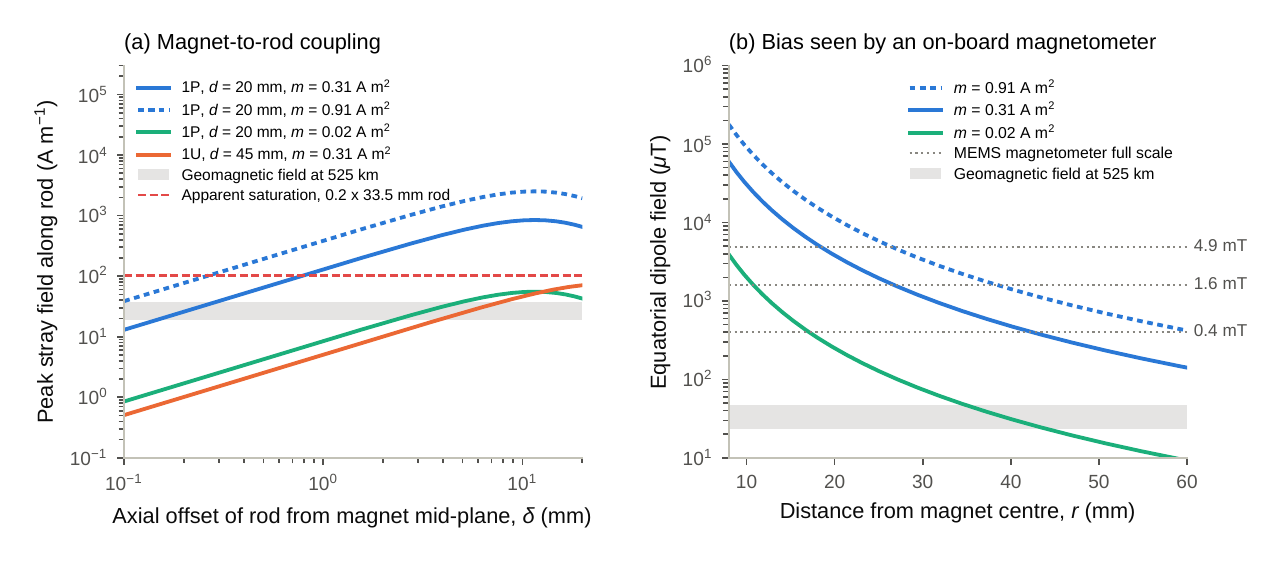
Magnetic coupling inside a passively stabilized PocketQube. (a) Peak stray field along a hysteresis rod (Eq. 3) versus the rod’s offset from the magnet mid-plane, for a 1P geometry ( mm) and a 1U geometry ( mm). Magnet moments of 0.31 and 0.91 A m² bracket the estimate for Grizu-263A (Section 5.4); 0.02 A m² is a moment sized to the disturbance torques. (b) Equatorial dipole field versus distance from the magnet, compared with the geomagnetic field at 525 km and with representative MEMS magnetometer full-scale ranges [46, 47].
4.5. Communications#
A quarter-wave monopole at 437 MHz is 171 mm long, more than three times the edge of a 1P, so every UHF PocketQube depends on a deployable antenna. The downlink is power-limited: the received energy per bit scales with the transmitted power divided by the data rate, so the data volume per pass is proportional to the energy that the power subsystem can allocate to the transmitter [11]. Many PocketQubes operate in the amateur-satellite service in the 435–438 MHz band, which requires coordination through the International Amateur Radio Union (IARU) and is restricted to non-commercial purposes under the ITU Radio Regulations [49]; the additional spectrum for telemetry, tracking and command of short-duration missions agreed at WRC-19 offers an alternative for non-amateur missions [11]. Modulation choices range from conventional 2-FSK to LoRa chirp spread spectrum, whose robustness at low signal levels has made it popular for low-rate links (e.g. FossaSat-1 [23]), although Doppler and ionospheric scintillation must be accounted for [50, 51]. A worked link budget for Grizu-263A is given in Section 5.5.
4.6. Orbital lifetime, debris mitigation and trackability#
The high specific surface of PocketQubes makes them sensitive to atmospheric drag. For a circular orbit of semi-major axis , the decay rate is
where is Earth’s gravitational parameter, the atmospheric density at altitude , the drag coefficient and the mean projected area. For a first-order assessment, the density is taken from the model of Kennewell [52]:
with and the scale height in km, in K, the 10.7 cm solar radio flux in solar flux units (sfu) and the geomagnetic index. Re-entry is assumed at 180 km. The model reproduces the solar-activity dependence of thermospheric density with a single scale height; it is adequate for comparing configurations, whereas compliance analyses require empirical models such as NRLMSISE-00 [53] and solar-cycle-dependent flux forecasts.
With and , the ballistic parameter is 0.030–0.033 m² kg⁻¹ for fully loaded 1P–3P PocketQubes, compared with 0.018 and 0.014 m² kg⁻¹ for fully loaded 1U and 3U CubeSats. Because the lifetime in an exponential atmosphere is approximately inversely proportional to , a PocketQube lives roughly half as long as a 1U at the same altitude (Fig. 4): from 500 km at a moderate flux of 140 sfu (), the estimated lifetime is 1.7 years for a 1P and 3.1 years for a 1U. A total orbital lifetime of five years—a conservative way of meeting the five-year post-mission disposal rule now applied to US-licensed satellites [54]—is achieved by a 1P below about 560 km at moderate activity (between 490 and 630 km from low to high activity), and the 25-year guideline long used in international debris-mitigation standards [55] below about 655 km. These values are consistent with the recommendation of Bouwmeester et al. [11] to operate PocketQubes below 500 km, ideally between 300 and 400 km. The strong dependence on solar activity also implies large uncertainty in individual lifetime predictions, as the Grizu-263A case shows (Section 5.8).
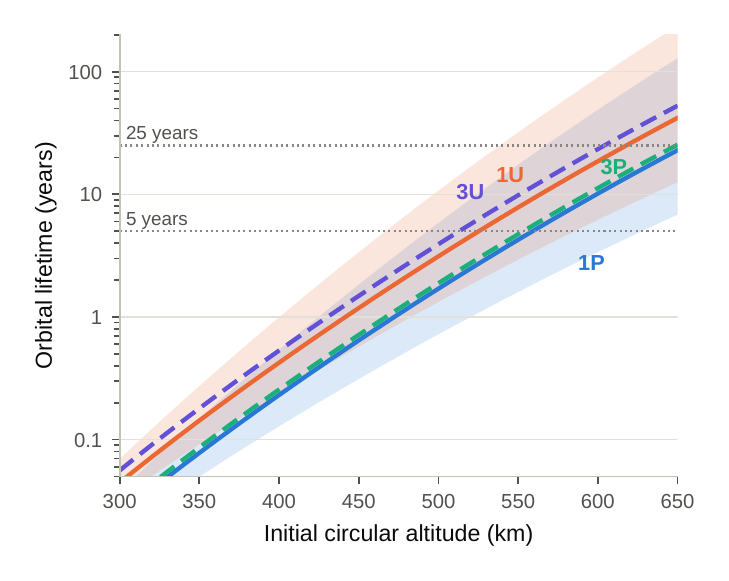
Orbital lifetime versus initial circular altitude for fully loaded PocketQubes (1P, 3P) and CubeSats (1U, 3U), computed with Eqs. (5)–(6) for sfu and (lines). Shaded bands span low ( sfu, ) to high ( sfu, ) solar activity for 1P (blue) and 1U (orange). Dotted lines mark 5- and 25-year lifetimes.
Trackability has improved with the population. PocketQubes are routinely catalogued once deployed—the 1P Grizu-263A, for example, received NORAD number 51025 [31]—but the accuracy of orbits derived from TLEs degrades for small objects [56], and PocketQubes show larger differences between successive TLEs than larger satellites [11]. Detectability also depends on the sensor frequency [57]. Using a volume-equivalent sphere of radius , a 1P has a size parameter at 440 MHz—deep in the Rayleigh regime, in which the radar cross-section scales as , so that a 1P returns roughly 80 times less power than a 1U—but at 3 GHz, where resonant and geometric scattering keep the penalty much smaller. Modern S-band surveillance radars [58] thus mitigate the detection problem, but identification remains difficult after large rideshare deployments, when dozens of similar objects separate within minutes and operators must match their signals to anonymous TLEs [59].
4.7. Propulsion#
Propulsion has been identified as the main enabling technology for future PocketQubes [12], and the constraint is quantitative. Holding a 1P at constant altitude requires a continuous thrust equal to its drag, . With the density model of Eq. (6), a fully loaded 1P needs 0.3–1.9 µN (42–241 m s⁻¹ of per year) at 400 km, 0.10–0.82 µN at 450 km and 0.03–0.37 µN at 500 km, for low to high solar activity. MEMS-based micropropulsion concepts for CubeSats and PocketQubes have been reviewed by Silva et al. [60], and a MEMS resistojet was planned for partial demonstration on Delfi-PQ [20]; more general reviews of small-spacecraft propulsion are given in [61, 62]. At the smallest scale, the open-source AIS-gPPT3-1C pulsed-plasma module (34 g, 40 × 38 × 24 mm) produced an impulse bit of about 0.65 µN s, i.e. about 0.2 µN at 0.33 Hz, before its development was discontinued because sub-joule pulsed-plasma thrusters could not deliver useful thrust [63]; AMSAT-EA’s GENESIS PocketQubes, which were intended to demonstrate a miniature pulsed-plasma thruster, were affected by the Firefly Alpha anomalies [15, 22]. The comparison exposes a tension: debris mitigation pushes PocketQubes towards low orbits, where they can only operate for long periods with micronewton-class propulsion that fits in a few tens of grams and draws a few hundred milliwatts—a combination that has not yet been demonstrated.
Table 4.First-order scaling of PocketQubes and CubeSats at the maximum mass of their standards. Power from Eq. (1) (, , ); thermal time constant from Eq. (2); lifetimes from Eqs. (5)–(6) with , sfu and .
| 1P | 2P | 3P | 1U | 3U | |
|---|---|---|---|---|---|
| External envelope (mm) | 50×50×50 | 50×50×114ᵃ | 50×50×178 | 100×100×113.5 | 100×100×340.5 |
| Volume (cm³) | 125 | 285 | 445 | 1135 | 3405 |
| External surface (cm²) | 150 | 278 | 406 | 654 | 1562 |
| Maximum mass (kg) | 0.25 | 0.50 | 0.75 | 2.00 | 6.00 |
| Mean projected area (cm²) | 37.5 | 69.5 | 101.5 | 163.5 | 390.5 |
| (m² kg⁻¹) | 0.033 | 0.031 | 0.030 | 0.018 | 0.014 |
| Orbit-average power, body-mounted (W) | 0.55 | 1.02 | 1.49 | 2.39 | 5.71 |
| Specific power (W kg⁻¹) | 2.2 | 2.0 | 2.0 | 1.2 | 0.95 |
| Thermal time constant (min) | 56 | 61 | 63 | 104 | 130 |
| Lifetime from 450 km (years) | 0.64 | 0.70 | 0.71 | 1.18 | 1.49 |
| Lifetime from 500 km (years) | 1.70 | 1.84 | 1.89 | 3.12 | 3.92 |
| Lifetime from 550 km (years) | 4.26 | 4.60 | 4.72 | 7.82 | 9.82 |
ᵃ Indicative length for a 2P.
5. Case study: Grizu-263A, Türkiye’s first PocketQube#
5.1. Programme background#
Grizu-263A was developed by the Grizu-263 Space Team of Zonguldak Bülent Ecevit University (ZBEÜ), a student team founded in 2016 whose earlier work centred on CanSat-class projects. The team and the satellite are named after the 263 miners who lost their lives in the firedamp explosion at the Kozlu coal mine in Zonguldak on 3 March 1992 [64]. Work on the modular PocketQube platform started at the end of 2018; after about two years of development the flight model was delivered to the launch provider in October 2020 [36]. Grizu-263A was the first PocketQube from Türkiye [31]; the next, Hello Space’s 1P Istanbul, followed in 2023 [15].
5.2. Mission objectives#
The mission was defined as a technology demonstration with an amateur-radio service [31, 36]. Its objectives were to (i) design, build and operate a spacecraft able to perform the basic functions of a satellite within a 1P envelope; (ii) demonstrate a modular core bus to which payloads can be added without changing the core subsystems; (iii) characterize the in-orbit behaviour of the PMAC system and the efficiency of the electrical power subsystem (EPS) through inertial-measurement-unit (IMU), current and voltage telemetry; and (iv) provide radio amateurs worldwide with openly decodable telemetry, Doppler-observation opportunities and a digital repeater (digipeater) mode that relays short messages uplinked from the ground. The uplink was deliberately minimal: in addition to digipeater messages, the spacecraft accepted a command to change the telemetry period and the transmitter shut-down command required for operation in the amateur-satellite service [31, 36].
5.3. System architecture#
Figure 5 and Table 5 summarize the architecture. Body-mounted solar panels on five faces (top, base, left, right and the face behind the antenna) feed the EPS, which contains the battery and seven INA-type current and bus-voltage monitors: one on the EPS-to-OBC line, one on the main EPS bus and one on each solar panel. The on-board computer (OBC) formats telemetry from these monitors, a three-axis IMU (accelerometer, gyroscope and magnetometer) and an internal temperature sensor, and implements the digipeater logic. The communication subsystem (COMM) transmits telemetry at 4800 Bd on 437.190 MHz or at 2400 Bd on 435.675 MHz through a deployable quarter-wave monopole and relays commands to the OBC. A simple fault-tolerance mechanism links the subsystems: if communication between COMM and OBC is lost, COMM generates an error code and reports it directly to the EPS, so that the fault can be handled without the OBC. Attitude is controlled passively (Section 5.4).
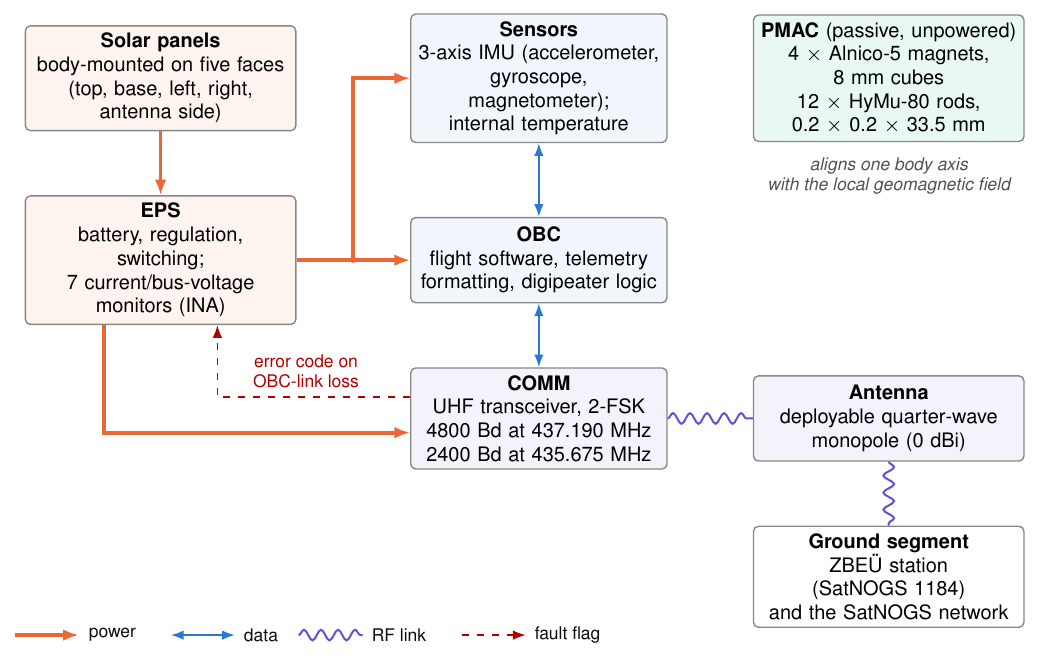
Functional architecture of Grizu-263A.
The power budget filed for frequency coordination gives an average generation of 0.75 W and an average consumption of 1.5 W in the active mode, so the high-consumption mode is necessarily duty-cycled and the battery bridges eclipses and transmissions. The generation figure agrees with the sunlit-average power predicted by Eq. (1) without the eclipse factor (0.71–0.86 W for five to six populated faces at ), which suggests that it refers to sunlit operation; the corresponding orbit average is 0.46–0.55 W.
Table 5.Key parameters of Grizu-263A.
| Parameter | Value | Source |
|---|---|---|
| Form factor and mass | 1P, 50 × 50 × 50 mm; 237 g flight model (250 g allocation) | [36] |
| Identifiers | NORAD 51025; COSPAR 2022-002AT; call sign YM2VRZ | [31, 65] |
| Launch | 13 January 2022, 15:25 UTC; Falcon 9 (Transporter-3), Cape Canaveral; AlbaPod deployer | [17, 31] |
| Orbit | Sun-synchronous, ≈525 km at deployment, inclination ≈97.4° | [36, 65] |
| Re-entry | 3 October 2023 (628 days after launch) | [31] |
| Power | Body-mounted panels on five faces; battery; 7 current/bus-voltage monitors; 0.75 W generation, 1.5 W active consumption (coordination filing) | This work |
| Attitude control | Passive: 4 Alnico-5 magnets (8 × 8 × 8 mm), 12 HyMu-80 rods (0.2 × 0.2 × 33.5 mm) | This work |
| Downlink | 2-FSK, 4800 Bd at 437.190 MHz and 2400 Bd at 435.675 MHz; emission designator 12K5F1D; EIRP 20 dBm; quarter-wave monopole (0 dBi) | [31], this work |
| Uplink services | Digipeater messages; telemetry-period command; transmitter shut-down command | [31, 36] |
| Telemetry frame | 31 fields: identification and time (7), temperature (1), currents and voltages (14), IMU (9); 5 frames every 10 s | [31, 36] |
| Frequency coordination | IARU coordinated (serial 775) | [31] |
| Ground segment | ZBEÜ station (SatNOGS 1184; 41.452° N, 31.762° E; 120 m; 10° mask) and the SatNOGS network | This work |
| Pre-launch expectations | About 1 year of active operation and about 4 years in orbit | [36, 64] |
5.4. Passive magnetic attitude control#
The PMAC system uses four 8 mm Alnico-5 cubes to align one body axis with the local geomagnetic field and twelve HyMu-80 hysteresis rods to damp angular rates and librations; it consumes no power. Pre-flight attitude dynamics were simulated with the Smart Nanosatellite Attitude Propagator (SNAP) [42, 66]. Table 6 complements the design data with first-order magnetostatic and dynamic estimates.
Mass properties. For a homogeneous 237 g cube with 50 mm edges, the principal moments of inertia are kg m²; the real, non-uniform mass distribution changes this value by a few tens of per cent. Simulations of 1P spacecraft must use mass properties of this order: inertia tensors taken from CubeSat-scale templates are roughly two orders of magnitude too large and slow the predicted dynamics accordingly.
Magnet moment. The moment delivered by an Alnico magnet depends strongly on its shape, because Alnico’s low coercivity makes it sensitive to self-demagnetization. The operating point was estimated by intersecting a hyperbolic approximation of the Alnico-5 demagnetization curve, with , T, kA m⁻¹ and (giving kJ m⁻³, typical of Alnico-5 [44]), with the load line . For an isolated cube () the operating point is T, so each cube carries only about 15% of its remanent magnetization and the four cubes together provide about 0.31 A m². If the cubes are stacked into a single 8 × 8 × 32 mm column ( [45]), the moment rises to about 0.91 A m²; full remanence would correspond to 2.0 A m². The flight value therefore lies between about 0.3 and 0.9 A m², depending on the arrangement and magnetization procedure, and a direct measurement—for instance with a magnetometer at known distances or in a Helmholtz cage—is recommended for future missions.
Torque budget and dynamics. At 525 km the dipole field strength varies between 23 µT at the magnetic equator and 47 µT near the poles. The restoring torque at a 10° misalignment is 1.2 × 10⁻⁶–7.4 × 10⁻⁶ N m, two to three orders of magnitude above the aerodynamic, solar-radiation-pressure and gravity-gradient torques (Table 6); the largest disturbance is the deployed antenna, whose drag acts with a lever arm of about 0.11 m. A residual spacecraft dipole of 10⁻³ A m² would shift the equilibrium direction by less than 0.2°. The undamped libration period, , is 10–23 s, far shorter than the time over which the field direction changes along the orbit, so the magnet axis tracks the local field closely. A magnet of 0.02 A m² would still provide a tenfold torque margin and would lengthen the libration period to about 90 s.
Implications. The analysis of Section 4.4.1 applies directly: with 0.3–0.9 A m² and magnet-to-rod distances of 20 mm or less, the stray field along the rods exceeds the geomagnetic field unless the rods lie within a fraction of a millimetre of the magnet mid-plane, and the IMU magnetometer measures a bias of several millitesla unless it is far from the magnets. Both effects can be verified from flight telemetry: the decay of the gyroscope rates after deployment indicates the effective damping, and the magnetometer channels reveal whether the sensor saturated or recorded a constant bias superimposed on the orbital variation of the geomagnetic field. A further consequence of field-aligned attitude concerns the radio link. For a dipole field, the field inclination satisfies , where is the magnetic latitude; the stabilized axis is therefore nearly horizontal at the magnetic equator and nearly vertical at high latitudes, so the orientation of the monopole pattern relative to a ground station—and the depth of its nulls—varies systematically with latitude. This predictable modulation can be checked against the signal strengths recorded by SatNOGS stations (Section 5.9).
Table 6.Passive magnetic attitude control of Grizu-263A: components, derived properties and torque budget at 525 km. Aerodynamic and radiation-pressure torques assume a 171 mm × 5 mm antenna tape with a 0.11 m lever arm and a 5 mm centre-of-pressure offset of the body.
| Quantity | Value |
|---|---|
| Permanent magnets | 4 Alnico-5 cubes, 8 × 8 × 8 mm (2.05 cm³ in total) |
| Estimated magnetic moment | 0.31 A m² (isolated cubes, ) to 0.91 A m² (stacked column, ); 2.0 A m² at full remanence |
| Hysteresis rods | 12 HyMu-80 rods, 0.2 × 0.2 × 33.5 mm (16 mm³ in total); aspect ratio 168; apparent saturation field ≈100 A m⁻¹ (Eq. 4) |
| Principal moment of inertia | ≈9.9 × 10⁻⁵ kg m² (homogeneous cube) |
| Geomagnetic field (dipole) | 23–47 µT (18.6–37.3 A m⁻¹) |
| Magnetic restoring torque at 10° | 1.2 × 10⁻⁶ to 7.4 × 10⁻⁶ N m |
| Aerodynamic torque | 2.5 × 10⁻⁹ ( sfu) to 7.3 × 10⁻⁹ N m ( sfu) |
| Solar radiation pressure torque | ≈7 × 10⁻¹⁰ N m |
| Gravity-gradient torque | ≲7 × 10⁻¹¹ N m |
| Undamped libration period | 23 s (0.31 A m², equator) to 10 s (0.91 A m², pole) |
| Moment for a tenfold margin at 10° | ≈0.02 A m² (libration period ≈90 s) |
5.5. Communications and ground segment#
Grizu-263A operated in the 435–438 MHz amateur-satellite band with IARU coordination [31], supported by the national amateur satellite association TAMSAT (AMSAT-TR); a group of licensed radio amateurs supervised the team’s student operators. All telemetry formats were published without encryption, and a Kaitai Struct decoder (grizu263a) was integrated into the SatNOGS database to decode the 31 telemetry fields automatically [28, 31]. The ZBEÜ ground station (SatNOGS station 1184, Maidenhead locator KN51vk, 41.452° N, 31.762° E, 120 m altitude, 10° elevation mask) was commissioned in December 2019 by receiving KISS-framed telemetry from the CHOMPTT CubeSat.
The downlink budget (Table 7, Fig. 6) uses the coordinated EIRP of 20 dBm (100 mW into a 0 dBi monopole). Two representative amateur stations are considered: a directional station with a 13 dBic crossed-Yagi antenna and a system noise temperature of 350 K ( dB K⁻¹), and an omnidirectional station with a 2 dBic antenna and 500 K ( dB K⁻¹). Polarization mismatch between the linear monopole and circularly polarized ground antennas (3 dB), atmospheric and ionospheric losses (0.5 dB) and pointing and cable losses (1 dB) are included, together with a 2 dB implementation loss. For non-coherent binary FSK the bit error probability is [67], so a bit error rate of 10⁻⁵ requires dB. The results are consistent with the operational experience. At 4800 Bd, decoding requires a directional antenna above about 12° elevation and is never possible with the omnidirectional station; the 2400 Bd mode gains 3 dB, enabling directional stations down to 3° elevation and omnidirectional stations only near zenith (above 74°). The dual-rate design thus traded throughput for accessibility, and the small margins agree with the observation, in the first days of the mission, that many network recordings lacked the signal-to-noise ratio needed for decoding [59].
Table 7.Downlink budget of Grizu-263A at 30° elevation (slant range 951 km).
| Directional, 4800 Bd | Directional, 2400 Bd | Omnidirectional, 4800 Bd | Omnidirectional, 2400 Bd | |
|---|---|---|---|---|
| Frequency (MHz) | 437.190 | 435.675 | 437.190 | 435.675 |
| EIRP (dBW) | −10.0 | −10.0 | −10.0 | −10.0 |
| Free-space loss (dB) | 144.8 | 144.8 | 144.8 | 144.8 |
| Polarization, atmospheric and pointing losses (dB) | 4.5 | 4.5 | 4.5 | 4.5 |
| Ground-station (dB K⁻¹) | −12.4 | −12.4 | −25.0 | −25.0 |
| (dB Hz) | 56.8 | 56.9 | 44.3 | 44.3 |
| Data rate (dB bit s⁻¹) | 36.8 | 33.8 | 36.8 | 33.8 |
| (dB) | 20.0 | 23.1 | 7.5 | 10.5 |
| Implementation loss (dB) | 2.0 | 2.0 | 2.0 | 2.0 |
| Required for BER 10⁻⁵ (dB) | 13.4 | 13.4 | 13.4 | 13.4 |
| Margin (dB) | +4.7 | +7.7 | −7.9 | −4.8 |
| Minimum elevation for positive margin | 12° | 3° | – | 74° |
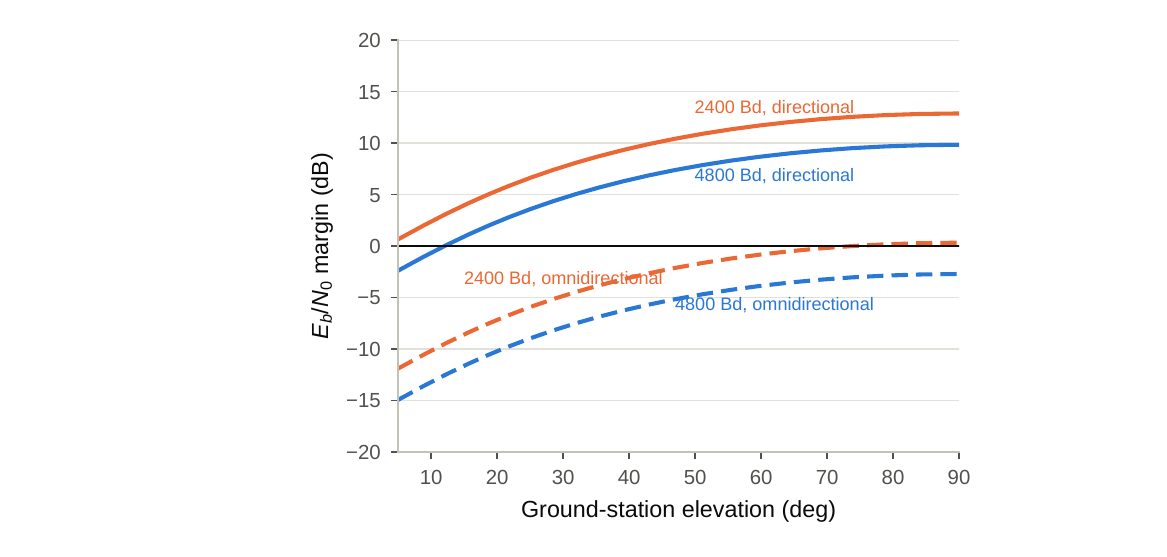
Downlink margin of Grizu-263A versus ground-station elevation for both transmitter modes and for representative directional ( dB K⁻¹, solid) and omnidirectional ( dB K⁻¹, dashed) amateur stations.
5.6. Assembly, integration and test#
The development followed a test-as-you-fly sequence of bench tests, engineering-model tests, thermal-vacuum tests and vibration tests. Protoqualification vibration tests of the flight model, mounted inside its flight pod, were carried out on 21 September 2020 at the Vibration and Acoustics Laboratory of the Faculty of Mechanical Engineering of Istanbul Technical University. The test set-up comprised a TIRA TV59327/AIT shaker controlled with Vibration VIEW software, a Brüel & Kjær PULSE system for data acquisition and spectral analysis, a control accelerometer on the slip table and response accelerometers on the pod and at a reference point, from which transmissibility functions were derived. Each axis—the two horizontal axes (Z and X) followed by the vertical axis (Y)—was subjected to a resonance survey and a random-vibration run, and visual inspections after every run showed no damage. Following the user guide prepared for the launch provider, the satellite was integrated into an AlbaPod deployer in October 2020, and the kill switch on the antenna face was released for flight [17, 36].
5.7. Launch and operations#
The launch slipped from the originally planned window at the turn of 2020–2021 [17] to 13 January 2022, when Grizu-263A lifted off at 15:25 UTC on the SpaceX Transporter-3 rideshare from Cape Canaveral, together with other PocketQubes including Delfi-PQ, HADES, EASAT-2, SATLLA-2A/2B, Unicorn-1 and Unicorn-2A/2D [15, 17, 31]. The ZBEÜ ground station received the first data on 14 January [64]. The early days illustrate the identification and decoding challenges of mass deployments: before catalogue numbers were assigned, the SatNOGS community tracked Grizu-263A under a temporary identifier (99488), and the first community decoders, which assumed a different line coding, failed until the framing was clarified; frames were decoded on 19 January 2022 [59]. The satellite then received NORAD number 51025 [31].
Grizu-263A operated until its re-entry on 3 October 2023 [31, 65], i.e. for 628 days or about 9500 revolutions, well beyond the expected year of active operation [36]. Its primary communication objective was met, with telemetry received and shared by stations around the world [64]; SatNOGS observations show that both downlink modes were still being received by stations in several countries between 29 September and 1 October 2023, only days before re-entry.
5.8. Orbital decay: forecast versus outcome#
The orbital lifetime is the one mission outcome that can be compared directly with a pre-launch expectation. The team expected about four years in orbit [36, 64]; the satellite re-entered after 21 months. To understand the difference, the decay was reconstructed with Eqs. (5)–(6), starting from a circular orbit at 525 km on the launch date and driving the model with the observed monthly mean [68] (mean 141 sfu over the mission) and a constant . Three a priori values of the ballistic parameter were considered: the tumbling cube alone (, ; 0.035 m² kg⁻¹), the cube plus a 5 mm-wide antenna tape (0.039 m² kg⁻¹, nominal) and an upper bound with and a 10 mm-wide tape (0.047 m² kg⁻¹).
With these a priori values, the model predicts lifetimes of 852, 778 and 671 days, i.e. 7–36% longer than the observed 628 days (Fig. 7). The residual is within the accuracy expected from a single-scale-height density model and from the uncertainty in the initial orbit: changing the initial altitude by ±10 km changes the predicted lifetime from 673 to 906 days, while changing between 6 and 18 changes it by less than ±5%. The observed lifetime is matched exactly with an effective ballistic parameter of 0.050 m² kg⁻¹, 1.3 times the nominal a priori value, which absorbs the model bias together with the uncertainties in , area and initial altitude. With the same effective parameter but a constant flux of 100 sfu, the model yields 3.4 years (4.4 years with the nominal a priori parameter), consistent with the pre-launch expectation. The difference between forecast and outcome can therefore be attributed largely to solar activity: the flux during the mission was about 40% higher than the 100 sfu that reproduces the four-year forecast. This is consistent with the evolution of Solar Cycle 25, which the NOAA/NASA prediction panel had forecast in 2019 to peak at a sunspot number of 115 in July 2025 [69], and which NOAA revised in October 2023 to an earlier peak in 2024 with a sunspot number of 137–173 [70]. For PocketQubes, whose lifetimes are short and whose ballistic parameters are high, lifetime predictions should therefore be expressed as ranges spanning plausible solar-activity scenarios rather than as single values.
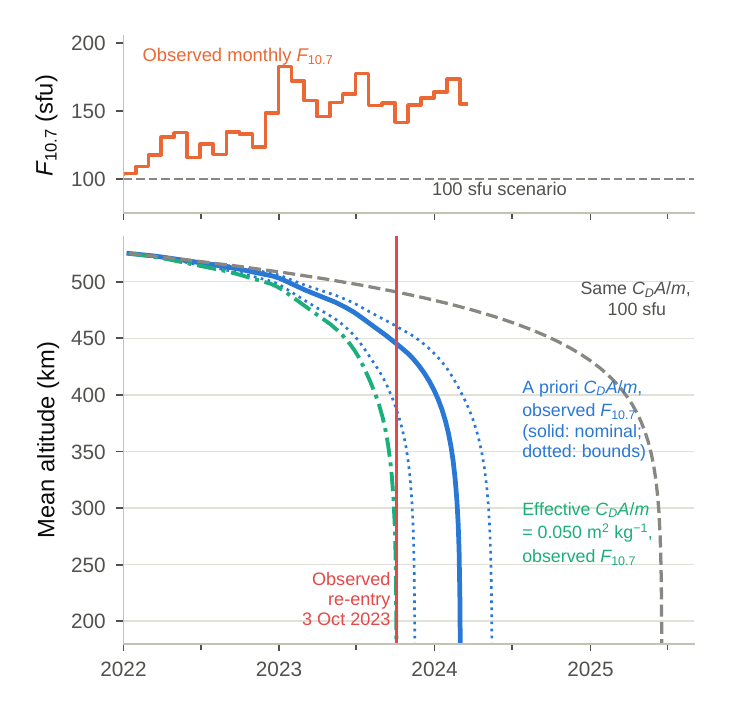
Orbital decay of Grizu-263A. Top: observed monthly [68]. Bottom: mean altitude computed with Eqs. (5)–(6) using the observed flux and a priori ballistic parameters (blue; solid: 0.039, dotted: 0.035 and 0.047 m² kg⁻¹), the effective parameter that matches the observed re-entry (green), and the same effective parameter with a constant 100 sfu (grey). The vertical line marks the observed re-entry on 3 October 2023 [31].
5.9. Exploiting open ground-station data#
Because Grizu-263A transmitted openly decodable telemetry for 21 months, the SatNOGS archive holds a rich record of its life: for each observation, a waterfall image of the received spectrum, an audio recording, demodulated frames and decoded telemetry [26, 31]. Combined with the public TLE history and space-weather indices, these artefacts support several engineering analyses (Fig. 8). Fitting the Doppler curves of individual passes refines the orbit and resolves object identification after mass deployments. The periodicity of signal fading in the audio records provides a radio-based proxy for the spin rate, which can be cross-checked against the gyroscope telemetry and thereby against the PMAC damping predicted in Section 5.4. The seven current channels allow the solar panels to be used as coarse sun sensors, which, combined with the magnetometer after bias calibration [48], yield a coarse attitude estimate with standard two-vector methods [71]. Long-term trends in panel currents, bus voltages and temperature quantify the degradation of the EPS and the thermal environment, and the decay analysis of Section 5.8 closes the loop between mission design and outcome. Atmospheric drag degrades the accuracy of TLEs for light spacecraft such as Grizu-263A, which appears as a growing Doppler offset in the waterfalls and must be accounted for in all of these analyses [56].
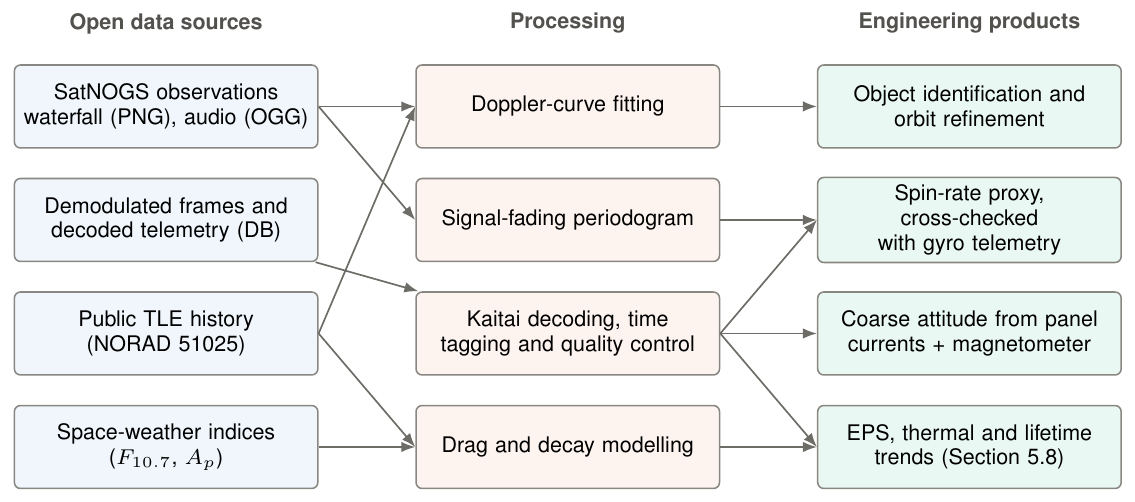
Engineering analyses enabled by open ground-station data for an openly transmitting PocketQube such as Grizu-263A.
5.10. Lessons learned#
Table 8 condenses the lessons from Grizu-263A that are transferable to other 1P missions. Several of them concern the interfaces of the spacecraft with its environment—the launch schedule, the radio-amateur community, the geomagnetic field and the upper atmosphere—rather than its internal design, which reflects the extent to which the external environment dominates the margins of the smallest satellites.
Table 8.Lessons learned from Grizu-263A.
| Area | Observation | Recommendation |
|---|---|---|
| Launch schedule | Fifteen months elapsed between delivery (October 2020) and launch (January 2022) | Plan battery storage and maintenance charging, preserve team continuity and keep ground operations ready for slips |
| Decoding and identification | Community decoders initially failed and the satellite was tracked under a temporary identifier [59] | Publish modulation, line coding, framing and a reference decoder before launch; test them with recorded flight-model signals |
| Link design | With 20 dBm EIRP, 4800 Bd requires directional stations; 2400 Bd reaches omnidirectional stations only near zenith | Retain dual-rate operation; add forward error correction or adaptive data rates to extend coverage |
| Passive attitude control | The estimated magnet moment (0.3–0.9 A m²) exceeds the disturbance-driven need (≈0.02 A m²) by more than an order of magnitude | Size the magnet to disturbance torques, control magnet-to-rod geometry, measure the moment, and verify damping in a Helmholtz cage |
| Simulation inputs | 1P inertia is ≈10⁻⁴ kg m² | Use mass properties derived from the 1P CAD model, not from CubeSat templates |
| Orbital lifetime | Observed life of 21 months versus a four-year expectation | Report lifetime ranges over solar-activity scenarios; update the forecast as the cycle evolves |
| Telemetry content | Panel currents, gyroscope and magnetometer data enable post-flight reconstruction from open data | Include frame and reset counters and on-board timestamps; publish calibration data with the decoder |
| Open science and outreach | Open decoders, 3D-printable models and public campaigns broadened participation [36] | Archive design documents and telemetry in citable open repositories |
6. Open challenges and research directions#
The census, the scaling analyses and the case study point to a small number of gaps between the ambitions of PocketQube missions and the maturity of the enabling technologies (Table 9).
Standardization beyond mechanics. The PocketQube Standard fixes the mechanical interface, but electrical, test and operational requirements are still defined by individual deployer providers [18]. Interface standards such as PQ9/CS14 [19] and open reference designs [24] reduce non-recurring engineering effort; a community-maintained set of test levels and of minimum telemetry and decoding information would make PocketQubes easier to integrate, insure and operate.
Attitude control and power. Active ADCS at the 1P scale remains largely bespoke [13]. Promising directions include PCB-integrated magnetorquers [33], miniature momentum or reaction wheels [11], and, for passive systems, disturbance-driven magnet sizing and controlled magnet-to-rod geometry (Section 4.4.1). Power remains bounded by surface area; deployable arrays help only when combined with pointing control.
Propulsion. Micronewton-class thrust within a few tens of grams and a few hundred milliwatts would allow PocketQubes to operate in very low orbits, where natural decay keeps the debris footprint small, and would enable collision avoidance and formation flying [12, 60]. Section 4.7 quantifies the requirement: 0.3–1.9 µN for a 1P at 400 km.
On-board autonomy. Energy-efficient machine learning on microcontrollers (TinyML) [72] could support adaptive attitude control, fault detection, isolation and recovery, and on-board data reduction, following the demonstration of on-board deep learning on larger small satellites [73, 74]. For PocketQubes, the relevant metric is inference per millijoule rather than raw throughput.
Launch access, identification and space safety. One sixth of all PocketQubes launched in 2013–2023 were lost or degraded in the launch segment (Section 3). Diversifying launch routes, budgeting for re-flights and clarifying insurance options [33] are programmatic priorities. Rapid identification after mass deployments benefits from openly documented signals and from dedicated identification payloads now being prepared for PocketQubes [15]. Lifetime predictions should be reported as ranges over solar-activity scenarios (Section 5.8).
From single satellites to distributed systems. Individual PocketQubes have limited capability, but their utility for Earth observation and communications is expected to emerge in networks of hundreds to thousands of units [11]. Distributed measurements of space weather and of the upper atmosphere are natural candidates [14], and earlier work on very small satellites for distributed missions and on ChipSats provides architectural precedents [75, 76]. Commercial batch deployments such as FossaSat-2E and Unicorn-2 (Section 3) are the first steps in this direction.
Table 9.Research gaps and enabling developments for PocketQubes.
| Area | Current status | Enabling developments | Refs. |
|---|---|---|---|
| Standardization | Mechanical standard only; electrical and test requirements set by providers | Community test levels; PQ9/CS14-type buses; minimum telemetry and decoder documentation | [9, 18, 19] |
| ADCS | Passive control on most 1P missions; three-axis control demonstrated on 3P | PCB-integrated magnetorquers; miniature wheels; disturbance-driven PMAC sizing | [13, 17, 33] |
| Power and thermal | ≈0.5 W orbit average for a body-mounted 1P; short thermal time constant | High-efficiency cells; deployables with pointing; thermal design for transmit bursts | [11], Sec. 4 |
| Propulsion | No sustained orbit control demonstrated to date; sub-joule PPT abandoned | µN-class thrusters below ≈50 g and ≈0.5 W | [12, 60, 63] |
| Communications | Power-limited UHF links; LoRa for robust low-rate links | Forward error correction, adaptive rates, higher-frequency and optical links | [23, 33, 51] |
| Autonomy | Mostly scripted operations | TinyML-based FDIR, adaptive control and data reduction | [72–74] |
| Launch and space safety | 17% launch-segment losses (2013–2023); identification after mass deployments | Diversified launch routes; insurance options; identification beacons; lifetime ranges | Sec. 3, [33, 59] |
| Distributed systems | Commercial batches of up to 13 units | Inter-satellite links, coordinated operations, multi-point science | [11, 14, 75] |
7. Conclusions#
This review combined a census of the PocketQube population, first-order scaling relations and a flight case study. The main conclusions are as follows.
- Seventy-seven PocketQubes were launched between 2013 and 2023, 49% of them in 2022. By unit count the population is dominated by 1P, 2P and 3P spacecraft, and two commercial operators account for 39% of all units, which explains why mission-weighted and unit-weighted statistics in the literature differ.
- The route to orbit has shifted from host-satellite deployers to direct rideshare and, since 2022, to orbital transfer vehicles, which carried every PocketQube launched in 2023. Launch-segment anomalies lost or degraded 17% of all units, making launch risk a first-order programmatic factor for the class.
- Relative to a 1U CubeSat at maximum mass, a fully loaded 1P offers about one quarter of the body-mounted power but nearly twice the specific power, about half the thermal time constant and about twice the ballistic parameter; its orbital lifetime at a given altitude is therefore roughly halved, and a five-year lifetime is reached below about 560 km at moderate solar activity.
- In a 50 mm cube, the stray field of a passive-attitude-control magnet couples to the hysteresis rods and to the magnetometer with a strength that scales as the inverse fourth and third powers of distance, respectively. Magnets should be sized to the disturbance torques—about 0.02 A m² for a 1P at 525 km—rather than to CubeSat practice.
- Grizu-263A, Türkiye’s first PocketQube, operated for 628 days, well beyond its expected year of active operation. Its 21-month orbital lifetime, against a pre-launch expectation of about four years, is reproduced within 7–36% by a simple drag model driven by the observed solar flux and is consistent with the higher-than-forecast activity of Solar Cycle 25.
- The 20 dBm downlink of a 1P supports 4800 Bd reception only with directional ground antennas; dual-rate operation, open documentation of the signal and community ground networks were essential to the mission’s reach.
Future progress depends on micronewton-class propulsion, standardized avionics and test requirements, miniature active ADCS and distributed architectures that turn the low unit cost of PocketQubes into system-level capability.
Declarations#
Competing interest. nadir lab. declares no known competing financial interests or personal relationships that could have appeared to influence the work reported in this paper.
Acknowledgements. nadir lab. thanks Zonguldak Bülent Ecevit University and the main sponsor ERDEMİR for supporting the Grizu-263 Space Team; Turkish Aerospace (TUSAŞ), Istanbul Technical University and its Vibration and Acoustics Laboratory (Prof. Dr. Kenan Y. Şanlıtürk, Mehmet Sait Özer and M. Cenk Bursalı), Delft University of Technology, Alba Orbital, PCBWay and the Türkiye Amateur Satellite Technologies Association (TAMSAT/AMSAT-TR) for their support; the radio amateurs TA4AXT, TA2RMU, TA2RTO and TA2RCK for supervising the student operators; and the SatNOGS community and radio amateurs worldwide who received, decoded and shared Grizu-263A telemetry.
Data availability. The census compiled for this review is listed in Appendix A. Grizu-263A telemetry received by the SatNOGS network is publicly available through the SatNOGS database [31]. The scripts used for the analyses in Sections 4 and 5 are available via hi@nadirlab.space on reasonable request.
Use of generative AI. During the preparation of this work Claude (Anthropic) was used to restructure the manuscript, edit the language and prepare the first-order analyses and figures. The content was reviewed and edited as needed, and nadir lab. takes full responsibility for the content of the publication.
Appendix A. Census of PocketQubes launched in 2013–2023#
The census was compiled from [15] (accessed 20 October 2026); launch outcomes were cross-checked against [22, 30, 31]. Abbreviations: T-n, SpaceX Transporter-n rideshare; ION, D-Orbit ION satellite carrier; Orbiter, Launcher Orbiter SN1; 425, Falcon 9 rideshare of 1 December 2023. Outcome: N, nominal deployment; F, launch failure; L, deployed into an off-nominal low orbit and re-entered within days; D, not deployed from the transfer vehicle.
| # | Spacecraft (alternative name) | Size | Operator | Launch date | Launch; deployment | Outcome |
|---|---|---|---|---|---|---|
| 1 | WREN | 1P | STADOKO UG | 2013-11-21 | Dnepr; UniSat-5 | N |
| 2 | $50SAT (Eagle-2, MO-76) | 1.5P | Morehead State Univ. | 2013-11-21 | Dnepr; UniSat-5 | N |
| 3 | Beakersat-1 (T-LogoQube, Eagle-1) | 2.5P | Morehead State Univ. / Sonoma State Univ. | 2013-11-21 | Dnepr; UniSat-5 | N |
| 4 | QubeScout-S1 | 2.5P | Univ. of Maryland | 2013-11-21 | Dnepr; UniSat-5 | N |
| 5 | FossaSat-1 | 1P | Fossa Systems | 2019-12-06 | Electron | N |
| 6 | SMOG-P (MO-105) | 1P | BME | 2019-12-06 | Electron | N |
| 7 | TRSI-Sat | 1P | ACME AtronOmatic | 2019-12-06 | Electron | N |
| 8 | ATL-1 (MO-106) | 2P | ATL Ltd. | 2019-12-06 | Electron | N |
| 9 | NOOR 1A (Unicorn-2B) | 3P | Stara Space | 2019-12-06 | Electron | N |
| 10 | NOOR 1B (Unicorn-2C) | 3P | Stara Space | 2019-12-06 | Electron | N |
| 11 | DIY-1 (ArduiQube, DO-111) | 1P | DIYSatellite group | 2021-03-22 | Soyuz-2.1a; UniSat-7 | N |
| 12 | SMOG-1 (MO-110) | 1P | BME | 2021-03-22 | Soyuz-2.1a; UniSat-7 | N |
| 13 | STECCO | 6P | Sapienza Univ. of Rome | 2021-03-22 | Soyuz-2.1a; UniSat-7 | N |
| 14 | FossaSat-1B | 1P | Fossa Systems | 2021-09-03 | Alpha FLTA001 | F |
| 15 | Qubik-1 | 1P | Libre Space Foundation | 2021-09-03 | Alpha FLTA001 | F |
| 16 | Qubik-2 | 1P | Libre Space Foundation | 2021-09-03 | Alpha FLTA001 | F |
| 17 | GENESIS-L | 1.5P | AMSAT-EA | 2021-09-03 | Alpha FLTA001 | F |
| 18 | GENESIS-N | 1.5P | AMSAT-EA | 2021-09-03 | Alpha FLTA001 | F |
| 19 | FossaSat-2 | 2P | Fossa Systems | 2021-09-03 | Alpha FLTA001 | F |
| 20 | Grizu-263A | 1P | Zonguldak Bülent Ecevit Univ. | 2022-01-13 | Falcon 9 T-3 | N |
| 21 | PION-BR1 | 1P | PION Labs | 2022-01-13 | Falcon 9 T-3 | N |
| 22 | SanoSat-1 (NO-116) | 1P | ORION Space | 2022-01-13 | Falcon 9 T-3 | N |
| 23 | Tartan-Artibeus-1 (Unicorn-2TA1) | 1P | Carnegie Mellon Univ. | 2022-01-13 | Falcon 9 T-3 | N |
| 24 | EASAT-2 (SO-114) | 1.5P | AMSAT-EA | 2022-01-13 | Falcon 9 T-3 | N |
| 25 | HADES (SO-115) | 1.5P | AMSAT-EA | 2022-01-13 | Falcon 9 T-3 | N |
| 26 | FossaSat-2E1 (WISeSAT-1) | 2P | Fossa Systems | 2022-01-13 | Falcon 9 T-3 | N |
| 27 | FossaSat-2E2 (WISeSAT-2) | 2P | Fossa Systems | 2022-01-13 | Falcon 9 T-3 | N |
| 28 | FossaSat-2E3 | 2P | Fossa Systems | 2022-01-13 | Falcon 9 T-3 | N |
| 29 | FossaSat-2E4 | 2P | Fossa Systems | 2022-01-13 | Falcon 9 T-3 | N |
| 30 | FossaSat-2E5 | 2P | Fossa Systems | 2022-01-13 | Falcon 9 T-3 | N |
| 31 | FossaSat-2E6 | 2P | Fossa Systems | 2022-01-13 | Falcon 9 T-3 | N |
| 32 | MDQube-SAT-1 | 2P | Innova Space | 2022-01-13 | Falcon 9 T-3 | N |
| 33 | SATLLA-2A | 2P | Ariel Univ. | 2022-01-13 | Falcon 9 T-3 | N |
| 34 | SATLLA-2B | 2P | Ariel Univ. | 2022-01-13 | Falcon 9 T-3 | N |
| 35 | Unicorn-1 | 2P | Alba Orbital | 2022-01-13 | Falcon 9 T-3 | N |
| 36 | Delfi-PQ | 3P | TU Delft | 2022-01-13 | Falcon 9 T-3 | N |
| 37 | Challenger | 3P | Mini-Cubes | 2022-01-13 | Falcon 9 T-3 | N |
| 38 | Unicorn-2A | 3P | Alba Orbital | 2022-01-13 | Falcon 9 T-3 | N |
| 39 | Unicorn-2D | 3P | Alba Orbital | 2022-01-13 | Falcon 9 T-3 | N |
| 40 | Unicorn-2E | 3P | Alba Orbital | 2022-01-13 | Falcon 9 T-3 | N |
| 41 | MyRadar-1 | 1P | ACME AtronOmatic | 2022-05-02 | Electron | N |
| 42 | TRSI-2 | 1P | ACME AtronOmatic | 2022-05-02 | Electron | N |
| 43 | TRSI-3 | 1P | ACME AtronOmatic | 2022-05-02 | Electron | N |
| 44 | Unicorn-2 | 3P | Alba Orbital | 2022-05-02 | Electron | N |
| 45 | Veery FS-1 | 1P | Care Weather Technologies | 2022-05-25 | Falcon 9 T-5; ION | N |
| 46 | FossaSat-2E7 | 2P | Fossa Systems | 2022-05-25 | Falcon 9 T-5; ION | N |
| 47 | FossaSat-2E8 | 2P | Fossa Systems | 2022-05-25 | Falcon 9 T-5; ION | N |
| 48 | FossaSat-2E9 | 2P | Fossa Systems | 2022-05-25 | Falcon 9 T-5; ION | N |
| 49 | FossaSat-2E10 | 2P | Fossa Systems | 2022-05-25 | Falcon 9 T-5; ION | N |
| 50 | FossaSat-2E11 | 2P | Fossa Systems | 2022-05-25 | Falcon 9 T-5; ION | N |
| 51 | FossaSat-2E12 | 2P | Fossa Systems | 2022-05-25 | Falcon 9 T-5; ION | N |
| 52 | FossaSat-2E13 | 2P | Fossa Systems | 2022-05-25 | Falcon 9 T-5; ION | N |
| 53 | FossaSat-1B (second unit) | 1P | Fossa Systems | 2022-10-01 | Alpha FLTA002 | L |
| 54 | Qubik-3 | 1P | Libre Space Foundation | 2022-10-01 | Alpha FLTA002 | L |
| 55 | Qubik-4 | 1P | Libre Space Foundation | 2022-10-01 | Alpha FLTA002 | L |
| 56 | GENESIS-G (Astroland-1) | 1.5P | AMSAT-EA | 2022-10-01 | Alpha FLTA002 | L |
| 57 | GENESIS-J (Astroland-2) | 1.5P | AMSAT-EA | 2022-10-01 | Alpha FLTA002 | L |
| 58 | Unicorn-2G | 3P | Alba Orbital | 2023-01-03 | Falcon 9 T-6; Orbiter | D |
| 59 | Unicorn-2H | 3P | Alba Orbital | 2023-01-03 | Falcon 9 T-6; Orbiter | D |
| 60 | Istanbul | 1P | Hello Space | 2023-06-12 | Falcon 9 T-8; ION | N |
| 61 | ROM-2 (HADES-C) | 1P | RomSpace / AMSAT-EA | 2023-06-12 | Falcon 9 T-8; ION | N |
| 62 | URESAT-1 (HADES-B, SO-120) | 1.5P | AMSAT-EA | 2023-06-12 | Falcon 9 T-8; ION | N |
| 63 | SATLLA-2I | 2P | Ariel Univ. | 2023-06-12 | Falcon 9 T-8; ION | N |
| 64 | MRC-100 | 3P | BME | 2023-06-12 | Falcon 9 T-8; ION | N |
| 65 | Unicorn-2I | 3P | Alba Orbital | 2023-06-12 | Falcon 9 T-8; ION | N |
| 66 | ROM-3 | 1P | RomSpace | 2023-11-11 | Falcon 9 T-9; ION | N |
| 67 | SpaceANT-D | 1P | InSpace | 2023-11-11 | Falcon 9 T-9; ION | N |
| 68 | Tartan-Artibeus-2 | 1P | Carnegie Mellon Univ. | 2023-11-11 | Falcon 9 T-9; ION | N |
| 69 | HADES-D (SO-121) | 1.5P | AMSAT-EA | 2023-11-11 | Falcon 9 T-9; ION | N |
| 70 | Hello Test-1 | 2P | Hello Space | 2023-11-11 | Falcon 9 T-9; ION | N |
| 71 | Hello Test-2 | 2P | Hello Space | 2023-11-11 | Falcon 9 T-9; ION | N |
| 72 | Unicorn-2J | 3P | Alba Orbital | 2023-11-11 | Falcon 9 T-9; ION | N |
| 73 | Unicorn-2K | 3P | Alba Orbital | 2023-11-11 | Falcon 9 T-9; ION | N |
| 74 | MDQube-SAT-2 | 2P | Innova Space | 2023-12-01 | Falcon 9 (425); ION | N |
| 75 | Unicorn-2L | 3P | Alba Orbital | 2023-12-01 | Falcon 9 (425); ION | N |
| 76 | Unicorn-2M | 3P | Alba Orbital | 2023-12-01 | Falcon 9 (425); ION | N |
| 77 | Unicorn-2N | 3P | Alba Orbital | 2023-12-01 | Falcon 9 (425); ION | N |
| 78 | POQUITO | 1P | Univ. of Luxembourg (SnT) | 2025-01-14 | Falcon 9 T-12; ION / AlbaPod | N |
| 79 | HYPE (HYPE AGH) | 1P | AGH Univ. of Krakow (SatLab AGH) | 2025-01-14 | Falcon 9 T-12; ION / AlbaPod | N |
| 80 | PROMETHEUS-1 | 1P | Univ. do Minho / IST / CMU | 2025-01-14 | Falcon 9 T-12; ION / AlbaPod | N |
| 81 | Skylink-1 | 3P | Hello Space | 2025-01-14 | Falcon 9 T-12; ION / AlbaPod | N |
| 82 | Skylink-2 | 3P | Hello Space | 2025-01-14 | Falcon 9 T-12; ION / AlbaPod | N |
| 83 | HADES-R (SO-124, Smart IR) | 1.5P | AMSAT-EA / Hydra Space | 2025-01-14 | Falcon 9 T-12; ION / AlbaPod | N |
| 84 | Hydra-T | 1.5P | Hydra Space Systems | 2025-01-14 | Falcon 9 T-12; ION / AlbaPod | N |
| 85 | Unicorn-2O | 3P | Alba Orbital | 2025-03-15 | Falcon 9 T-13; AlbaPod | N |
| 86 | Unicorn-2P | 3P | Alba Orbital | 2025-03-15 | Falcon 9 T-13; AlbaPod | N |
| 87 | Unicorn-2Q | 3P | Alba Orbital | 2025-03-15 | Falcon 9 T-13; AlbaPod | N |
| 88 | HADES-ICM (SO-125) | 1.5P | AMSAT-EA / Hydra Space / IC Mercury | 2025-03-15 | Falcon 9 T-13; AlbaPod | N |
| 89 | Hydra-W | 1.5P | Hydra Space / UC3M | 2025-03-15 | Falcon 9 T-13; AlbaPod | N |
| 90 | HUNITY (NMHH-1) | 3P | BME (Budapest Univ. of Tech.) | 2025-11-28 | Falcon 9 T-15; AlbaPod | N |
| 91 | SARI-1 | 1P | Saudi Space Agency / KACST | 2025-11-28 | Falcon 9 T-15; AlbaPod | N |
| 92 | SARI-2 | 1P | Saudi Space Agency / KACST | 2025-11-28 | Falcon 9 T-15; AlbaPod | N |
| 93 | ANISCSAT | 1P | Azercosmos / Baku State Univ. | 2025-11-28 | Falcon 9 T-15; AlbaPod | N |